



Pica ( fr. Pique ) - piercing edged weapons , a kind of long spear . It consists of a shaft 3-5 meters long and a trihedral or tetrahedral metal tip 12-57 centimeters long. The total weight is 3-4 kilograms. This weapon was designed to protect the infantry from cavalry attacks , and was also used in cavalry - in Cossack , Lancers and horseback pikiner regiments. It was spread in the XV - the first half of the XX centuries . [one]
Typically, the following differences between peaks and spears are listed:
- the peak is significantly longer and, accordingly, heavier, because of which it must be held in two hands;
- the peak tip is designed for piercing armor and does not have a broad leaf-shaped (in the form of a blade), but a narrow faceted shape, respectively, the peak is exclusively a stabbing weapon, while many spears with a wide tip can be used (and were used) for cutting cutting strokes;
- the peak is usually not a throwing weapon (with the exception of the boarding peak, sarisa also comes from throwing weapons).
Unlike sarisa, a typical peak usually has no counterweight and is usually shorter.
Content
- 1 Application History
- 2 Types of Peaks
- 2.1 European peak
- 2.2 Awl-shaped peak
- 2.3 Boarding Peak
- 3 notes
- 4 References
- 5 videos
Application History
The earliest European references to the use of spades in battle date back to the 12th century . [2] The Scots were the first to use long infantry spears in the Middle Ages , forming battle formations in the form of shiltrons in a number of battles for the independence of their kingdom .
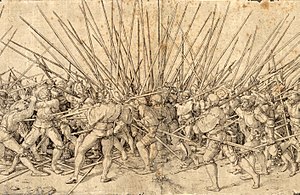
In the XV century, the peak was adopted by the Swiss , who became masters in maneuvering with spiers (this type of weapon is called in German). Later, many methods of fighting with peaks were adopted by the Swiss Landsknechts from the Swiss . Subsequently, numerous fierce battles were fought between the Germans and Swiss during the Italian Wars , when large formations of well-trained pikemen appeared on both sides.
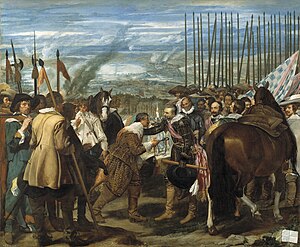
This type of weapon was widely used in the XVII century . After increasing the role of firearms, pikemen turned from an attacking force into a stable base of the infantry fighting order, providing musketeers with protection from cavalry (which arrows themselves usually could not stop the attack with fire due to the low rate of fire of their weapons). [3] After the advent of mobile artillery, in order to increase the mobility of troops, the heavy peak began to be replaced by a light peak - only 300 centimeters long and 2.5 kilograms in weight. [2] With the advent of bayonets on the muskets, the need for peaks began to weaken sharply, and troops of this kind gradually disappeared.
In Russia, peaks became widespread at the end of the 17th century. In 1698, officers armed themselves with pikes [4]. In infantry field regiments, according to a 1720 report card, it was determined to contain horned and pikiner spears. In 1724 they were removed from service and obliged to be stored in warehouses [5] . For example, the first ranks of the Preobrazhensky Infantry Regiment were armed with peaks in order to cover the battle formation during cavalry attacks until 1721 . The length of such peaks was 3.5 meters, the tip had a trihedral shape with wavy edges and a length of 57 centimeters. In 1756, in the arsenal of the lower ranks of the newly created grenadier regiments, there were 216 pike-liners, which were intended for use only in wartime and were transported in a wagon train . In fact, they were not used and were replaced by guns with bayonets [6] . Later in Russia, the shorter peaks were adopted by the Cossacks , and since 1801 they received the Lancers . In the 1840s, the cavalry peak was adopted by the first ranks of dragoons , lancer, hussar and cuirassier .
At the beginning of the 20th century, peaks were left only in the 1st line of some Cossack regiments and in two guards of the Lancers of Ulan [7] .
The cavalry of the Red Army was armed with peaks until the outbreak of World War II . [one]
Pikes were usually delivered in the groin (front) or in the lumbar region (rear). It was almost impossible to dodge such a blow, and wounds, as a rule, turned out to be severe. A more or less effective protection against such attacks was a “roll” worn over the shoulder from a military cloak, and later from an overcoat [8] .
Peak Types
The following peak types can be distinguished [9] :
European Peak
"Long-liver" among edged weapons. The length of the classic European peak is 3.3 meters, and the tip is only 12 centimeters. Weight - about 4.5 kilograms. This kind of spades was in service with the infantry of the European armies until 1918, in some countries it was abolished before the First World War , in 1914, and in some armies only in the 1920s and 1930s. The cavalry was also armed with peaks until 1931.
Awl-shaped peak
Its other name is “Moorish peak”. An infantry peak 4.5-6.8 meters long with a tetrahedral tip. Unlike classical European peaks, the awl-shaped tip could reach half a meter in length. To attach the tip, a tubular nozzle was used, that is, the point was worn on the shaft and mounted on it. Some tips were equipped with two steel strips coming from the nasad and nailed from below on the sides of the pole to give the peak additional rigidity and prevent its chopping. There were also peaks with a triangular cross-section of the tip.
Boarding Peak
It was used by sailors of the sailing fleet for combat during boarding (when the ships are linked by sides). Such a peak was somewhat shorter than its land counterpart and was used to throw at the enemy or as a regular spear. The weight of this weapon was about 2.7 kilograms and a length of 1.2-1.8 meters. Pica was the simplest weapon on the ship and was used not only by pirates for attack, but also by civil ships to protect against pirates. Due to its length, the peak was effective against swords, knives and other cold steel during boarding.
Notes
- ↑ 1 2 Pike - Weapon. Dictionary dictionary. Yu. V. Shokarev.
- ↑ 1 2 Infantry Spears - Shooting and related subjects.
- ↑ Impact, chopping and piercing weapons - Military history of the Middle Ages.
- ↑ History of the Preobrazhensky Regiment / Comp. Life Guard Transfiguration. regiment headquarters cap. Azanchevsky 1st. - Moscow: type. Katkova and Co. °, 1859. - 6, XXII, 232, 142 p., 1 p. kart.; 23.
- ↑ Complete collection of laws of the Russian Empire: Collection 1st. From 1649 to Dec 12 1825 g. T. 1-. - St. Petersburg: type. 2 Separations of Own. e. and. at. chancery, 1830-1851. - 30. T. 43, Part 1: The book of states ...: Separation 1. - 1.392, 316, 156 s.
- ↑ History of the Life Guard of the Grenadier Regiment: 1756-1906 / comp. V.K. Sudravsky, captain L.-g. grenadier regiment. - St. Petersburg: T-in R. Golike and A. Vilborg, 1906-. - 36 cm. T. 1: 1st Grenadier Regiment. Life-Grenadier Regiment: 1756-1801 - 1906. - VIII, 326, 112 p., [11] p. ill., col. silt : ill., k., portr.
- ↑ White or edged weapons // Brockhaus and Efron Encyclopedic Dictionary : in 86 volumes (82 volumes and 4 additional). - SPb. , 1890-1907.
- ↑ Venskov A.V. “Cossacks against Napoleon. From the Don to Paris ”-“ Veche ”, Moscow 2013
- ↑ Types of spades - Ancient weapons.