
The Netherlands is a constitutional parliamentary monarchy.
Content
Constitution
The first constitution of the Netherlands of 1815 vested the king with the main power, but gave legislative powers to the bicameral parliament ( General States ). The country's modern constitution was adopted in 1848 at the initiative of King Willem II and the famous liberal Johan Rudolf Torbeke . This constitution can be considered a “peaceful revolution” because it sharply limited the king’s power and transferred executive power to the cabinet. Parliament was now elected in direct elections, and he gained great influence on government decisions. Thus, the Netherlands became one of the first countries in Europe to complete the transition from an absolute monarchy to a constitutional monarchy and parliamentary democracy.
In 1917, a change in the constitution gave suffrage to all men over 23; in 1919, all women received the right to vote. Since 1971, all citizens over the age of 18 have the right to vote. In 1983, a new Constitution was adopted, from now on, the population was guaranteed not only political, but also social rights : protection against discrimination (based on religion, political beliefs, race, gender and other reasons), a ban on the death penalty and the right to a living wage . The government has received an obligation to protect the population from unemployment and to protect the environment. Several amendments to the constitution after 1983 abolished military service in the army and allowed the use of armed forces for peacekeeping operations abroad.
The Constitution (de Grondwet) lists the civil and social rights of residents of the state; it also describes the role and functions of institutions vested with executive, legislative and judicial powers. It should be noted that the Constitution is valid only on the European territory of the Kingdom of the Netherlands. The state as a whole (in addition to the European part, also Aruba , Curacao and Sint Maarten ) has its own Charter, according to which a federal structure is fixed. There is no Constitutional Court in the Netherlands, and judges have no competence to review laws. But international treaties and the Statute of the Kingdom have more force, therefore, under the conditions, in some cases, the law can be reviewed by judges. The following procedure for adopting constitutional amendments is as follows:
- For the revision of the Constitution, an Act of Parliament must be adopted, which indicates the need for adoption of an amendment to the Constitution as proposed by it.
- The Second Chamber may divide the submitted bill into several bills on the proposal submitted by the King either on behalf of the King or in another established manner.
- Both houses of the General States are dissolved after the publication of the Act of Parliament referred to in paragraph one.
- The newly elected chambers are considering a bill to amend the Constitution, and the bill should be adopted by a majority of at least two-thirds of the deputies.
- The Second Chamber may divide the bill amending the Constitution into several bills on the proposal submitted by the King either on behalf of the King or in another established manner, if a decision on this matter is passed by a majority of not less than two-thirds of the votes of the deputies. [one]
Political Institutions
The main political institutions are: the monarchy, cabinet, General States (parliament) and the judiciary.
Monarchy
The Dutch monarch is officially the head of state, but delegates power to the cabinet. Since 2013, the king is Willem-Alexander from the ancient Oran dynasty , the heiress to the throne - his daughter Princess Katarina-Amalia of the Netherlands . From 1890 to 2013, only women were on the throne. The monarch often abdicates in favor of the heir upon reaching old age. In practice, the monarch almost does not interfere in political life, confining himself to official ceremonies, but at the same time has a certain influence on the formation of a new cabinet after the parliamentary elections and on the appointment of royal commissars in the provinces.
Legislature
The Dutch Parliament called the General States consists of the Lower or Second Chamber (150 seats) and the Higher or First Chamber (75 seats), which is also called the Senate. Both houses discuss and pass bills and monitor the actions of the cabinet. The Second Chamber has legislative initiative and amendment rights.
The members of the second chamber are elected by direct vote every four years, therefore, in case of withdrawal from the party, the deputy can remain independent or join another. Members of the First Chamber are elected by indirect ballot on Dutch lists by members of the provincial councils every four years after the provincial council elections, which are held according to the proportional system.
The main political parties of the Netherlands are the People's Party for Freedom and Democracy (33rd out of 150 in the lower house of parliament), the Labor Party (9th), the Freedom Party (20th), the Christian Democratic Appeal (19th), the Socialist Party (14th ), Greens (14 seats), Democrats 66 (19 seats).
Executive Power
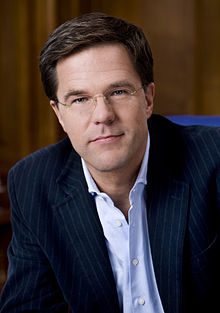
The executive power is concentrated in the hands of an informal body - the cabinet of the Netherlands , consisting of ministers and state secretaries (ministers form a narrower constitutional body - the Council of Ministers of the Netherlands ). The cabinet is obliged to coordinate the main decisions with the parliament, and therefore is formed on the basis of a parliamentary majority. Not a single party in the past more than 100 years of the history of the Netherlands has had a majority in parliament, so governments have always been coalitional in nature. Since October 14, 2010, the Prime Minister has been the leader of the People's Party for Freedom and Democracy, Mark Rutte .
| 2010 election results | ||||
|---|---|---|---|---|
| Parties | Leader | Number of votes | Seats in the Second Chamber | Seats in the First Chamber |
| People's Party for Freedom and Democracy (VVD) | Mark Rutte | 1 929 575 | 31 | sixteen |
| Labor Party (PvdA) | Job Cohen | 1 848 805 | thirty | 14 |
| Freedom Party (PVV) | Geert Wilders | 1,454,493 | 24 | ten |
| Christian Democratic Appeal (CDA) | Jan Peter Balkenende | 1,281,886 | 21 | eleven |
| Socialist Party (PVV) | Emil Rumer | 924 696 | 15 | eight |
| Democrats 66 (D66) | Alexander Pehtold | 654 167 | ten | five |
| Green Left (GL) | Yolanda Sap | 628 096 | ten | five |
| Christian Union (CU) | Arie Slob | 305 094 | five | 2 |
| Reform Party (SGP) | Kees van der Stay | 163,581 | 2 | one |
| Animal Protection Party (PvdD) | Marianne thime | 122 317 | 2 | one |
| 50PLUS (50+) | Ian Nigel | - | 0 | one |
| Senate Independent Party (OSF) | Keyes de Lange | - | 0 | one |
| total (turnout 75.4%) | 9 442 977 | 150 | 75 | |
Notes
- ↑ http://constitution.garant.ru/DOC_3864853.htm#sub_para_N_1800 Archived February 16, 2009 on the Wayback Machine