
Mandapa ( Sanskrit मण्डप , Hindi मंडप , English mandapa ) is also read as “ mantapam ” or “ mandapan ” - in Indian architecture it is an open hall with columns or a pavilion for public rituals . [one]
Temple Architecture
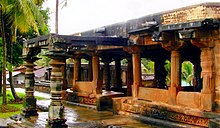
In a Hindu temple, the mandapa is a porch-like construction that leads to the temple through lavishly decorated gates (gopurams). It is used for religious dances and music, and is also part of the main building of the temple. Usually the prayer hall was built opposite the Temple of Saints (garbhagriha). A large temple consists of more than one mandapa.
If one building has several mandaps, then each is used for a different purpose and gets a name corresponding to its function. For example, a mandapa dedicated to sacred marriage is referred to as the Kalyana mandapa. Usually the hall contained columns decorated with amazing carvings. In modern conditions, it is also a building where Hindu weddings are held. The bride and groom are surrounded by a circle of fire, which is kindled by a priest in the center of the mandapa.
Variety of Names

When there is more than one mandapa in the temple, various names are given to them. [one]
- Arsa mandapam is an intermediate space between the temple outside and Garbo grhaha (the Holy of Holies) or other mandapas of the temple.
- Astana Mandapam - meeting room,
- Kalyana Mandapam - dedicated to the ritual wedding of God and the Goddess.
- Maha mandapam - (maha = large) If the temple consists of more than one mandapa, then this mandapa is the largest and thickest. It is used for religious discourses. For some time, the Maha Mandapam was built along the transverse axis with a transept (stretched particles along the transverse axis). Externally, the transept ends with a large window, provides the temple with light and freshness.
- Nandi mandapa (or Nare Mandir) - in the temples of the god Shiva , a pavilion with a statue of the sacred bull Nenda that looks at the statue of the phallus of Shiva.
- Mandapa rank
- Meасanas mandapa
- Namaskar Mandapa
- Open mandapa
Mentioned in other languages
- In Indonesia, the mandapa is better known as pendopo. Unusual is the fact that such facilities in Indonesia are in most cases built for the Muslim community. Many of the mosques follow the pendopo design, with a layered roof to resemble Mount Meru.
- In Tamil, this platform - Aairam Kaali mandap - is a hall with a hundred columns, close to the view of Wiman (the aircraft described in ancient Indian literature), which forms an obvious part of the terrain of classical Dravidian architecture.
- The Burmese term mandate , which is etymologically derived from the word mandapa from the Pali language, is an open platform or pavilion from which people spray water on passers-by during the Buddhist Tinjan festival.
- Mandapa in Thai - Mondop . She often appears in Thai temples and art, or in the form of Khor Trai (temple library) or an altar, such as in Wat Chang Meng in the city of Chiang Mai .
See also
- Indian architecture
- Hindu architecture
- Hindu temple
Notes
- ↑ 1 2 Khajuraho Architecture . personal.carthage.edu. Date of treatment November 21, 2015.