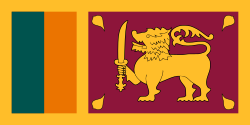

Islam in Sri Lanka is the second largest religious group. According to the 2012 census, 1,967,227 Sri Lankans (about 9.1%) profess Islam [1] . 99.7% of all representatives of one of the largest nationalities of the country - Laracalla - practice Islam [1] . Locals also use the term “Muslim” to refer to the Laracalla people.
Content
History
Islam was brought to Sri Lanka in the 7th century by Arab merchants. In the 8th century, Arabs controlled most of the trade in the Indian Ocean and contributed to the spread of Islam. Many of them settled on the island in large numbers. However, with the advent of the Portuguese to Sri Lanka in the sixteenth century , most of the descendants of the Arabs, who were called Laracalla or Sri Lankan Moors, were persecuted. Sinhalese rulers gave refuge to many Muslims on the Central Plateau and in the Eastern provinces of Sri Lanka [2] .
During the 18th and 19th centuries, with the permission of the Dutch and British rulers, Javanese and Malay Muslims settled on the island. They adopted the Islamic traditions of the Laracalla nation, introducing them with their unique Islamic practices. The descendants of the settlers now form a group of Sri Lankan Malays. In the XIX and XX centuries , the migration of Indian Muslims was noted on the island, which also contributed to the growth of Islam. In particular, Muslims from Pakistan and South India brought the Shafiite and Hanafi traditions of Islamic law, although until then, most Muslims of the island adhered to the traditional practices of Sunni and Sufism .
Muslims during the Civil War
For 26 years, there has been a civil war in Sri Lanka between the central government and the militants of the Tamil Eelam Liberation Tigers (LTTE). LTTE fought for the creation of an independent state, Tamil-Ilam , in territories that are also the main habitat of Laracalla. LTTE set itself the goal of building a mono-ethnic state. They launched the genocide of Muslims, hundreds of Muslims were killed, hundreds of thousands were forced to leave their homes. So, in October 1990, more than 95 thousand Muslims were expelled from the Northern Province [3] . After the end of the civil war, some families returned to their previous places of residence. There are more than 2,000 Muslims in Jaffna ; mosques and Islamic shops have been restored in the city.
Current situation
In the 21st century, among the Muslims of Sri Lanka, the influence of Salafism increased, the spread of which was sponsored by Saudi Arabia, and the number of followers of Wahhabism also increased [4] . As a result of this, a number of conflicts have occurred between the Buddhist and Muslim communities of the island.
Sri Lankan Moors
Sri Lankan Moors are native speakers of the Tamil language and Islamic faith. Several genealogical theories indicate that Laracalla belong to the Tamil ethnic group , their ancestors were also Tamils, and converted to Islam from other faiths [5] [6] [7] . Other scholars claim that Sri Lankan moors are descendants of Arab merchants who brought Islam to the island. The Sinhala and the central government adhere to this theory, which distinguishes Laracalla as an ethnic group separate from the Tamils . This classification and separation of Laracalla from Tamils is contested by several sources [5] [7] [8] .
East Coast
Muslims predominate in the eastern provinces of the country. Laracalla settled on the east coast during the persecution by the Portuguese [2] . The Moors are mainly engaged in agriculture , fishing, and trade . Inheritance in Laracalla occurs along the female line as in the southwestern Indian state of Kerala , while they use the Islamic legal system [9] .
West Coast
Most of the Moors on the west coast are engaged in trade and public service, and live in large cities in the Western and Northwest provinces. On the west coast, family inheritance takes place along the male line. Like the Central Provinces, the name of their newborn Moors on the west coast is the name of their father, which is similar to the Arab tradition .
Malays
Sri Lankan Malays come from Southeast Asia and today comprise about 50,000 people or 2.5% of all Muslims in the country. Their ancestors came to the island when Sri Lanka and Indonesia were Dutch colonies. Most of the Malay settlers were soldiers who were brought to Sri Lanka by the Dutch colonial administration, and then remained to live on the island. Some of the migrants were prisoners, as well as representatives of noble families of Indonesia who were sent to Ceylon and did not leave the island later. The basis of the Malayan identity is the Malay language with numerous borrowings from Sinhala and Tamil . Like the Moors, most Malays are followers of the Shafiite madhhab of Sunnism .
Other Indian Muslims
Muslims of Indian descent are descendants of migrants who arrived on the island in search of a better life in the colonial period. Some of them came during the time of Portuguese domination, while others came during various periods of the British period of government. Most of them come from the states of Tamil Nadu and Kerala , and unlike Larakall, they are ethnically connected with the inhabitants of South India . Their total number is estimated at 30,000 people. Most Indian immigrants professed Sunni Hanafi madhhab, while there were a small number of Shiite worshipers from North and West India .
See also
- Religion in Sri Lanka
- Laracalla
Notes
- ↑ 1 2 Department of Census and Statistics, The Census of Population and Housing of Sri Lanka-2011
- ↑ 1 2 Minister Hakeem urge apologies from Maha Sangha and JHU Archived May 24, 2013 on Wayback Machine
- ↑ The "liberation" of the east heightens the anxieties of the Muslim community about its role in the new scheme of things. Archived on August 9, 2009.
- ↑ https://www.colombotelegraph.com/index.php/the-wahhabi-invasion-of-sri-lanka/
- ↑ 1 2 Mohan, Vasundhara. Identity Crisis of Sri Lankan Muslims. - Delhi: Mittal Publications, 1987. - P. 9-14.27-30.67-74.113-118.
- ↑ Ross Brann, “The Moors?”
- ↑ 1 2 Analysis: Tamil-Muslim divide . BBC News World Edition. Date of treatment July 6, 2014.
- ↑ Zemzem, Akbar. The Life and Times of Marhoom Wappichi Marikar (booklet). - Colombo, 1970.
- ↑ Kmaraikayar . Date of treatment July 2, 2007.