(Ordinary, Eastern, Danube) bream [1] ( Latin Abramis brama ); (young individuals - podleschiki , old in the southern regions of Russia - chebak , middle ones in the southern regions of Russia - kilak ) - the only representative of the genus of bream ( Abramis ) from the family of cyprinids ( Cyprinidae ), order Carps ( Cypriniformes ).
| Bream |
 |
| Scientific classification |
|---|
| No rank : | Bilateral symmetric |
|
| International Scientific Name |
|---|
Abramis brama Linnaeus , 1758 |
| Security status |
|---|
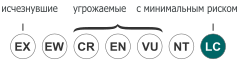
Least concernIUCN 3.1 Least Concern : 135696 |
|
Content
Bream caught on the Waal River ( Netherlands ) The body is high, the maximum height is about a third of the body length. The head and mouth are small. The mouth ends with a tube that can be extended. The dorsal fin is high and short, with three hard unbranched and 8-10 soft branching rays. The anal fin is long, with three hard and 22-29 soft rays, begins behind the posterior edge of the base of the dorsal fin. Between the ventral fins and anal there is a keel not covered with scales. Pharyngeal teeth single, five on each side.
In an adult bream, the back is gray or brown, the sides are golden brown, the belly is yellowish, all fins are gray with often dark edges. In young individuals, the coloring is silver.
The maximum body length is 82 cm, the mass is 6 kg , the maximum life expectancy is 23 years [2] .
Bream is held in groups, mainly in deep places overgrown with plants. Careful and quite smart.
The convex shape of the mouth is ideal for searching for food in soft mud. The larvae feed on zooplankton. Fry after reaching a length of 30 mm go to the food benthos. It feeds on insect larvae, tubers , shells and snails . It can also eat algae [3] .
Bream can gather in large flocks, especially in large lakes or on strong currents. Such flocks clean out sections of the bottom of reservoirs without a trace and move very briskly further, leaving behind them cleaned “roads”. Such movements can be easily noticed by the emerging bubbles of marsh gas , which are released when a flock of bream "overturns" another bottom area.
Bream winter in deep places. Those living at the mouths of the Volga part winter in the sea, partly enter the river.
Bream reaches sexual maturity at the age of 3 to 4 years. Spawning occurs always on grassy shallows, in shallow bays, and is done with a loud splash. The male at this time on the body formed numerous small dull-conical tubercles, first white, then amber-yellow. Spawning time in central and northern Russia is not earlier than the first days of May, in the south since mid-April. The course of the bream in the Volga from the seashore begins in February under the ice, and the gross course happens around mid-April. Fertility from 92 to 338 thousand eggs. The optimum temperature for spawning is about 21 ° C [4] . During the spawning period, males form territories in which females spawn. Fry hatch after 3 to 12 days and are attached to the water vegetation with a special secret. They remain attached to the full use of the yolk.
Bream is found in Central and Northern Europe in the basins of the Northern , Baltic , Caspian , Black and Azov Seas ), acclimatized in Siberia in the basins of the Ob , Irtysh and Yenisei rivers . In the 1930s it was introduced into the Trans-Ural lakes [5] . There are in the Aral Sea , in the lake Balkhash and the lower reaches of the Syr Darya . In the Far North and in the south of the territory of the former USSR it is not. In the Northern Dvina, it is not numerous and probably penetrated here through channels from the Volga system. In the Caucasus, it is found only in a few places (near Lenkoran and in Lake Paleostomi , as well as in the Mingechaur reservoir ). It lives in lakes, ponds, rivers, reservoirs and brackish waters of the Caspian, Aral and Azov seas.
Valuable fishing view. World catch reached 62.9 thousand tons in 1999. The maximum catch in the USSR at the end of the 1930s was 120 thousand tons, and at the end of the 1990s the national catch ranged from 25 to 32 thousand tons. The main fishing in the rivers and lakes is carried out by seine and faring systems, and in the sea - by fixed seine and fixed nets [3] .
It is realized in trade in dried, smoked, fresh and frozen form. Used also for making canned food.
Karyotype : 50 chromosomes ( 2 n ), NF = 80 [6] .
- ↑ Reshetnikov Yu. S. , Kotlyar A. N. , Russ T. S. , Shatunovsky M. I. Pyatiazychny dictionary of animal names. Fish. Latin, Russian, English, German, French. / edited by Acad. V.E. Sokolova . - M .: Rus. laz., 1989. - p. 133. - 12 500 copies. - ISBN 5-200-00237-0 .
- ↑ Bream (English) in the FishBase database.
- ↑ 1 2 Commercial fish of Russia: In 2 t. / Ed. O. F. Gritsenko, A. N. Kotlyar, B. N. Koteneva. - M .: Publishing house VNIRO, 2006. - T. 1. - p. 168-170. - 656 s. - ISBN 5-85382-229-2 .
- ↑ Targońska K. et al. Abramis brama (L.) Under natural and controlled conditions ( Journal of Thermal Biology): Journal. - 2014. - Vol. 39, no. January . - p. 17-23. - ISSN 0306-4565 . - DOI : 10.1016 / j.jtherbio.2013.11.005 .
- ↑ Smagin A.I. Ecology of water bodies of the technogenic radiation anomaly zone in the South Urals / Abstract of dissertation in the specialty 03.00.16, Institute of Ecology and Evolution named after A.N. Severtsov RAS, Perm // Ozersk: “George”. - 2008. - 51 p. (P. 13).
- ↑ Vasiliev V. P. Evolutionary karyology of fish. - M .: Science, 1985. - 300 p.
- Bream // Brockhaus and Efron Encyclopedic Dictionary : 86 tons (82 tons and 4 extra). - SPb. , 1890-1907.