Clever Geek Handbook
📜 ⬆️ ⬇️

Parallelogram identity

Parallelogram

The parallelogram identity is one of the equalities in vector algebra and vector analysis .

Content

In Euclidean geometry

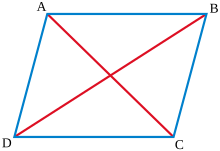
The sum of the squared lengths of the sides of the parallelogram is the sum of the squared lengths of its diagonals .

(AB)2+(BC)2+(CD)2+(DA)2=(AC)2+(BD)2.{\ displaystyle \ (AB) ^ {2} + (BC) ^ {2} + (CD) ^ {2} + (DA) ^ {2} = (AC) ^ {2} + (BD) ^ {2 }.}  

In spaces with scalar product

 
Parallelogram Identity Illustration

In vector spaces with a scalar product, this identity looks like this [1] :

2‖x‖2+2‖y‖2=‖x+y‖2+‖x-y‖2{\ displaystyle \ 2 \ | x \ | ^ {2} +2 \ | y \ | ^ {2} = \ | x + y \ | ^ {2} + \ | xy \ | ^ {2}}  

Where

‖x‖2=⟨x,x⟩.{\ displaystyle \ \ | x \ | ^ {2} = \ langle x, x \ rangle.}  

In normed spaces (polarization identity)

In the normed space ( V ,‖⋅‖ {\ displaystyle \ | \ cdot \ |}   ), for which the parallelogram identity holds, we can introduce the scalar product⟨x,y⟩ {\ displaystyle \ langle x, \ y \ rangle}   generating this norm, that is, such that‖x‖2=⟨x,x⟩ {\ displaystyle \ | x \ | ^ {2} = \ langle x, \ x \ rangle}   all vectorsx {\ displaystyle x}   of spaceV {\ displaystyle V}   . This theorem is attributed to Frechet , von Neumann and Jordan [2] [3] . This can be done in the following way:

  • for real space
    ⟨x,y⟩=‖x+y‖2-‖x-y‖2four,{\ displaystyle \ langle x, y \ rangle = {\ | x + y \ | ^ {2} - \ | xy \ | ^ {2} \ over 4},}   or‖x+y‖2-‖x‖2-‖y‖22, {\ displaystyle {\ | x + y \ | ^ {2} - \ | x \ | ^ {2} - \ | y \ | ^ {2} \ over 2},}   or‖x‖2+‖y‖2-‖x-y‖22. {\ displaystyle {\ | x \ | ^ {2} + \ | y \ | ^ {2} - \ | xy \ | ^ {2} \ over 2}.}  
  • for complex space
    ⟨x,y⟩=‖x+y‖2-‖x-y‖2four+i‖ix-y‖2-‖ix+y‖2four.{\ displaystyle \ langle x, y \ rangle = {\ | x + y \ | ^ {2} - \ | xy \ | ^ {2} \ over 4} + i {\ | ix-y \ | ^ {2 } - \ | ix + y \ | ^ {2} \ over 4}.}  

The above formulas expressing the scalar product of two vectors in terms of the norm are called the polarization identity .

Obviously, the norm expressed in terms of any scalar product as follows‖x‖2=⟨x,x⟩ {\ displaystyle \ \ | x \ | ^ {2} = \ langle x, x \ rangle}   will satisfy this identity.

Polarization identity is often used to turn Banach spaces into Hilbert spaces .

Summary

If B is a symmetric bilinear form in a vector space, and the quadratic form Q is expressed as

Q(v)=B(v,v){\ displaystyle \ Q (v) = B (v, v)}   ,

then

fourB(u,v)=Q(u+v)-Q(u-v),2B(u,v)=Q(u+v)-Q(u)-Q(v),2B(u,v)=Q(u)+Q(v)-Q(u-v).{\ displaystyle {\ begin {array} {l} 4B (u, v) = Q (u + v) -Q (uv), \\ 2B (u, v) = Q (u + v) -Q (u ) -Q (v), \\ 2B (u, v) = Q (u) + Q (v) -Q (uv). \ End {array}}}  

Notes

  1. ↑ Shilov, 1961 , p. 185.
  2. ↑ Philippe Blanchard, Erwin Brüning. Proposition 14.1.2 (Fréchet – von Neumann – Jordan) // Mathematical methods in physics: distributions, Hilbert space operators, and variational methods . - Birkhäuser, 2003 .-- P. 192. - ISBN 0817642285 .
  3. ↑ Gerald Teschl. Theorem 0.19 (Jordan – von Neumann) // Mathematical methods in quantum mechanics: with applications to Schrödinger operators . - American Mathematical Society Bookstore, 2009. - P. 19. - ISBN 0-8218-4660-4 .

Links

  • Analytical geometry on the plane and in space / Vector algebra (Russian)

Literature

  • Shilov G.E. Mathematical analysis. Special course. - M .: Nauka, 1961 .-- 436 p.
Source - https://ru.wikipedia.org/w/index.php?title= Parallelogram Identity&oldid = 95774426


More articles:

  • Oshima, Naoto
  • Guigny, Charles-Étienne
  • Kulakovo municipality
  • Connecting Polyhedra
  • Ruthenium (III) Oxide
  • Tibet Culture
  • Rukavishnikov House
  • Christmas Story
  • Hamzaoglu, Hamza
  • Makarevsky, Alexander Andreevich

All articles

Clever Geek | 2019