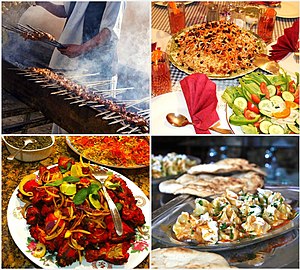
plov ;
tandoori chicks ;
manta (dumplings)
Afghan cuisine is the culinary traditions of Afghanistan and the peoples inhabiting this country ( Pashtuns , Tajiks , Turkmen , Hazaras , Uzbeks and others). National culinary features reflect its ethnic and geographical diversity - Afghanistan is located at the intersection of routes from the Far East to Persia and from Central Asia to the Indian subcontinent , the Great Silk Road passed through it [1] . As a result, Afghan cuisine has absorbed a wide variety of traditions, it often uses ingredients and technologies from neighboring regions [2] .
Content
Grains, Fruits, and Vegetables
The basis of the diet of Afghans are cereals, such as wheat , corn and barley , in the north, in the Hindu Kush , and in the east ( Jalalabad ), and rice [3] . They make noodles and flatbreads, wheat is the most popular - naan and chapati , they are used as a bit of tea and tea, and are used instead of a spoon during a meal [2] . Bread is baked in the early morning, either in a tandoor or in a local bakery (bringing dough with you); Nomadic people in the country use metal dishes to bake bread [4] .
Bread with tea (in rich families - also raw, kaymak , honey and jam) is a typical breakfast for Afghans [5] . With the help of bread they eat not only solid food, but also soup — dipping a cake into it [6] . Poor lunch often consists of broth and flatbread [5] . In season bread is consumed with grapes; Another traditional dish with bread is kaymak, boiled with garlic, salt and pepper, which is put on the bread [5] .
Bolani - burrito
Fresh dumplings, "manta"
Afghan bakery
Other common dishes made from dough are , manta , sambos and [2] [4] . Many popular dishes contain rice : in Afghanistan, there are many types of pilaf, and rice is used as a side dish for meat, stews , kurut and vegetables - crumbly or sticky ; the crumbly long grain rice is also made into a dessert — shola rice pudding [2] [2] . Rice is served with carrots, orange zest , apricots, raisins, almonds and pistachios [4] . Often eat noodles and other pasta and bakery products.
Afghanistan is an agrarian country where they grow many fruits, vegetables and nuts. Abroad, Afghan melons, watermelons and local grapes, which are consumed both raw and raisins , have become famous; pomegranates , plums , cherries , mulberries , quinces , apricots , nectarines , apples and pears are also cultivated; Onions , potatoes , tomatoes , eggplants , shallots , green beans , okra , white and cauliflower, radishes , pumpkin , zucchini and similar vegetables [3] . Bananas, lemons and oranges grow in the subtropics of Jalalabad.
Carrots, eggplants and lemons canned in marinade; apricots, peaches, cherries, sweet peppers, coriander and mint are turned into chutneys [3] [5] . Nuts ( pistachios , almonds , walnuts and pine nuts) are eaten as snacks for tea and added to pastries, rice and desserts [7] [3] .
Meat and Dairy Products
The majority of the population of Afghanistan professes Islam , prohibiting the use of pork for food; Because of this, it is not used in local cuisine. On the Afghan tables, lamb is most common, they also serve goat meat , beef , buffalo and camel meat, chicken and game meat [2] . Once, chicken meat was considered the food of the rich, which is why it is imported a lot from Iran, Pakistan and India [3] . Mutton kebabs of various kinds are widespread: from ribs, from minced meat with potatoes and beans, and so on [2] . Game is also eaten - quails , ducks , pigeons and partridges [3] . Afghan Uzbeks and Kyrgyz use horse meat [3] . All parts of animals go to food, including offal ; the meat is also faded [5] . Due to the high cost of living, many eat meat 1-2 times a week [8] .
Almost no fish is consumed, despite the fact that local rivers are full of trout , carp and catfish ; seafood does not eat at all [9] [2] .
An important role in the Afghan kitchen is played by cow , buffalo , sheep and goat milk and dairy products: yogurt (it is used mainly as an ingredient in cooking other dishes), kurut , paneer , kaymak (it is eaten with naan or added to tea) [9] [ 2] . Milk as a product is used very rarely, in the heat they drink “dog” - yogurt, diluted with water, with mint [9] .
Savory meatballs with meatballs
Eggplant Dish
Meat pilaf
Spices
Dishes seasoned with various herbs and spices - saffron , star anise , cardamom , cinnamon , red pepper , paprika , cloves , coriander , Chinese Cinnamomum , zira , fennel , fenugreek , ginger , kalindzhi , black pepper , poppy seed, sesame , turmeric - in this case on European taste, they are not very sharp [3] . A lot of asafoetids are grown on Afghan fields, but almost all of them are exported to India.
When cooking soups and stews, they add a lot of coriander, mint , garlic and dill, rose water is often found in desserts [3] .
Desserts and Drinks
Each meal is completed with fresh fruit. Sweets are very expensive and are found mainly in the festive meal [7] [5] . Rice puddings like firni are popular in Afghanistan; baklava , biscuit, halva , sweet “kebab”, called “silk” - to make it, a beaten egg is carefully poured into hot oil so that thin threads are drawn from the liquid; the resulting dish is sprinkled with sweet syrup and sprinkled with pistachios [7] . At compote of dried fruits is prepared, resembling the Iranian haft sin [7] .
Sugar beet and sugar cane , which are grown in the north and east of the country, respectively, are processed into sugar , the snack “nabot”, which is a sugar sugar , is popular [3] .
In Afghanistan, they drink a lot of tea, both black and green [9] . Sugar and cardamom are usually added to it and are eaten with almonds, while milk is found mainly in the festive drink “Kaymak-tea”, the main ingredients of which are green tea and baking soda — the tea becomes pink under its influence; Kaimak is also added to the cup [9] [7] . Many drink tea with a piece of lollipop in their mouth [9] . An important role in the social life of Afghans is a teahouse [7] . Rich families serve fruit juices, sorbet and carbonated drinks [9] .
Teahouse, 1976
Afghan Cardamom Tea
Sweet Shop
Cooking
Afghan families are often very large, which is why cooking is not an easy task. Historically, grocery shopping was considered a male occupation, but in modern Afghanistan it has become the business of women and children; women usually cook, with the exception of professional chefs who are hired in wealthy families (they are almost always men) [9] . Cooking food, especially meat, takes a long time, since it takes place on a small fire [4] .
Kitchen accessories are primitive, stoves are mostly wood-burning, or are filled with gas cylinders; some families have a tandoor [9] . Refrigerators are rare, sophisticated appliances, such as mixers , are missing [9] . In many homes there is no running water [9] . Frying pans , pots, pestles and mortars , as well as rolling pins for dough are used [9] . To measure the amount of ingredients use special pots of a known volume, but usually they are added "by eye" [9] .
Traditionally for cooking used fat tail , cottonseed or melted butter ; modern Afghans cook in ghee and vegetable oil [9] .
Many Afghan sauces include onions, most often , also strongly fried onions are dried, ground and later added to preparing dishes [4] .
Afghani in the market
Street vendor in Kabul
Afghan soup
Eating food
Traditionally, in Afghanistan they eat, sitting on the floor on pillows, and in large groups. For 3-4 people they put a big dish with rice surrounded by smaller vessels with stern , kebabs and vegetable dishes [5] . Food is taken with the right hand; the rice is rolled into lumps and then sent to the mouth [6] .
All food is served simultaneously; use meat dishes first, then desserts [6] . After the meal, fruit is served first, and then unsweetened cardamom tea [6] .
Restaurants are mainly concentrated in Kabul, eating outside the home is not accepted (with the exception of teahouse and barbeque ) [6] . From traditional fast food , called “Tabang val,” fried corn, flatbread bolani with onions, salted chickpea , beans, boiled potatoes, samosa and raisins, soaked in water are common [6] . Other types of street food are served in stalls: faludu , a dairy dessert with noodles, sugar, pistachios and rose water; grilled fish with zalebi (jalabiya), that is, donuts; Halim, steep porridge with minced meat and sugar; cheese with raisins [6] .
A teahouse is a small cafe in which men gather to talk over tea, or, if the institution is large enough, and snacks like “sherva-e-chaynaki” (literally “teapot soup”): lamb, onions, and peas are put into the teapot fresh coriander, salt and pepper, and then slowly cooked near the tea samovar or directly on it [10] . Next to many teahouses are barbecues, which serve lamb kebab with onions, coriander and tomatoes, meatballs “jacket”, lamb, fried with a small amount of salt and without spices “shinvari”, lamb eggs and other dishes [10] .
Street vendor with ready-made food in Herat
Amir Abdur-Rahman concubines in front of a laid table, 1894-1896
Holidays
In Afghanistan, the pre-Islamic New Year ( Nauroz ) and all major Islamic holidays are celebrated , as well as the birth of children (especially the first-born son), circumcision , engagement and wedding [11] .
The birth of children is accompanied by the delivery of special dishes that should strengthen the health of the woman in labor: they give her flour soup “Humach”, dessert made from flour “liti”, special halvah “kachi”, “aush” (noodles richly flavored with garlic) and “shola-e -Holba, a sweet sticky rice dish with fenugreek [12] .
At the engagement, the bridegroom's family comes to visit the bride's family, bringing with them gifts and lots of sweets, the bride's family gives them a hearty dinner and kaymak tea [12] . A similar feast takes place during the wedding, but on a larger scale; Silk kebabs, candied almonds, a “molida” dish, which is a sweet cereal made from sugar, flour, butter and sugar with cardamom and rose water, and many other “happy” dishes are served on the table [13] .
The Muslim fast in Ramadan is observed by all Afghans: until the sun sets, they refrain from food and water, only after dark does they break the fast with water and salt, or dates . After that, many complex and expensive dishes are served: soups, mantle , savory shola, stern with meat, vegetable dishes, fruits and tea [10] . Before dawn they eat again , usually bread, tea, eggs, cheese, kaymak and canned vegetables [11] .
During Id-al-Fitr, Afghans visit relatives and drink tea with them with special desserts: gozinaki with walnuts and almonds (“halva-e-svanak”), nougat with shir-payra nuts, and pastries “gosh-fil” ("Elephant ear") [11] .
On New Year's Eve in Afghanistan they cook samanak from germinated wheat grains, compote “haft-miva”, as well as rice cakes “kulcha-naurozi” and rice with spinach [11] . Many families leave at this time for a picnic, where women prepare dishes with rice, and men fry kebabs; after eating these dishes drink tea with halvah [11] . Halvah is also served at a funeral [13] .
Notes
- ↑ Albala, 2011 , p. 9.
- ↑ 1 2 3 4 5 6 7 8 9 Oxford, 2014 , p. 204.
- ↑ 1 2 3 4 5 6 7 8 9 10 Albala, 2011 , p. eleven.
- ↑ 1 2 3 4 5 Albala, 2011 , p. 13.
- ↑ 1 2 3 4 5 6 7 Albala, 2011 , p. 14.
- ↑ 1 2 3 4 5 6 7 Albala, 2011 , p. 15.
- ↑ 1 2 3 4 5 6 Oxford, 2014 , p. 205.
- ↑ Albala, 2011 , p. 20.
- ↑ 1 2 3 4 5 6 7 8 9 10 11 12 13 14 Albala, 2011 , p. 12.
- ↑ 1 2 3 Albala, 2011 , p. sixteen.
- ↑ 1 2 3 4 5 Albala, 2011 , p. 17
- ↑ 1 2 Albala, 2011 , p. 18.
- ↑ 1 2 Albala, 2011 , p. nineteen.
Literature
- Aslanov M.G. Afghans. Food // Peoples of Western Asia / Ed. ON. Kislyakov and others. - Moscow : USSR Academy of Sciences, 1957. - P. 90-93. - 616 s.
- The Oxford Companion to Food / Alan Davidson, Tom Jaine. - Oxford University Press , 2014. - ISBN 978-0-19-104072-6 .
- Albala K. Food Cultures of the World Encyclopedia (English) . - Greenwood, 2011. - Vol. 3. - 1400 p. - (Food Cultures of the World Encyclopedia). - ISBN 9780313376269 .
Links
- Wikimedia Commons has media related to Afghan cuisine
- Cooking a silk kebab on YouTube
- Cooking Kaymak Tea on YouTube