Rock flying squirrel [1] ( lat. Eupetaurus cinereus ) - a species of rodents of the squirrel family. The only species in the genus Eupetaurus (“good flyer,” from the Greek: εὐ- + πέτομαι , “good to fly”). Species lat. cinereus means ash gray.
| Rock flying squirrel |
|
| Scientific classification |
|---|
| No rank : | Bilateral symmetrical |
| Squadron : | Euarchontoglires |
| Gender: | Eupetaurus Thomas , 1888 |
| View: | Rock flying squirrel |
|
| International scientific name |
|---|
Eupetaurus cinereus Thomas , 1888 |
| Security status |
|---|
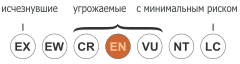
Endangered speciesIUCN 3.1 Endangered : 8269 |
|
To date, about ten samples have been documented. It is found in the northern part of the Himalayas, northern Pakistan and Tibet. It lives in rocky forest regions at altitudes from 2400 to 3800 m above sea level. Leads a nocturnal lifestyle.
The body length of the studied individuals is from 51 to 61 cm, the tail length is from 38 to 48 cm. Between the front and hind legs, an elastic leather membrane is covered with fur. The tail is fluffy, the body is covered with thick fur. The color of the back is bluish-gray, the abdominal part is pale gray. The fur on the throat and ears is creamy white, on the feet black. The fur on the tail is about 7.6 cm long. The claws are blunt, adapted for life in the mountains.
The basis of the diet consists of buds and cones of trees. In winter, it deepens into forests, where it feeds mainly on mosses and lichens. Almost nothing is known about reproductive features. For the season, presumably can bring two litters.
The species lives in extremely harsh conditions, in a limited area. Apparently, the species has always been very rare. Further studies of adaptive and reproductive characteristics are required. The species is endangered. Over the past 10 years, the species range has been halved due to deforestation. The total population is from 1000 to 3000 individuals. Over the next 5 years, a fifth of the population is projected to decline, as uncontrolled deforestation in this region does not stop.