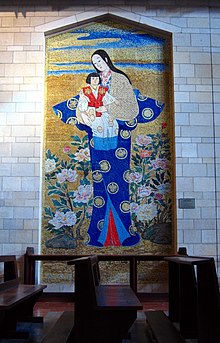
The Catholic Church in Japan is part of the worldwide Catholic Church under the spiritual guidance of the Pope from the Vatican . Belongs to the Roman (Latin) rite of the Catholic Church. In Japan , according to statistics, there are about 509 thousand Catholics, which is slightly less than 0.5% of the total population [1] .
Content
History
Catholicism, as well as all Christianity as a whole, was brought to Japan thanks to Portuguese explorers and missionaries , as well as thanks to the Jesuit order , primarily the Spaniard Francis Xavieri and the Italian Alessandro Valignano . The first Japanese to become a Catholic is considered Anziro . Portuguese Catholics also founded the city of Nagasaki [2] , which was to become an important center of Christianity in the Far East , although these plans were not subsequently realized. By 1581, there were already more than 150,000 local Catholics and 200 churches in Japan. Oda Nobunaga , ruler of Japan, encouraged the spread of the Christian faith throughout the country and was friendly to Europeans who sailed into the country for trade. However, his successor, Hideyoshi Toyotomi , although at first he continued the policy of his predecessor in this matter, in 1587 issued a decree banning missionary activity. This decision was caused by conflicts with Portuguese pirates, leading the local population into slavery, as well as problems with Christian feudal lords in the south of the country, who were rich in trade with the Portuguese and sought to gain independence. Persecution of Christians continued until the second half of the XIX century, when Japan emerged from world isolation [3] .
In 1862, P. S. Girard built the first (in several centuries) Catholic Church in Japan in Yokohama [4] . At first, Japanese authorities were suspicious of the new religion. In 1867, more than 20 Catholics were arrested, and in 1868 a decree banning the practice of Christianity was issued: “Since the contemptible religion of Christians is strictly prohibited, each person personally must declare his or her renunciation of belonging to it and point out who it is adheres to avoid self-suspicious attitude ” [4] . But soon the attitude of the Japanese authorities towards Catholicism improved. In 1881, the first issue of the Catholic newspaper was published [4] . In 1961, Japan had 810 Catholic churches and houses of worship, 168 monasteries and shelters [4] .
There is a modern translation of the Bible into Japanese, authored by the Italian missionary Federico Barbaro . A significant number of Catholics in Japan are ethnic Japanese who emigrated from Brazil .
Structure
There are 16 dioceses in the country, 3 of which are archdioceses [5] , as well as 1,589 clergy and 848 parishes [1] . The centralized governing body of the Catholic Church in the country is the Conference of Catholic Bishops of Japan.
Until 2011, the Italian archbishop Alberto Bottari de Castello was the nuncio in the country. Currently, the Apostolic Nuncio in Japan is the Indian Archbishop Joseph Hennot . He is the ambassador of the Holy See in Japan and is also a delegate to the local church.
- Dioceses
- Archdiocese of Nagasaki
- Diocese of Fukuoka
- Diocese of Kagoshima
- Diocese of Naha
- Diocese of Oita
- Archdiocese of Osaka
- Diocese of Hiroshima
- Diocese of Kyoto
- Diocese of Nagoya
- Diocese of Takamatsu
- Archdiocese of Tokyo
- Diocese of Niigata
- Diocese of Saitama
- Diocese of Sapporo
- Diocese of Sendai
- Diocese of Yokohama
See also
- 26 Japanese martyrs from Nagasaki
- Aso tarot
- Lorenzo Ruiz
- Mother of God of Akita
Links
- ↑ 1 2 Catholic Hierarchy Directory
- ↑ Nagasaki: The Catholic “Rome of Japan” . www.tsunagujapan.com (2014).
- ↑ Catholicism in Japan . www.apologia.ru. Date of treatment November 2, 2015.
- ↑ 1 2 3 4 Yarotskaya Yu. A. Influence of the Catholic Church on the religious culture of Japan // Bulletin of Polotsk State University. Series E: Pedagogical sciences. - 2014. - No. 15. - S. 109
- ↑ GCatholic.org on the Catholic Church in Japan
- ↑ Röpke, Ian. Historical Dictionary of Osaka and Kyoto. - Scarecrow Press, 1999. - ISBN 978-0810836228 .