Petrovsky Park - a park on the Cape Smolyanoy, located on the territory of the Anninsky fortifications in the Petrovsky microdistrict of the city of Vyborg on the island of Tverdysh and adjacent to Petrovskaya Square .
| Sight | |
| Petrovsky park | |
|---|---|
 View of the park from the roof of the castle. In the center is the archive building, to the right of the restaurant in the former powder cellar | |
| A country | |
| Location | |
| Status |  Identified object of cultural heritage of the peoples of the Russian Federation ( normative act ). (Wikigid database) Identified object of cultural heritage of the peoples of the Russian Federation ( normative act ). (Wikigid database) |
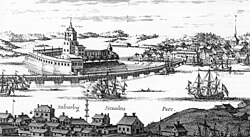
The territory of the present park has long been occupied by wooden private houses with extensive gardens. In 1710, during the siege of Vyborg by Russian troops , at the top of the mountain, from which a view to the Vyborg castle opens, the headquarters of Peter I , who led the troops, was located, as evidenced by the royal monogram and cross, knocked out on a rock, according to legend, by Peter himself. In the 18th century, fortifications of the Anninsky fortifications, including powder cellars, were erected on the mountain. In 1846, on the top and on the eastern slope of the Petrovskaya Mountain, a park was designed, laid out in the middle of the 19th century (the garden of St. Anne). Tall and long-lasting trees, such as Siberian larch and arboreal willow, were planted in it. In 1855, Peter the Great Redoubt was erected in a garden on a cliff; the garden was fenced. In 1873, part of the garden was transferred by the military department to the city authorities, and in the 1880s a restaurant was built on the mountain.


In preparation for the celebration of the bicentenary of the capture of Vyborg by Russian troops, Emperor Nicholas II decided to erect a monument to Peter I and a military cathedral on the top of the mountain. In connection with these restaurant and redoubt were demolished. In 1910, the grand opening of the monument and the laying of the cathedral took place in the expanded and landscaped park. The granite steps of the staircase leading to the emperor’s monument and fenced with a monogram and cross were decorated with ship mortars. And next to the Peter and Paul Cathedral under construction, a temporary wooden Orthodox chapel was erected.
However, after Finland declared independence in April 1918, Finnish troops occupied Vyborg and dropped a bronze statue from the pedestal. In 1927, a stone lion, a monument to Finland's Independence , took its place. The chapel was not preserved. A new attraction of the park was the building of the district archive in the style of functionalism erected on the foundation of an unfinished Orthodox cathedral. During this period, the park was officially called Tervaniemenpuisto (Finnish. "Cape Smolyanoy Park").


In 1940, after the Soviet-Finnish War (1939-1940), the Soviet military removed the monument of Independence of Finland, and then returned the monument to Peter I to the historical site. But in August 1941, the Finnish troops who returned to the city, the monument to Peter I was again dropped. and the wreckage of the Finnish Independence Monument is located in the park.
In the post-war period, work was done to improve the Petrovsky Park: the lattice was reconstructed, the wreckage of the Independence Monument was transferred to Monrepos Park, and in 1954, the monument to Peter I was restored to its former location, but on a new pedestal.
Literature
- Kauppi W.-R., Milchik M. Vyborg. Capital of Old Finland / Ed. M. Inbar. - Helsinki, 1993 .-- 200 p. - ISBN 951-717-743-7 .
- Kepp E.E. Vyborg. Art Attractions / Ed. O.V. Cossacks. - Vyborg: “Fantact”, 1992. - 200 p.
- Neuvonen P., Peyuhya T., Mustonen T. Vyborg. Architectural guide / Per. L. Kudryavtseva. - 2nd ed. - Vyborg: “CH”, 2008. - 160 p. - ISBN 5-900096-06-8 .
- Pages of Vyborg history. Digest of articles. Book Two / Comp. S.A. Abdullina. - SPb. : “European House”, 2004. - 732 p. - ISBN 5-8015-0167-3 .