Juliusz Katz-Suchy ( Polish: Juliusz Katz-Suchy ; January 28, 1912 , Sanok , Kingdom of Galicia and Lodomeria - October 27, 1971 , Aarhus , Kingdom of Denmark ) - Polish diplomat and communist leader. In 1946-1951 and in 1953-1954 - Permanent Representative of Poland to the United Nations in New York . In 1958-1962, the Polish ambassador to India .
| Juliusz Katz-Sukhiy | |||||||
|---|---|---|---|---|---|---|---|
| polish Juliusz Katz-Suchy | |||||||
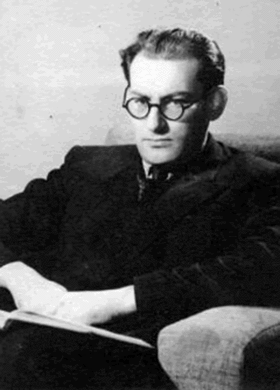 Juliusz Katz in his youth | |||||||
| |||||||
| Predecessor | Oscar Lange | ||||||
| Successor | Henryk Birecki | ||||||
| |||||||
| Predecessor | Henryk Birecki | ||||||
| Successor | Jerzy Michalovsky | ||||||
| |||||||
| Predecessor | Jerzy Grudzinsky | ||||||
| Successor | Przemyslaw Ogrodziński | ||||||
| Birth | January 28, 1912 Sanok | ||||||
| Death | October 27, 1971 (59 years old) Aarhus | ||||||
| Birth name | Judah Katz | ||||||
| Children | Erica, Barbara | ||||||
| The consignment | |||||||
| Awards |
| ||||||
| Place of work | |||||||


Biography
Yuda Katz was born on January 28, 1912 in Sanok . He was the third child of the Jewish family of Shulim Katz, the storekeeper of the tobacco monopoly, and then a small merchant. In addition to Judah, the family included Sister Tonka (1902–?) And brother Bentsion (1907–1968), the future rector of Tel Aviv University . Shortly after the birth of Judah, his mother died [1] .
He graduated from elementary school, and then, in 1931, the city gymnasium in Sanok [2] . Even in the gymnasium, he joined the communist movement. In 1927-1929 he was a member of Hashomer hazair . In 1928 he joined the Communist Youth League of Western Ukraine (KSM ZU). Since 1929, he was secretary of the city committee of KSM ZU, as well as a member of the district committee of the organization. In the 1930s, he became a member of the Communist Party of Western Ukraine [3] .
He entered the law faculty of the Jagiellonian University , but was expelled after the first course for communist activity. He was sentenced to 5 years in prison, of which he served two and a half. A couple of months was concluded in the Birch-Kartuzskaya . Illegally moved to Czechoslovakia , where he continued his studies in Prague [4] . During this period, he published articles of a socialist orientation in the press, including under the pseudonym Sukhiy, which later became part of his surname [3] . In March 1938 he was forced to flee from Czechoslovakia back to Poland. From Poland on a fishing vessel he moved to England [4] .
In England, he began working at Reuters . During World War II, he first worked for the government of General Sikorski [4] at the Polish Telegraph Agency [5] , but then he joined the small pro-communist group of Polish emigrants [4] .
After the war he returned to Poland, and began working in the diplomatic service. After the UK recognized the Government of National Unity , in 1945, he was appointed press officer of the Polish Embassy in London . However, already in 1946, he was transferred as Deputy Permanent Representative of Poland to the UN to New York . Then he took the post of representative, replacing Professor Oscar Lange . He held office until mid-1951, taking part in sessions of the UN General Assembly , in sessions of the UN Economic and Social Council , in the work of the United Nations Economic Commission for Europe in Geneva . In parallel, he served as director of the Polish Institute of International Affairs. He was a member of the board of the Ministry of Foreign Affairs of Poland . In the period 1953-1954, he again served as the representative of Poland to the UN [4] .
He participated in the committee that created the draft Universal Declaration of Human Rights . During the voting of the declaration at the 183rd plenary meeting of the United Nations General Assembly in the Palais de Chaillot ( Paris ) on December 10, 1948, abstained, like most countries of the Soviet bloc . He explained his voice like this:
The Universal Declaration is a step backward from the Declaration developed during the French Revolution .
- [3]
.
In 1955, he was the representative of Poland at the International Atomic Energy Conference. In 1957-1962, the ambassador of Poland to India [5] .
In the summer of 1961, Katz-Sukhoi's cousin, Irena Penzik, the daughter of the famous lawyer and deputy Seim Abram Penzik , who worked as a secretary for Julius during his stay in New York, published the book “Sand for Taste” (Ashes to the Taste). The book contained memories of the period of work at Katz-Sukhoi, and caused irreparable harm to his political career [4] .
In 1962, after returning from India, Juliusz Katz-Sukhiy became a professor at the Department of International Law at the University of Warsaw [5] , although he did not have a completed higher education [4] .
During the anti-Semitic campaign of 1968, he was dismissed from all posts. In 1970, he moved to Denmark and began teaching at Aarhus University [4] .
He died on October 27, 1971. He was buried next to his wife Elzbieta (1912-1989) in the Jewish cemetery of Copenhagen [4] .
He had two daughters, Eric and Barbara [1] .
Rewards
- Order "Banner of Labor" 2 degrees
- Polish Renaissance Order of the Commander [6]
- Golden Cross of Merit (1946 [7] , 1954 [8] )
- Medal "10th Anniversary of People's Poland" (1955) [9]
Bibliography
- 1967: Międzynarodowe stosunki gospodarcze. Organizacja i aspekty prawno-polityczne
- 1966: Zarys historii dyplomacji
Notes
- ↑ 1 2 Warsaw Stories
- ↑ Absolwenci
- ↑ 1 2 3 Juliusz Katz-Suchi, representative of Poland in the Third Committee, which created the draft Universal Declaration of Human Rights.
- ↑ 1 2 3 4 5 6 7 8 9 O Juliuszu Katz - Suchym ponownie
- ↑ 1 2 3 Encyclopaedia Judaica
- ↑
- ↑
- ↑
- ↑ Uchwała Rady Państwa z dnia 10 stycznia 1955 r. o nadaniu odznaczeń państwowych.