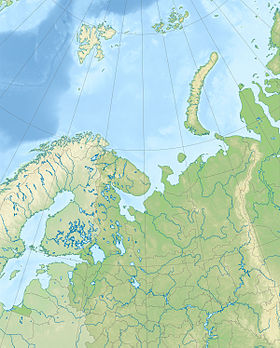
Dvinsko-Mezenskaya Plain (also known as Onego-Dvinsko-Mezenskaya Plain) - a lowland plain in the north of the European part of Russia, refers to the northern slope of the East European Plain . Together with the Pechora lowland, it is sometimes united in the North Russian Lowland . The plain is bounded by Karelia in the west (the Andom Upland and the Windy Belt Range) and the Timan Ridge in the east, the White Sea in the north and the Northern Uvala Upland in the south.
| Dvinsko-Mezenskaya plain | |
|---|---|
| Specifications | |
| Rivers | Northern Dvina , Mezen , Onega |
| Location | |
| A country |
|
| Subjects of the Russian Federation | Arkhangelsk region , Komi Republic |


Content
Relief and geological structure
The plain is confined to the Mezen syneclise of the Russian plate [1] . The plain is dissected by wide glacial hollows, along which flowing rivers flow - the Northern Dvina , Mezen and their tributaries. In the northwestern part of it, fresh traces of the Valdai glacier's presence are observed: hilly end-root ridges, lakes, and zandra fields. In the southeast, glacial landforms are eroded, and the watersheds are very flattened. On the Onega - Dvinsky watershed and Kuloysky plateau in the carbonate and gypsum rocks of the Paleozoic, karst dips are developed, large caves are known [2] . Permafrost ( Mezen tundra ) is widespread in the northeastern part of the plain [3] .
Climate and Soil
The plain is located approximately at the same latitude with Karelia , but east of it, therefore the climate is more continental : the average January temperature is from –12 ° in the west to –16 ° in the east, the average July temperature is from 13-14 ° in the north to 18 ° in the south -western. The bogging of the territory, the predominance of podzolic-bog and gley-podzolic soils in the soil cover are associated with the flat relief. Typical podzolic soils and podzols are common only in the southwestern half of the plain [2] .
Plant World
The northern taiga is widespread in the north of the Dvina-Mezen Plain, and the middle taiga in the south. The main forest-forming species is spruce . An admixture of Siberian conifers is observed: larch Sukachev and Siberian fir (in the southeast). The forests of the province are intensively developed. An important role for rafting is played by the Northern Dvina with its tributaries. Along the river valleys, flood meadows with excellent yields and hay quality are spread. Agriculture is significantly developed only in the southwestern third of the plain [2] .