The Gordon model is a variation of the dividend discount model , a method for calculating the price of a stock or business. This model is often used to value OTC companies, which is difficult to evaluate using other methods.
The model implies that the company currently pays dividends in the amount of D , which in the future will increase with an unchanged rate g . It is also understood that the required interest rate ( discount rate ) of the stock remains constant at level k .
Then the current value of the stock will be equal to:
.
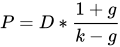
In practice, P is often adjusted for various factors, such as company size. The use of a simplified form of the formula is common

Where - next year's dividend .


Formula Output
The value of the stock can be determined by the discount method in the following form: 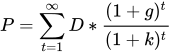
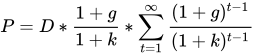
Using the formula for the sum of a geometric progression , we get:
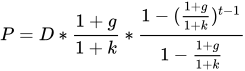
Then, given that 


As a result, we get:
Income plus capital gains equal to total returns
The dividend discount model can also be used to assert that the general rate of return on a stock is equal to the sum of its income and capital gains.
- can be converted to
Dividend yield plus growth (g) equal to cost of equity (k)
Assume that the dividend growth rate in the model is a proxy variable for revenue growth and overall stock prices and capital gains. We also assume that the cost of equity is a proxy variable of the required rate of return on investors. [one]
The growth rate cannot exceed the rate of return on equity
From the first equation you can see that cannot be negative. When in the short term the growth rate of dividends exceeds the cost of equity (the rate of return on equity), then usually use the two-stage method of the model:
Consequently,
Where indicates the expected growth rate in the short term, denotes the rate of long-term growth and - the length of the period (number of years) during which a short-term growth rate is applied.
Even if g is very close to k , P approaches infinity, hence the model becomes meaningless.
Some model properties
a) At a zero growth rate of g , dividends are capitalized.
- .
b) The equation is also applicable for deriving the cost of capital by finding .
c) Which is equivalent to the formula of the Gordon growth model:
where “ "Stands for the current value of the share," “The expected dividend per share next year,“ g ”refers to the growth rate of dividends, and“ k ”represents the required rate of return for the investor.
Model Limitations
a) The assumption of a steady and infinite growth rate not exceeding the cost of capital is not always reasonable.
b) If no dividend is paid on the stock in the current period, as for most growth stocks , then simpler versions of the dividend discount model should be used to estimate the value of the stock. One common technique is to assume that Modigliani-Miller ’s hypothesis that dividends are irrelevant is true, and therefore dividends per share D are replaced by earnings per share E. However, this requires the use of profit growth rather than dividends, which may vary. This approach is especially useful for calculating the residual value of future periods.
c) The stock price in the Gordon model is sensitive to selected growth rates .
In general, the use of the model is limited to companies with stable growth rates. For proper use, data for determining growth rates must be carefully selected. The Gordon model is most suitable for companies whose growth rates are equal to or lower than the nominal economic growth rates, while these companies have a certain dividend payment policy , which they intend to pursue in the future [2] .
Notes
- ↑ Spreadsheet for variable inputs to Gordon Model
- ↑ Damodaran, Asvat, 2011 , p. 432.
Literature
- Asvat Damodaran. Investment valuation. Tools and Techniques for Valuing Any Assets = Investment Valuation: Tools and Techniques for Determining the Value of Any Asset. - M .: Alpina Publisher , 2011. - 1324 p. - ISBN 978-5-9614-1677-0 .