Anton Martinovich Rzhond (June 11, 1865, Galenzov , Lublin province [1] - July 1, 1940, Warsaw , Poland ) - doctor, deputy of the State Duma of the first and third convocations from the city of Lodz .
| Anton Martinovich Rzhond | |
|---|---|
| Antoni Rząd | |
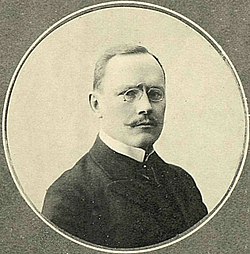 Member of the Third Duma, 1913 | |
| Date of Birth | June 11, 1865 |
| Place of Birth | Galenzov Lublin province |
| Date of death | July 1, 1940 (aged 75) |
| Place of death | Warsaw |
| Citizenship |  Russian empire Russian empire  Poland Poland |
| Occupation | doctor, deputy of the State Duma of I and III convocations from the city of Lodz |
| Education | |
| Religion | roman catholic |
| The consignment | National Democratic Party of Poland |
| Awards |  |
| Autograph |  |
Biography
Born into a peasant family of Rzhondov, Martin and Pelagia (nee Gajczewska) [2] . In 1887 [2] - a graduate of the Lublin Gymnasium. In 1892 he graduated from the medical faculty of the University of Warsaw. After graduating from university, in 1893 [2] he was engaged in medical practice for a short time in the city of Krasnotava [1] . After that he continued his education in pediatrics [2] at the University of Berlin, where he received a doctorate in medicine. Since 1894 [1] he was engaged in private medical practice in Lodz . Moreover, his annual salary was about 5 thousand rubles. He published articles on medical topics in Polish magazines “Czasopiśmie Lekarskim” (Journal of Medicine) and “Nowinach Lekarskich” (Medical News) [2] .
While still a student at Warsaw University, he became a member of the Polish Youth Union “Zet”, in 1900 joined the National League [2] . As part of public activities under the auspices of the National League, he became a member of the National Association “Sanctified” (“Enlightenment”) and participated in the organization of the Polish school “Matica” (“Fatherland”). He was the head of the People’s University [2] .
He was known as a talented speaker and publicist. He published his articles in many periodicals. Actively participated in the campaign for sobriety. It has established itself as a popularizer of hygiene, a supporter of cooperatives [1] . He was mobilized during the Russo-Japanese War of 1904-1905, spent 11 months in Kerch in the Crimea as a military doctor [2] , and accordingly did not take part in hostilities. In 1906, after demobilization, he returned to the Kingdom of Poland, where he again became involved in political activity. In 1906, under the leadership of the National League, he collaborated with the Lodz Council of the National Labor Union [2] . He joined the National Democratic Party, organized the sale and distribution of the press “Przeglądu Wszechpolskiego” (All-Polish Review) and “Polaka” (Pole) from Galicia.
April 20, 1906 was elected to the State Duma of the I convocation from the Congress of City Voters Lodz. Joined the Polish Colo . He was a member of the Duma commission for the execution of the state list of income and expenses. On behalf of the Polish Colo, he spoke at a general meeting of the State Duma for the return to work of participants in a school strike in the Kingdom of Poland. He signed a statement by 27 members of the State Duma, Poles, on the relationship of the Kingdom of Poland to the Russian Empire under the previous legislation and the Basic State Laws on April 23, 1906.
On November 1, 1907, he was elected to the State Duma of the 3rd convocation also from the Congress of City Voters of Lodz. He entered the Polish Colo again. He was a member of the Duma commissions on public education and on the labor issue. On May 29, 1910, he announced the resignation of deputy powers, which was explained by the active work in the cooperative bank he organized in Warsaw.
In 1910, one of the organizers, from 1910 to 1924, President of the Board of the Bank of Cooperative Societies in Warsaw. Having resigned as a deputy, he moved to Warsaw, and also stopped medical practice [2] .
He remained in Warsaw during its occupation by German troops during the First World War. He was an employee of the Red Cross and the Warsaw Civil Committee. Member of the Main Board of the Polish Matica School. In July 1916 he was elected a member of the first city council of Warsaw. He spoke and published a document on the city budget of Warsaw for 1916. In 1917-1919 he became the formal owner of the Polish bookstore in Warsaw, which was acquired in 1919 by the Polish Educational Society (Polskiej Macierzy Szkolnej) [2] .
From 1917 to 1919 he edited the monthly magazine “Siłę” (Strength), dedicated to the affairs of credit companies. At this time, he was one of the leaders of the cooperative movement and worked towards the unification of small financial cooperatives. In January 1919, he was elected a member of the Legislative Sejm in the 31st constituency ( Petrokov and Petrokovsky constituency) on the list of the Republican Electoral Commission from Democratic Parties (Narodowy Komitet Wyborczy Stronnictw Demokratycznych). In the Sejm, he was a member of the National-National Association. He took part in the work of the fiscal committee. In 1920 during the Soviet-Polish war he took part in the organization of a volunteer army. In connection with the plebiscite in Upper Silesia, he published the brochure “Pod wspólnym dachem” (Polska, jej obszar i ludność) (Under one roof (Poland, its area and population), Warsaw 1920). In 1924 - a member of the National Savings Council, in 1929-1930 - a member of the Association of Polish Cooperative Audit [2] .
Most of Rzhond’s numerous publications between the two wars are related to credit cooperative affairs. This, for example, “Spółdzielnie kredytowe a kasy szkolne” (Credit cooperatives and a money transfer school ? , Warsaw, 1921), “Warunki gromadzenia kapitału” (Conditions for mobilizing capital, Warsaw, 1927), “Spółdzielczość w praktyceie w praktyceie w praktyceie w teraktyce w terakaw "(Cooperatives in practice, in theory and in the legal field, Warsaw, 1930). The Draft Law on Cooperation (Varashava, 1925) aroused the greatest interest and controversy. Rzhonda was accused of conservative tendencies and blurring the differences between cooperatives and capitalist companies. Rzhond also published numerous articles, mainly on socio-economic topics in various publications: “Jedności ”(Unity),“ Polaku ”(Pole),“ Sile ”(Strength),“ Przeglądzie Spółdzielczym ”(Cooperative Review),“ Roczniku Banku Towarzystw Spółdzielczych ”(Yearbook of Banking Cooperative Societies),“ Społem ”(Together) "," Zorzy "(Aurora) and the daily press [2] .
In 1924, a member of the organizing committee for the transfer of the remains of Henryk Sienkiewicz. From 1934 until the outbreak of World War II, a member of the audit committee of the Foundation for the Educational House named after Henryk Sienkiewicz in Warsaw. He died in Warsaw on July 1, 1940 and was buried in the Powzki Cemetery. [2]
Family
Wife (from January 25, 1898) - Zofya Antonina, nee Kowerska (September 21, 1871 - January 31, 1946), folklorist and translator. She collected stories, fairy tales and folk songs in the vicinity of Lublin , released many collections of short stories and songs, and also collaborated with Wisłą (Wisla) and Ziemianką, translated into Polish the Cywilizację pierwotną (Primitive Civilization, Warsaw, 1896) by Edward Taylor and the tales of the Brothers Grimm (Warsaw, 1896), member of the Polish Educational Society (Polskiej Macierzy Szkolnej). Part of her music collection is stored in the Museum of Ethnography in Warsaw [2] .
Married to Anton Rzhond, they had a son, Jack, a lawyer. [2]
Rewards
- Cross of the Order of the Renaissance of Poland [ which one? ] .
Literature
- Stanisław Konarski . Antoni Rząd - Internetowy Polski Słownik Biograficzny
- N. D. Postnikov. RZHOND Anton Martinovich // State Duma of the Russian Empire: 1906-1917. B. Yu. Ivanov, A.A. Komzolova, I.S. Ryakhovskaya. Moscow. ROSSPEN. 2008. S. 522-523.
- Boyovich M. M. Members of the State Duma (Portraits and Biographies). The first convocation. M, 1906.P. 433.
- State Duma of the first call. Portraits, short biographies and characteristics of deputies. - Moscow: "Renaissance", 1906. S. 112.
- Boyovich M. M. Members of the State Duma (Portraits and Biographies). The third convocation. M .: Type. Partnership I. D. Sytin. 1909. S. 411.
- 3rd convocation of the State Duma: portraits, biographies, autographs. - St. Petersburg: edition of N. N. Olshanskago, 1910. Tab. 35.
Recommended Sources
- Brzoza Cz., Stepan K. Poslowie polscy w Parlamente Rosyjskim, 1906-1917: Slownik biograficzny. Warszawa, 2001.
- Russian State Historical Archive. Foundation 1278. Inventory 1 (1st convocation). Case 99. Sheet 7; Inventory 9. Case 665; Fund 1327. Inventory 1. 1905. Case 143. Sheet 174 turnover.
Notes
- ↑ 1 2 3 4 3rd convocation of the State Duma: portraits, biographies, autographs. - St. Petersburg: edition of N. N. Olshanskago, 1910. Tab. 35.
- ↑ 1 2 3 4 5 6 7 8 9 10 11 12 13 14 15 16 Stanisław Konarski . Antoni Rząd - Internetowy Polski Słownik Biograficzny