Vesnianki [1] ( lat. Plecoptera ) is a detachment of insects with incomplete transformation from the Polyneoptera treasure. Earlier, he was assigned to the now invalid group of pseudo-winged wings . Adult insects lead a terrestrial lifestyle and are found mainly in the spring, whence their name comes from. An elongated soft body carries four transparent wings, which in a calm state, the insect flatly folds on the dorsal side. At the posterior end of the body there is for the most part a pair of long tail filaments. Currently, scientists have described 3833 species, including 120 fossil species (Zhang, 2013) [2] .
| Vesnyanki |
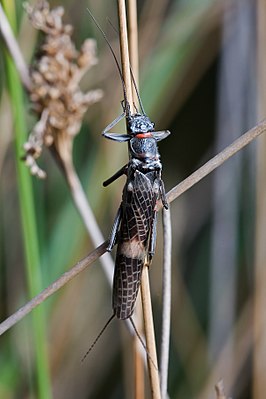
Eusthenia sp. |
| Scientific classification |
|---|
| No rank : | Bilateral symmetrical |
| Subtype : | Tracheo-breathing |
| Infraclass : | Winged insects |
|
| International scientific name |
|---|
Plecoptera Burmeister , 1839 |
|
Content
The larvae of small springflies feed on algae, but most are predators eating larvae of mosquitoes , midges, mayflies and other small invertebrates . In the adult stage, stoneflies, as a rule, do not eat.
The chest tracheal gills [3] , which look like bundles of filaments hanging on the sides of the body, serve as respiratory organs for the larvae of springflies, respiration through the rest of the body plays a secondary role [4] . Springtime larvae prefer flowing, oxygenated water. Unlike most insects, some species of stoneflies have larvae with respiratory pigments - hemocyanin [5] .
Coloring of larvae is yellow-brown or brownish-gray. It is in perfect harmony with the color of the rocky bottom on which insects are held. It is not easy to see a larva sitting motionless on a stone. Adult insects are brown in color, have an elongated, flattened body, and two pairs of dark membranous wings with a developed network of veins that fold flat on the abdomen.
Reproduction of stoneflies occurs in general in the same way as dragonflies . The eggs are very small. Upon hatching, the larvae grow, molt many times, and receive the rudiments of the wings. Due to the great morphological and biological similarity with adult insects, springflies are called imagoids or nymphs . Before turning into adult insects, nymphs are selected on surface objects (stones, tree trunks).
The list is based on the biological project “Tree of Life” [6]
- Suborder Antarctoperlaria
- Eustheniidae Family
- Diamphipnoidae Family
- Family Austroperlidae
- Gripopterygidae Family
- Infrastructure Unit Euholognatha
- Family Capniidae - Capniids
- Leuctridae Family - White - winged Ears
- Nemouridae Family - Nemurids
- Family Notonemouridae
- Taeniopterygidae Family - Springwing Rings
- Infrastructure Systellognatha
- Pteronarcyidae Family
- Styloperlidae Family
- Peltoperlidae Family
- Family Perlodidae - Vesniankovye
- The Perlidae Family - Real Freckles
- Chloroperlidae Family - Light Green Spring
4 species of springflies are listed in the IUCN Red List of Threatened Species, 1 is on the verge of extinction (CR), 2 are vulnerable (VU) and 1 is already extinct [7] :
- Alloperla roberti is an extinct species of spring flies from the family Chloroperlidae [8] [9] . Known only for two adult males, caught in 1860 in the upper Mississippi River in Rock Island County (central-eastern part of North America). Special searches in these places in 1997 were unsuccessful [10] .
- Eusthenia nothofagi is a vulnerable species of spring flies from the Eustheniidae family [11] . Endemic of the extreme southeast of Australia (forests from the Notophagus Cunningham and from the sclerophytic eucalyptus Eucalyptus regnans in the Otway Ranges area) [12] .
- Leptoperla cacuminis is a vulnerable species of spring flies from the Gripopterygidae family [13] , endemic to Mount Kosciuszko in southeastern Australia [14] .
- Riekoperla darlingtoni is a species of spring flies from the Gripopterygidae family that is on the verge of extinction [15] . Endemic to streams and surroundings in the Mount Donna Buang region in the extreme south-east of Australia [16] .
- ↑ Vesnyanki / Ryazanova G.I. // Grand Duke - Ascending node of the orbit. - M .: Great Russian Encyclopedia, 2006. - P. 208. - ( Great Russian Encyclopedia : [in 35 vols.] / Ch. Ed. Yu. S. Osipov ; 2004—2017, vol. 5). - ISBN 5-85270-334-6 .
- ↑ Zhang Z.-Q. "Phylum Athropoda." - In: Zhang Z.-Q. (Ed.) “Animal Biodiversity: An Outline of Higher-level Classification and Survey of Taxonomic Richness (Addenda 2013).” (English) // Zootaxa / Zhang Z.-Q. (Chief Editor & Founder). - Auckland: Magnolia Press, 2013 .-- Vol. 3703, no. 1 . - P. 17-26. - ISBN 978-1-77557-248-0 (paperback) ISBN 978-1-77557-249-7 (online edition). - ISSN 1175-5326 .
- ↑ W. Wichard, H. Komnick. Structure and function of the respiratory epithelium in the tracheal gills of stonefly larvae // Journal of Insect Physiology. - 1974-12-01. - T. 20 , no. 12 . - S. 2397–2406 . - ISSN 0022-1910 . - DOI : 10.1016 / 0022-1910 (74) 90026-2 .
- ↑ NN Kapoor. Some studies on the respiration of stonefly nymph, Paragnetina media (Walker ) // Hydrobiologia. - 1974-01-01. - Vol. 44 , iss. 1 . - P. 37–41 . - ISSN 1573-5117 . - DOI : 10.1007 / BF00036155 .
- ↑ Romolo Fochetti, Maria Angeles Puig, Brunella Gaetani, Valentina Amore. New data on the presence of hemocyanin in Plecoptera: Recomposing a puzzle (Eng.) // Journal of Insect Science. - 2011-01-01. - Vol. 11 , iss. 1 . - DOI : 10.1673 / 031.011.15301 .
- ↑ Tree of Life “ Plecoptera ” Read 2008-01-10.
- ↑ Plecoptera : information on the IUCN Red Book website
- ↑ DeWalt RE, Maehr MD, Neu-Becker U., Stueber G. 2017. Species † Alloperla roberti Surdick, 1981 . Plecoptera Species File Online. Version 5.0 / 5.0.
- ↑ World Conservation Monitoring Center. 1996. Alloperla roberti . The IUCN Red List of Threatened Species 1996.
- ↑ Webb DW, DeWalt RE (1997) A search for Alloperla roberti Surdick in northwestern Illinois (Plecoptera: Chloroperlidae) . Illinois Natural History Survey Center for Biodiversity. 15 p.
- ↑ DeWalt RE, Maehr MD, Neu-Becker U., Stueber G. 2017. Species Eusthenia nothofagi Zwick, 1979 . Plecoptera Species File Online. Version 5.0 / 5.0.
- ↑ Suter P. 2014. Eusthenia nothofagi . The IUCN Red List of Threatened Species 2014.
- ↑ DeWalt RE, Maehr MD, Neu-Becker U., Stueber G. 2017. Species Leptoperla cacuminis Hynes, 1974 . Plecoptera Species File Online. Version 5.0 / 5.0.
- ↑ Suter P. 2014. Leptoperla cacuminis . The IUCN Red List of Threatened Species 2014.
- ↑ DeWalt RE, Maehr MD, Neu-Becker U., Stueber G. 2017. Species Riekoperla darlingtoni (Illies, 1968) . Plecoptera Species File Online. Version 5.0 / 5.0.
- ↑ Suter P. 2014. Riekoperla darlingtoni . The IUCN Red List of Threatened Species 2014.
- Loskutova O.A. Vesnyanka. (Fauna of the European Northeast of Russia. T. 9). - SPb. : Science, 2006 .-- 224 p. - ISBN 5-02-026263-3 .
- Cherchesova S.K., Zhiltsova L.A. Key to springies (Plecoptera) of the Caucasus. - ICCA them. K.A. Timiryazev. - M., 2006 .-- 103 p.

