Philip I the Beautiful ( Spanish: Felipe I de Habsburgo el Hermoso ; July 22, 1478 , Bruges - September 25, 1506 , Burgos ) - Duke of Burgundy under the name Philip IV (since 1482 ) and King of Castile under the name Philip I (since 1504 ), the first representative of the Habsburg dynasty on the Spanish throne.
| Philip I the Beautiful | |||||||
|---|---|---|---|---|---|---|---|
| Felipe el hermoso | |||||||
 | |||||||
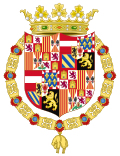 | |||||||
| Predecessor | Isabella I | ||||||
| Successor | Juana Mad | ||||||
| |||||||
| Predecessor | Maria | ||||||
| Successor | Charles II | ||||||
| Birth | July 22, 1478 Bruges , Flanders | ||||||
| Death | September 25, 1506 (aged 28) Burgos , Castile | ||||||
| Burial place | Royal Chapel in Granada | ||||||
| Kind | The Habsburgs | ||||||
| Father | Maximilian I | ||||||
| Mother | Maria Burgundy | ||||||
| Spouse | John the Mad | ||||||
| Children | 1. Eleanor of Austria 2. Charles V 3. Isabella of Austria 4. Ferdinand I 5. Mary of Austria 6. Catherine of Austria | ||||||
| Religion | |||||||
| Awards |
| ||||||


Youth
Philip was the son of the Austrian Archduke Maximilian I , the future emperor of the Holy Roman Empire , and Mary of Burgundy , the heiress of the possessions of the Burgundy house . He received his name in honor of the great-grandfather of the Duke Philip the Good .
In 1482, Philippe's mother unexpectedly died on a hunt, and he inherited a huge and rich Burgundy state , which included, in addition to the duchy of Burgundy itself, Brabant , Limburg , Luxembourg , Artois , Franche-Comté , Flanders , Gennegau , Holland , Namur , Geldern and a number of other flaxes in France and the empire. The guardian of the young duke was his father Maximilian of Habsburg.
Board in Burgundy
Although Maximilian took custody of Philip, the establishment of a regency was denied to him by the estates of the Burgundian state. Unlike the young duke, Maximilian did not enjoy the support of a significant part of the nobility and cities of the Netherlands . The conflict between Maximilian and the estates opposed to his rule was complicated by the claims of the French king Louis XI on the inheritance of Mary of Burgundy. Under a treaty in Arras in 1482, Franche-Comté and Artois were ceded to France.
This freed the hands of Maximilian to fight the Flemish estates, whose speeches have already developed into an open rebellion demanding the expansion of self-government of the Netherlands. The main centers of the rebels were the cities of Ghent and Bruges . In the latter, for some time, the Duke Philip was captured by the rebels. The struggle between Maximilian and the cities continued without much success on one side or the other until 1494 , when Maximilian, who became Emperor of the Holy Roman Empire in 1493 , officially transferred power over the Netherlands and Burgundy to his son Philip, who, in turn, promised to respect the rights and privileges of estates and protect the legitimate interests of Flemish cities.
Shortly before this, in 1493, the Sanlis Treaty was concluded with France, according to which Franche-Comté and Artois returned to the Duke Philip, and the French king received Picardy and the Duchy of Burgundy proper. This agreement settled the Franco-Habsburg dispute over the Burgundian inheritance and confirmed the transfer of the Netherlands to the Habsburgs.
The sole rule of Philip the Beautiful in the Netherlands began in 1494 in a relatively favorable environment. The unrest of the cities ceased, and the power of the sixteen-year-old duke limited the council, which included the leading barons of the Burgundian state. However, the support provided by Philip Perkin to Warbeck , an impostor claiming the English throne, seriously undermined Anglo-Burgundian relations and led to the relocation of the British wool trading center from Antwerp to Calais .
In response, the Duke Philip imposed an embargo on the import of wool and iron from England into his possessions. The conflict had an extremely negative effect on the economy of both England and the Netherlands, and caused a new increase in discontent in the Flemish cities, which lost their raw materials for their weaving industry.
Under pressure from the Flemings and his father, who was interested in English support against France in the Italian wars that had begun, Philip made peace with Henry VII in 1496 and entered into a comprehensive trade agreement with England, known as Intercursus Magnus . This treaty formalized the long-term Anglo-Burgundian military-political union and established freedom of trade between the two countries. A personal meeting between Philip and King Henry VII in Calais in 1500 was evidence of the establishment of strong friendly relations between England and Burgundy.
Another important event of the reign of Philip in the Netherlands was his marriage on October 20, 1496 to the infante Juan , daughter of Isabella , Queen of Castile , and Ferdinand II , king of Aragon .
The sister of Philip Margarita the following year married the heir of Isabella and Ferdinand Juan of Aragon . These marriages formed the basis of the dynastic union of Spain and the Habsburg house, directed against France . After the death of Juan of Aragon in 1497 , his older sister Isabella in 1498 and her son Miguel in 1500 , the wife of Philip the Beautiful became the only heir to the thrones of Castile and Aragon, which created the prospect of creating a huge Habsburg empire, including, in addition to Austria, the Netherlands and Burgundy, most of the Iberian Peninsula and overseas possessions.
Board in Spain
In 1502, Philip and his wife Juan of Castile traveled to Spain . The Cortes of Castile recognized John as heir to the throne and took her oath of allegiance. In Aragon , however, the estates refused to confirm her inheritance rights, relying on the possibility of having a son with King Ferdinand II. The Aragonese also negatively viewed the prospect of the coming to power of Burgundian and Dutch advisers and Philip's associates.
The situation was complicated by the fact that Juan’s mental illness, reinforced by her jealousy, became apparent. Infanta periodically fell into a state of depression , turning into outbursts of furious rage. Relations between the spouses became increasingly tense and soon they began to live separately. In 1503, Philip and his eldest son Carl returned to the Netherlands, leaving Juan in Madrid , who at that time was pregnant with her second son Ferdinand .
On November 26, 1504, Isabella, Queen of Castile , died. In the will, she named Juan as her heiress, establishing that in the event of her inability to manage the kingdom due to her health, Ferdinand of Aragon should have become regent before reaching the age of majority, the eldest son of Juana and Philip. However, Philip the Beautiful himself put forward his claims to the regency. He managed to secure the support of France and the Castilian estates. Ferdinand was forced to abandon claims for regency in exchange for the right to receive half of the income from Granada . The queen of Castile was recognized by Juan, and Philip became co-regent and regent.
His attempts to completely remove Juan from power were unsuccessful due to the resistance of the Cortes. Having no solid support in Spain, Philip generously distributed privileges and lands to the local aristocracy and his Flemish associates, which led to some weakening of royal power in the country. Philip I was a stranger to religious fanaticism; if he ruled Spain for longer, then there is reason to believe that he would curb the brutality of the Inquisition .
In January 1506, on the way to Spain from the Netherlands, the ship of Philip wrecked off the coast of England. Once in the power of the English king Henry VII , Philip was forced to make several concessions in Anglo-Dutch trade relations, hand over to England the last leaders of the York Party , who took refuge in the Burgundian possessions and promise military assistance in the event of a French attack on England. In exchange, he received his recognition by the king of Castile and a military alliance in the event of a threat to his rights by Aragon. After negotiations with Henry VII were completed, Philip resumed sailing and arrived in La Coruna on April 28, 1506, bringing with him a detachment of German mercenaries to deal with Ferdinand of Aragon's claims to Castile.
On June 27, 1506, between the Philippe and Ferdinand, the Villafafil Treaty was concluded, according to which Philip was officially recognized as the king of Castile, and Juan the Mad was actually removed from power.
The reign of Philip in Castile, however, was short-lived: after drinking cold water after playing the ball, the king caught a cold and died on September 25, 1506 at the age of twenty-eight.
After his death, Juan finally lost her mind, and the regency in Castile passed to her father, Ferdinand of Aragon. The heir to the Burgundian possessions of Philip and the future king of Spain and the emperor of the Holy Roman Empire was his eldest son Karl .
Body Burial Issues
- See Juan Mad
The wife of Philip, before delivering her husband’s body to the royal tomb in Granada , traveled around the country with an unusually long time, which caused persistent rumors about her mental illness.
Marriage and children
- (1496) John the Mad (1479-1555), Queen of Castile and Leon (c 1504):
- Eleanor (1498-1558), married (1518) to Manuel I , king of Portugal , second marriage (1530) to Francis I , king of France ;
- Charles V (1500–1558), emperor of the Holy Roman Empire (1519–1556), king of Spain (1516–1556) [1] ;
- Isabella (1501-1525), married (1515) to Christian II , king of Denmark , Norway and Sweden ;
- Ferdinand I (1503-1564), emperor of the Holy Roman Empire (since 1558), king of the Czech Republic and Hungary (since 1526), Archduke of Austria (since 1521);
- Mary (1505-1558), married (1522) to Louis II , king of the Czech Republic and Hungary ;
- Catherine (1507-1578), married (1525) to João III , king of Portugal .
Eleanor
Carlos (Charles V) .
Isabella
Ferdinand I
Maria
Catherine .
Genealogy
In philately
Philippe the Beautiful is depicted on the 1996 Belgian postage stamp.
Notes
- ↑ Charles V // Military Encyclopedia : [in 18 vol.] / Ed. V.F. Novitsky [et al.]. - SPb. ; [ M. ]: Type. t-va I. D. Sytin , 1911-1915.
| Predecessor Maria Burgundy | Duke of Burgundy , Brabant , Luxembourg , Count of Burgundy , Flanders , Genenegau , Holland and Zealand 1482 - 1506 | Successor Charles V |
| Predecessor Isabella I | king of castile 1504 - 1506 Co-ruler: Juan the Mad | Successor Juana Mad |