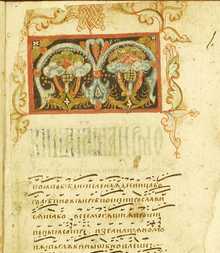
Irmós ( church-glory Іrmos [[1] Greek εἱρμός - interweaving, connection), in Byzantine and Russian Orthodox worship is the first stanza in each of the nine canon songs , in which sacred events or persons are glorified [2] . Irmos serves as a melodic - metrical model for the subsequent stanzas ( troparians ) of a given song. Hirmos' hymnographic texts (mainly paraphrases of the Holy Scriptures ). Musically, the irmos obey the osmogony system.
On the Sunday canon, the praises of the irmos alternate in every voice with the prayer-mournful irmos. Praiseworthy Hirmos encompass the entire system of Christian doctrine and speak of the creation of the world (mostly the 3rd rhythm), the Incarnation of the Son of God (mostly the 4th, sometimes the 4th and 5th, and sometimes the 3rd), the Church (3 or 4th). Through the images of the songs of the prophets Isaiah and Jonah, the Hirmos express the desire of the soul to the light of Christ , in the 6th Hirmos there are prayers for deliverance from the sinful abyss and suffering. Irmos 1st, 7th and 8th songs are also devoted to the representative events of the Old Testament. The 9th Hirmos glorifies the Mother of God in all canons [2] . The liturgical compilations (books) of the irmos have been known since ancient times, they are called the name of the thermologists .
Notes
- ↑ Complete Church Slavonic Dictionary (Archpriest G. Dyachenko) p. 237
- ↑ 1 2 Liturgy.RU Archival copy dated August 24, 2007 on Wayback Machine
Literature and music editions
- Velimirovič M. The Byzantine Heirmos and Heirmologion // Gattungen der Musik in Einzeldarstellungen. Bern, Munich, 1973.
- The curriculum of the Regency School at the Moscow Theological Academy, for a mixed choir. Sergiev Posad, 2009.