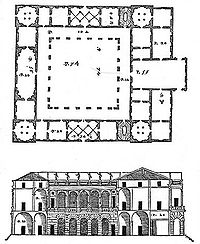
Palazzo Thien ( Italian: Palazzo Thiene ) - a palace in the city of Vicenza , built in 1550-1551 by the great Italian architect of the late Renaissance Andrea Palladio .

The future founder of palladianism and classicism in this of his early work is quite restrained. Carefully studying the “Ten Books on Architecture” by Vitruvius and developing his idea of a house with an atrium and peristyle, the architect created a new type of city palace - the palazzo. In the early works in Vicenza, the Palazzo Thien (1550–1551) of Iseppo da Porto (1552), the Paladio is still close to the Florentine palazzo of the 15th century, but already in these works they demonstrate a subtle understanding of the architectonics of the order. In 1994, the palace was listed as a UNESCO World Cultural Heritage Site . Now the building of the palazzo contains an art gallery, which presents works from the 15th to the 19th centuries , 300 engravings of the 18th century , the first printed books, there is also a section on ceramics and sculpture.
Content
Construction History
The original Gothic building was built in 1490 by the architect Lorenzo da Bologna . Its eastern facade was made of brick, and above the portal was a Venetian pink marble window by Tommaso da Lugano . In 1542, the brothers Marcantonio and Adriano Thiene decided to reconstruct the family palace and turn it into a huge residence measuring 54 by 62 meters. According to their idea, the facade of the building was to be facing the main street of Vicenza (now it bears the name Palladio). The likely creator of the original palace design in 1542 was Giulio Romano , but already during construction, in 1544 , when Romano died, it was redesigned by Andrea Palladio. The architectural elements of the Palazzo Tienne, which are attributed to Romano and which are clearly alien to the Palladian style, are easily recognizable. The palace features a four-column atrium, which brings to mind the similar atrium of the Palazzo Te , despite the fact that Palladio changed its arches. Romano also owns the windows and facades of the lower floors facing the street and the courtyard, while Palladio introduced his features in the entablature and capitals of the upper floors [1] .
General view of the courtyard.
Portal.
A fragment with a view of the entablature and capitals on the second floor , probably Palladio.
Of the many buildings of the Palladio in Vicenza, the Palazzo Thienne is the “least palladian-style building”, gravitating rather to the architecture of Rome and Mantua (probably the Palladio built the Palazzo Thienne under the influence of the works of Giulio Romano from Mantua) and focusing on his project [2] . Construction work was very slow. In 1552, Adriano Thiene died in France, and subsequently, as a result of family interests, moved to Ferrara when Giulio Thiene (son of Marcantonio) became the Marquis of Scandiano. As a result, only a small part of the grandiose Palladio project was implemented [1] .
Interesting Facts
- Having designed the famous Tarasov House on Spiridonovka Street, Moscow architect Ivan Vladislavovich Zholtovsky borrowed the shapes of the street facades and the structure itself from the Palais Tienne. Strictly symmetrical, lacking entrance doors, the facade along Spiridonovka almost literally reproduces the facade of the Palais Tienne. The only change in copy relative to the prototype is the increased height of the first floor. Following the proportions of the Doge's Venetian Palace , Zholtovsky made the first floor 1/13 taller than the second - thus the upper floor is perceived to be lightweight relative to the massive first floor. How and why Zholtovsky chose the Thienne palazzo as a model of the facades remains unknown [2] .
Notes
- ↑ 1 2 Palazzo Thiene description and photo. Italy: Vicenza
- ↑ 1 2 Sedov, V. Tarasov Mansion in Moscow // Project Classic. - 2007. - No. XXI-MMVII - 06/01/2007 .