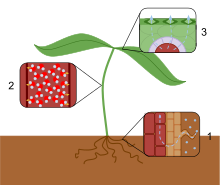
1 - Water is absorbed by the roots and enters the xylem .
2 - Water rises up xylem.
3 - From the xylem, water enters the mesophilic cells and evaporates from the surface of the plant through the stomata .
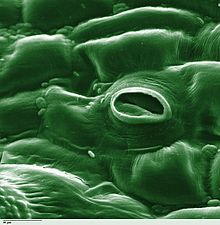
Transpiration is the process of moving water through a plant and its evaporation through the external organs of a plant, such as leaves , stems and flowers . Water is necessary for the life of the plant, but only a small part of the water entering through the roots is used directly for the needs of growth and metabolism . The remaining 99-99.5% is lost through transpiration. The surface of the leaf is covered with pores called stomata and in most plants most stomata are located on the lower part of the leaf. The stomata are limited by closure cells and accompanying cells (collectively known as the stomatal complex), which open and close the pores. Transpiration passes through stomatal fissures and can be considered as a necessary “price” associated with opening stomata for access of carbon dioxide , necessary for photosynthesis . Transpiration also cools the plant, alters the osmotic pressure in the cells and ensures the movement of water and nutrients from the roots to the shoots.
Water is absorbed by the roots from the soil with the help of osmosis and moves upward in the xylem along with the nutrients dissolved in it. The movement of water from roots to leaves is partially ensured by the capillary effect , but mainly due to the pressure difference. In tall plants and trees, gravity can be overcome only by reducing the hydrostatic pressure in the upper parts of the plant due to the diffusion of water through the stomata into the atmosphere .
Cooling is achieved by evaporation from the surface of the plant water, which has a high specific heat of vaporization .
Regulation
The plant regulates its level of transpiration by changing the size of the stomatal crevices. The level of transpiration is also affected by the state of the atmosphere around the leaf, humidity, temperature and sunlight, as well as the state of the soil and its temperature and humidity. In addition, one must take into account the size of the plant, which determines the amount of water absorbed by the roots and, subsequently, evaporated through the leaves.
| Feature | Effect on transpiration |
|---|---|
| Number of leaves | The more leaves, the larger the evaporation surface and the greater the number of stomata for gas exchange. This increases water loss. |
| Number of stomata | The more stomata on a leaf, the more water the leaf evaporates. |
| Sheet size | A leaf with a larger area evaporates more water than a leaf with a small one. |
| The presence of a plant cuticle | The wax-like cuticle film is poorly permeable to water and water vapor and reduces evaporation from the surface of the plant, with the exception of evaporation through the stomata. The shiny surface of the cuticle reflects the sun's rays, reducing leaf temperature and evaporation [1] . Small hairs ( trichomes ) on the leaf surface also reduce water loss, creating a zone of high humidity near the surface [1] . Such devices for water conservation can be observed in many plants from arid places - xerophytes . |
| CO 2 content | In many plants, a decrease in the level of carbon dioxide in the air leads to an increase in the turgor of the trailing cells and the opening of stomata [2] . |
| Light level | In addition to lowering the level of carbon dioxide during photosynthesis, light can also have a direct effect on trailing cells, causing them to swell [2] . |
| Temperature | An increase in temperature increases the rate of evaporation and decreases the relative humidity of the environment, which also increases the loss of water. |
| Relative humidity | Dry air around the leaves increases transpiration. |
| Wind | In stagnant air near the evaporation surface, an area with high humidity forms, which slows down the loss of water. |
During the growing season, the leaf can evaporate an amount of water many times its own weight. One hectare of wheat sowing evaporates during the summer of 2000-3000 tons of water [3] . In agriculture, they use the concept of transpiration coefficient , this is the ratio between the spent mass of water and the increase in dry mass. Typically, it ranges from 200 to 600 [3] (1000) [4] , that is, from 200 to 1000 liters of water are needed to form one kilogram of dry mass of agricultural crops.
Many techniques and instruments exist for measuring plant transpiration, including potometers , lysimeters , porometers , and thermometric sensors. To measure evapotranspiration, mainly isotopic methods are used [5] . Recent studies [6] show that water vaporized by plants differs in isotopic composition from groundwater.
Desert plants have special tools to reduce transpiration and preserve water, such as a thick cuticle, a reduced leaf area and hairs on the leaves. Many of them use the so-called CAM photosynthesis , when the stomata are closed during the day and open only at night, when the temperature is lower and the humidity is higher.
Notes
- ↑ 1 2 Plant Life / Ed. prof. ON. Krasilnikova, prof. A.A. Uranova. - M .: Education, 1974. - T. 1. - 487 p.
- ↑ 1 2 Gelston A., Davis P., Satter R. Life of a green plant . - M .: Mir, 1983 .-- 549 p.
- ↑ 1 2 Water regime of plants / N. A. Maksimov // Great Soviet Encyclopedia : [in 30 vol.] / Ch. ed. A.M. Prokhorov . - 3rd ed. - M .: Soviet Encyclopedia, 1969-1978.
- ↑ Martin, J .; Leonard, W. & Stamp, D. (1976), Principles of Field Crop Production (Third Edition) , New York: Macmillan Publishing Co., Inc., ISBN 0-02-376720-0
- ↑ Jasechko, Scott; Zachary D. Sharp, John J. Gibson, S. Jean Birks, Yi Yi & Peter J. Fawcett. Terrestrial water fluxes dominated by transpiration (English) // Nature: journal. - 2013 .-- 3 April ( vol. 496 , no. 7445 ). - P. 347-350 . - DOI : 10.1038 / nature11983 . - PMID 23552893 .
- ↑ Evaristo, Jaivime; Jasechko, Scott; McDonnell, Jeffrey J. Global separation of plant transpiration from groundwater and streamflow (Eng.) // Nature: journal. - 2015 .-- 3 September ( vol. 525 , no. 7567 ). - P. 91-94 . - ISSN 0028-0836 . - DOI : 10.1038 / nature14983 .