Kill van Kull is a strait in New York State between Staten Island and the Bergen Neck Peninsula.
| Kill van kull | |
|---|---|
| English Kill van kull | |
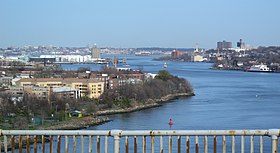 View of Kill van Kull from Beyonne Bridge in April 2010 | |
| Specifications | |
| Width | 0.3 km |
| Length | 4.8 km |
| Location | |
| Upstream water area | Atlantic Ocean |
| Separates | Staten Island , Bergen Neck |
| Extreme cape | Bergen point |
| A country |
|
| State | New York |
| County | New York |


History
According to a study conducted in 1981 by US engineering forces , the strait apparently formed after the glaciers descended in the Pleistocene [1] .
In Kill van Kull, along with the Arthur Kill Channel, oysters were actively bred and mined until the beginning of the 20th century. So, in the 19th century, in order to meet the growing demand of oysters, New York straits were imported from the backwaters of Virginia . In the 1850s, about a thousand workers were employed in the extraction of oysters [2] . In 1916, due to contamination of the strait with sewage, the oysters of Kill van Kull were struck by the epidemic of typhoid. This led to a significant reduction in their numbers. In January 1920, The New York Times wrote:
Oysters, once abundant and considered to be affordable food, are gradually moving into the luxury category and will soon become a delicacy.
Original textOysters, once plentiful and considered a frugal repast, are gradually being classed as luxuries and will soon become a delicacy [3] .
Description
The strait is about 5 kilometers long and about 300 meters wide. Kill Van Kull connects Upper New York Bay and Newark .
Through the strait passes Beyonnes bridge . Kill van Kull is the busiest waterway in the region: oil tankers and container ships regularly go from Newark Elizabeth Port to it.
The name of the strait is of Dutch origin and translates as “channel from the lowland” [4] .
Notes
- ↑ United States. Army. Corps of Engineers. Kill Van Kull Navigation Project, Newark Bay (NY, NJ): Environmental Impact Statement. - 1981. - P. B-3. - 1172 p.
- ↑ Edwin G. Burrows, Mike Wallace. Gotham: A History of New York City to 1898. - N. Y .: Oxford University Press, 2000 .-- P. 662. - 1383 p. - (The History of NYC Series). - ISBN 978-0-19-514049-1 .
- ↑ Mark Kurlansky. The Big Oyster: A Molluscular History of New York. - Random House, 2009 .-- P. 262. - 336 p. - ISBN 1409077934 .
- ↑ New Jersey Historical Society. New Jersey History. - 1925. - P. 245.
Literature
- Gerard R. Wolfe. Kill van Kull // The Encyclopedia of New York City / Kenneth T. Jackson, Lisa Keller, Nancy Flood. - 2. - Yale University Press, 2010. - P. 698-699. - 1584 p. - ISBN 0300182570 .