Mountain Philately [1] , or Frost's Philology [2] ( lat. Philoria frosti ) - a species of frogs from the genus of philoria . It is listed in the Red Book as a species that is on the verge of extinction according to the Warranty Act on Flora and Fauna of 1988 and the Act on the Protection of the Environment and Biodiversity of 1999 . Endemic to the Baw Baw Plateau, mainly in the National Park, located in the Australian state of Victoria [3] . First described by zoologist Walter Spencer in 1901. A specific Latin name is given in honor of the Australian naturalist Charles Frost (1853-1915) [4] .
| Mountain philately |
 |
| Scientific classification |
|---|
| No rank : | Bilateral symmetrical |
| Squad: | Tailless Amphibians |
| Subfamily : | Limnodynastinae |
|
| International scientific name |
|---|
Philoria frosti Spencer , 1901 |
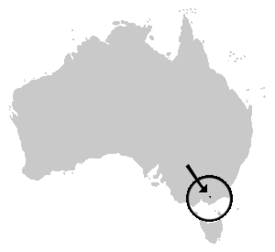
| Philoria frosti is found in only one place in Victoria |
|---|
|
| Security status |
|---|
Endangered SpeciesIUCN 3.1 Critically Endangered : 16997 |
|
The species range covers only about 135 km² [3] at altitudes of 900-1564 m above sea level. The adult frog has a length of 45-52 mm, the females are slightly larger than the males [5] . Body color is dark brown, abdomen with light brown or dark yellow spots. Behind each eye is a well-defined parotid gland . There are no membranes between the fingers. Tadpoles have a creamy white color, without pigmentation, have a large yolk sac , atrophied oral opening and do not feed until metamorphosis [6] .
In 1983, the number of the species was estimated at 10,000-15,000 adult males and did not cause much concern, in 2002 there were already about 7,000 of them (the count was carried out according to the number of votes during the mating season, so only mature males could be counted) [7] . Currently, the population of this frog is estimated at about 750 individuals, and according to some reports - less than 250. The exact reason for the disappearance of the species is unclear [3] .