Despite an area of just 0.9 km², [1] The Old City of Jerusalem is the location of many sites of fundamental religious significance. The shrine for the Jews is the Temple Mount and its Western Wall (“Boiler”); for Muslims - mosques on the Temple Mount (religious architectural complex Al-Haram al-Sharif ), and for Christians of all faiths - the Church of the Resurrection of Christ (Church of the Holy Sepulcher) and many churches erected where the foot of Jesus set foot. The 2000 Jerusalem Statistical Yearbook lists 1204 synagogues, 158 churches, and 73 mosques within the city. [2]
As a result, Jerusalem has a very special status for adherents of Abrahamic religions, as the location of the shrines of Judaism , Christianity and Islam . Jerusalem is a holy city for Judaism for approximately 3,000 years, for Christianity for about 2,000 years, and for Islam for about 1,400 years. The holy place common to all three religions is the Temple Mount. [3] Despite efforts to maintain peaceful religious coexistence, objects such as the Temple Mount are a constant source of friction and controversy.
Jerusalem in Judaism
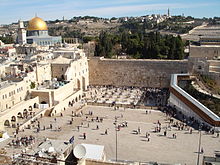
Jerusalem is the holiest city, the city of ancestors, the spiritual homeland and the center of the Jewish people from the 10th century. BC. - from the moment that King David proclaimed it his capital (the capital of the united kingdom of Israel ). [4] According to Jewish tradition, this is the place where the Divine presence is most fully manifested in our world. The holiest place in Jerusalem is the Temple Mount. Here is the stone from which the foundation of the world began. In the period of classical antiquity, Jerusalem was considered the center of the world in which God dwells. [five]

| “ | God said: take your only son you love, Isaac; and go to the land of Moriah [Jerusalem] and there bring it as a burnt offering on one of the mountains [Temple Mount], which I will tell you about. " | ” |
- Genesis 22: 2 | ||
Jerusalem has long been rooted in Jewish religious consciousness. The Jews studied and projected upon themselves the struggle of King David for the possession of Jerusalem and his desire to build a Jewish temple there , as described in the Book of Samuel and Psalms . Many of David's wailing about Jerusalem became part of popular prayers and songs. Synagogues around the world are traditionally building with the Holy Ark facing Jerusalem, [6] while the Arks in Jerusalem themselves are facing the Holy of Holies . [7] Jews believe that in the future, the restored Jerusalem Temple will become a center of worship and enlightenment for all of humanity, and therefore Jerusalem will become the spiritual center of the world. [eight]
The city has a special status in Jewish religious law . Maaser sheny [ unknown term ] , roars [ unknown term ] and bikurim (first fruits) must be eaten in Jerusalem. Any increase in the size of the city for these purposes must be agreed upon by the Sanhedrin . At the conclusion of the Seder Passover and service on Yom Kippur , outside Jerusalem, the words "Next year - in Jerusalem" are spoken. In Jerusalem itself, the Seder Passover may end with the words “Next year - in Jerusalem, revived” - probably referring to the Temple, destroyed two millennia ago. Reassuring the grieving, the Jews say, “May God comfort you among all those who grieve over Zion and Jerusalem.”
In Jewish Religious Texts
In the first section of the Tanakh (Jewish scripture) - the Torah , or the Pentateuch - Jerusalem is not mentioned [9] . Instead, Jerusalem refers to Jerusalem as the place God will choose. Maimonides quotes various reasons why this is so - and the first of them is that if the nations of the world knew that this place was destined to become the center of the highest religious ideals, they would occupy it to prevent Jews from ever getting control over him. [ten]
The earliest tradition associated with Jerusalem states that Adam, the first man, was created from the same piece of land on which the altar of the Jerusalem Temple was to appear in the future. After being expelled from the Garden of Eden, he returned to this place to offer a sacrifice to God; it is believed that Adam lived in Jerusalem all his life. Cain and Abel also placed their offerings on this Altar. The Jerusalem Altar remained an unchanged sanctuary, in which all peoples could worship, until its destruction by the flood . After the flood, Noah restored it. The Bible indicates that Noah blessed his son Shem - this meant that Jerusalem would be included in the inheritance of the latter. Shem and his descendants lived in Jerusalem and founded an academy there, where the word of God was taught. When the city became large enough to need government, Shem was crowned king and received the title "Malchi Tsedek." Zedek , meaning “righteousness,” is the term used to refer to Jerusalem.
In ancient times, the city was divided - “Lower City” was located in the east and “Upper City” - on a higher hill to the west. The eastern part was called Salem, while the upper, including the location of the Altar and identified with the Temple Mount in Jerusalem, was called the Land of Moriah. 340 years after the flood, the Canaanite tribes launched an invasion of the Holy Land , the Amorites occupied the western Upper City and subsequently destroyed the Altar. Sim and his people retained control of the Lower City and supported the activities of the academy there. Some legends say that as a young child, Abraham went to Jerusalem to study tradition with Noah and Shem. Later, God told Abraham to leave Mesopotamia and return to the Promised Land . After Abraham defeated the war he was drawn into, Shem blessed him. Soon after, east Jerusalem - Salem - began to pass under the rule of the Philistines who occupied this region. To reach peace with them, Abraham went to negotiate with their king Abimelech , who assured him that the Academy of Shem was safe. When the son and heir of Abraham Yitzchak was born, Abimelech turned to Abraham to make a covenant between them. The agreement stipulated that until at least one descendant of Abimelech inhabited the country, not a single descendant of Abraham would undertake a war against him. This covenant was in the future to become the reason that the Israelites did not capture the eastern part of Jerusalem.
By ordering Abraham to sacrifice his son , God sent them to Moriah. When it became clear to Abraham where the Altar stood, he restored it and prepared to sacrifice Isaac on it. There he spoke to God. It was after he passed this last test that he took Sim's place as Priest of the Altar on Mount Moriah. Abraham called this place "Yira" or "Yiru" ("Yeru"), which means "reverence." When this name was combined with the name of the eastern part of the city, the city received its current name YeruSalim, which is understood as "absolute reverence for God." Immediately after this, Abraham bought the Cave of the Patriarchs in Hebron from Efron the Hittite, who concluded an agreement with Abraham that his descendants would not take the city of Jerusalem from the Hittites by force. As a result, the western part of the city was ultimately bought by the Israelites from the descendants of Efron. [ten]
In the later parts of the Tanakh, Jerusalem is explicitly mentioned 669 times; Zion, usually meaning “Jerusalem” (sometimes “the Land of Israel ”), is mentioned 154 times. According to biblical tradition , David conquered the city from the Jebusites . He also acquired a plot of land where the Temple Mount is located; here David established an altar, and subsequently - in 960 BC. e. - His son, King Solomon , erected the First Temple . [4] These events, marking the foundation of the city and spanning a period of time around the point of the beginning of the 1st millennium BC, acquired key symbolic significance for the Jewish people.
In the Talmud, the Jewish connection with the city was worked out with great care. For example, the Psalms, which are often read and memorized by Jews for centuries, say:
- "At the rivers of Babylon we sat down and cried when we remembered Zion ... For there they asked us who captivated us about the words of the songs and took us away - about singing:" Sing us from the songs of Zion. How do we sing the song of the Lord in a strange land? If I forget you, Jerusalem, may my right hand be forgotten! May my tongue stick to my larynx, if I do not remember you, if I do not set Jerusalem at the very beginning of my joy. Remember, Lord, the sons of Edom on the day of Jerusalem, saying: "Bust, bust to its foundations." The daughter of Babylon is unfortunate, blessed is he who will repay your retribution, with which you repaid us. Blessed is he who seizes and smashes your babies against a stone! "(Psalm 137: 1-9)
- "God, the peoples came to Your inheritance, desecrated the temple of Your holy, turned Jerusalem into ruins; they gave the bodies of Your servants to be eaten by the birds of the air, the flesh of Yours devoted to wild animals; like their blood poured around Jerusalem." (Psalm 79: 1-3)
- "... O Jerusalem, Jerusalem, built as a city, merged into one ... Ask peace to Jerusalem ..." (Psalm 122: 2-6)
- “The mountains are around Jerusalem, and the Lord is around his people now and forever” (Psalm 125: 3);
- "The Lord builds Jerusalem, gathers the exiles of Israel ... Praise, Jerusalem, the Lord; praise, Zion, thy God" (Psalm 147: 2-12)
Jerusalem is also mentioned many times in the Mishnah and other later Jewish literary sources.
The rabbinical literature contains thousands of references to Jerusalem. Some of them are presented in the following citations:
- He who prays while in the Land of Israel must turn his heart to Jerusalem ... He who prays in Jerusalem turns his heart to the Temple ... He who prays in Jerusalem turns his heart to the Temple ... - Brahot 27a
- Why are the fruits of Ginosar not found in Jerusalem? So that the pilgrims would not say: “If it were our duty only to eat the fruits of Ginosar in Jerusalem, this would be enough” - Psachim 8b
- In the future, the one who is holy will spread Jerusalem to such an extent that the horse will run away and its owner will be able to regain it [while remaining within the city] - Psachim 50a
- Jerusalem was not divided between the tribes - Yoma 12a
- A snake or scorpion has never stung anyone in Jerusalem - Yoma 21a
- He who did not see Jerusalem in its glory did not see the beautiful city in its life. - tract Sukkah 51b
- 10 beauty caves lowered into the world, 9 took Jerushalaim - Our 49b
- Jerusalem is the light of the world - Protects the Slave 59
- Jerusalem will not be restored until the exiles are gathered in it - Tanhuma Noah 11
- The land of Israel is placed in the center of the world, and Jerusalem is placed in the center of the land of Israel - Tanhuma Kdoshim 10
- Why did not the Omnipresent create warm springs in Jerusalem, like those in Tiberias? So that a man does not say: “ Let us rise to Jerusalem in order to bathe” - Sifre Behaalotech 89
- There is no beauty like the beauty of Jerusalem - Avot de Rabbi Nathan 28
- Ten miracles were given to our ancestors in Jerusalem - Avot de Rabbi Nathan 35
- “Of all your tribes” - this is said about Jerusalem, because all Israel is one in it - Avot de Rabbi Nathan 35
- The future of Jerusalem - all nations and all governments will gather in it - Avot de Rabbi Nathan 35
- Everyone who prays in Jerusalem is as if he was praying before the throne of glory, because the gates of paradise are there - Pirkey de rabbi Eliezer 35
- In retribution to Jerusalem, I divided the sea for them - Yalkut Shimoni Isaiah 473
- In the future, the neighborhood of Jerusalem will be filled with precious stones and diamonds, and all of Israel will come and take them - Yalkut Shimoni Isaiah 478
- From the day Jerusalem was destroyed, God does not feel joy until He restores Jerusalem and returns Israel to it - Yalkut Shimoni Crying 1009
In Prayer
The daily prayers in Judaism contain countless references to Jerusalem. In particular, as prescribed in the Mishnah and formalized in Shulchan Aruch , the Amida prayer, read on the usual days of the week three times, should be uttered (by Jews from all over the world outside Jerusalem), turning their faces towards Jerusalem and the Temple Mount. Many Jews have Mizrah signs on their walls that indicate the direction of prayer. [7] [11] The amide contains the following appeal:
"And back to thy city of Jerusalem, according to your mercy, and dwell in it, as you promised; and establish the throne of thy servant David as soon as possible in it; and rebuild [Jerusalem] soon, today, forever. Blessed are you, The Lord, the builder of Jerusalem! ... And may we see with our own eyes how you will return, by your mercy, to Zion. Blessed are you, Lord, who returns your shechinah to Zion! "
The after-meal blessing after eating the food used with bread says the following:
“Have mercy, our Lord God ... over your city - Jerusalem, over Zion, where your glory dwells, over the kingdom of the house of David, your anointed one, and over the great and holy Temple, called by your name. ... And rebuild Jerusalem, the holy city, soon, today. Blessed are you, Lord, rebuilding Jerusalem in mercy. Amen. "
After eating light meals, a thank-you blessing says:
“Have mercy, our Lord God ... over your city - Jerusalem, over Zion, where your glory dwells, and over your altar and over your temple. And rebuild Jerusalem, the holy city, soon, today, bring us there and exalt us with its restoration, and let us partake of its fruits, and rejoice in its virtues, and we will bless you for it in holiness and purity. ”
Jerusalem Temple
The first Temple was destroyed in 586 BC. e. King of Babylon Nebuchadnezzar . After the Persians conquered Babylon, the Jews returned from captivity and built the Second Temple , which lasted over 400 years. [comm. 1] The nickname “holy city” ( עיר הקודש , transliteration 'ir hakodesh ) was probably assigned to Jerusalem in the post- Babylonian period . [12] [13] [14]
The second Temple was completely rebuilt by King Herod (34–7 BC). The Jerusalem Temple , which was one of the most magnificent buildings of its time, became a symbol of Jerusalem, the personification of its power and greatness. The greatest Jewish shrine was completely destroyed in 70 by the Roman commander (later emperor ) Titus . Today, the Western Wall - the rest of the retaining wall of the Temple Mount - is a holy place for Jews, second only to the Holy of Holies on the Temple Mount itself. [15]
The temple of Jerusalem in ancient times was the center of the Jewish world. On the temple territory was located ruled the nation Sanhedrin. The temple service was the center of the celebration of Rosh Hashanah and Yom Kippur. The temple was the center of the Three Pilgrimage Feasts - namely, Passover , Shavuot and Sukkot , when all Jews were charged with the obligation to gather in Jerusalem. In Jerusalem, special laws were enforced regarding the “four species” (plants) on Sukkot and the shofar on Rosh Hashanah. Every seven years, all Jews had to gather in the Temple to listen to the reading of the Torah by the king (Hahel commandment). The forty-nine days of the reckoning of Omer are a reminder of the sacrifice of Omer, which was made in the Temple daily between Passover and Shavuot. The eight-day holiday of Hanukkah marks the re-consecration of the Second Temple after its desecration by Antiochus IV .
Maimonides gives a list of the regulations relating to Jerusalem during the period of the Temple: a dead body must be removed from the city before the next morning; no human remains should be brought into the city; houses in it should not be rented out; “ger toshav” right of residence is not guaranteed [ unknown term ] ; funeral archives are not kept - with the exception of the House of David and the House of Hulda, which have existed since ancient times; planting orchards and fruit trees is prohibited; sowing and plowing are prohibited due to the risk of crop decline; trees are not planted, with the exception of rose gardens that have existed since ancient times; garbage dumps are prohibited due to the threat of parasite infection; beams and balconies cannot hang over public spaces; chimney stoves are prohibited due to smoke; It is forbidden to raise chickens.
The traditions established in the memory of the Temple and Jerusalem
In memory of the destruction of the Temple, many holidays are celebrated, including the Ninth of Ava , the Tenth of Tevet and the Seventeenth of Tammuz .
Some Jewish groups observe several traditions in remembrance of Jerusalem. A tiny amount of ash is touched on the forehead of the Jewish groom before he sets off to become under the wedding canopy . This symbolically reminds him that he would not allow his fun to be “above” the enduring need to remember the destruction of Jerusalem. The well-known tradition of the bridegroom breaking a glass , at the end of the wedding ceremony, with the heel of his shoe, is also connected with the theme of mourning Jerusalem. Some keep the tradition of the groom reading the sentence from the psalms: “If I forget you, Jerusalem, let my right hand be forgotten” (Psalms 137: 5).
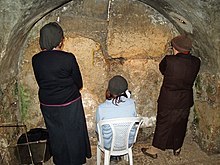
Another ancient tradition is to leave unpainted a section of the inner wall opposite the door to your own, in memory of the destruction ( szekher lehurban ) of the Temple and the city of Jerusalem.
According to Jewish law, in any sign of grief over Jerusalem, it is forbidden to listen to music in any form whatsoever, with the exception of holidays and celebrations, such as the marriage and inauguration of new Torah scrolls. However, this prohibition - although it is formalized in Shulchan Aruch - today is not respected by the vast majority of Orthodox Jews and even Haredim .
The Western Wall in Jerusalem

Jerusalem and prominent rabbis
The Talmud mentions that the rabbinical leader Yochanan ben Zakkai (c. 70 AD) insisted on surrender in order to save Jerusalem from destruction; however, he was ignored because the city was controlled by the Zealots .
An early manifestation of the Jewish desire to "return to Zion" is the journey of Yehuda Halevi , who died around 1140. The Jewish legend tells us that, approaching Jerusalem, he, shocked by the sight of the Holy City, sang the most beautiful of his elegy - the famous Zionid Zion halo Tish 'ali , and that at that moment he was overtaken and killed by an Arab.
Moshe bin Nahman , Ramban , followed, who emigrated to the Land of Israel in 1267 and arrived for a short time to live in Jerusalem. Он писал, что нашёл едва с десяток евреев, поскольку город был опустошён крестовыми походами ; тем не менее, вместе они построили синагогу , - известную, как синагога Рамбана, - которая является старейшей из всё ещё существующих по сей день.
Как Элиягу бен Соломон, известный как Виленский гаон (умер в 1797 г.), так и Израиль бен Элиезер, известный как Бааль Шем Тов (умер в 1760 г.), отправляли, одну за другой, маленькие «волны» своих учеников, с соответствующими наказами, поселиться в Иерусалиме, тогда находившемся под турецким османским управлением. Последние создали еврейскую религиозную инфраструктуру, до сего дня остающуюся стержнем еврейского сообщества харедим в Иерусалиме, ныне руководимого Эда ХаХареидис.
Иерусалим в современном Израиле
Иерусалим является местом нахождения большого числа крупнейших в мире ешив (талмудических и раввинических школ), и превратился в бесспорную столицу еврейской академической, религиозной и духовной жизни для большей части мирового еврейства. Примерами крупных ешив в Иерусалиме являются ешивы Мир и Бриск.
К крупным хасидским династиям , имеющим свои штаб-квартиры в Иерусалиме, относятся Толдос Ахарон, Толдос Аврохом Ицхок, Душинские, Гурская , Белзская, Брацлавская, Карлин-Столинская и Рахмастривская. Большинство этих групп насчитывают в диапазоне от около тысячи до десятков тысяч членов.
Иерусалим в христианстве


Иерусалим считается главным священным городом христиан [16] . Святость Иерусалима для христианства была зафиксирована ещё в Септуагинте [17] , которую христиане восприняли в качестве своего собственного канона. [18] Помимо его роли в Ветхом Завете , огромная важность Иерусалима для христиан определяется его значением для христианства первого века н.э., в период служения Иисуса и эпохи апостолов, как то зафиксировано в Новом Завете ; а также его значением в жизни Иисуса. [19]
Иерусалим в Новом Завете и в период раннего христианства
Согласно Новому Завету, Иисус был привезен в Иерусалим вскоре после своего рождения [20] , чтобы быть представленным в Храме ( Лук. 2:22) и посетить праздники (Лук. 2:41). Согласно каноническим Евангелиям , Иисус проповедовал бедным и исцелял в Иерусалиме, в особенности в храмовом дворе. Иерусалимский историк Дан Мазар в серии статей в Jerusalem Christian Review описал археологические открытия, сделанные на этом участке его отцом, проф. Бенджамином Мазаром – в том числе, ведущие на возвышение ступени I века, на которых могли проповедовать Иисус и его ученики, а также миквы и крестильни, использовавшиеся как еврейскими, так и христианскими паломниками. Согласно Деяниям святых апостолов , события пятидесятницы также происходили на этом участке. Существует также рассказ об очищении Иисусом храма - изгнании разнообразных торговцев вон из священных пределов храмового двора ( Мк. 11:15). [21] Большая часть этой территории была также открыта в процессе раскопок, проводимых старшим Мазаром.

В конце каждого из Евангелий имеются описания Тайной вечери Иисуса в «сионской горнице» в Иерусалиме, его ареста в Гефсимании , суда над ним, распятия его на Голгофе и захоронения неподалёку, его воскресения , вознесения и пророчества о возвращении . Согласно традиции, местом Тайной вечери является Сионская горница , расположенная на втором этаже того же здания на горе Сион , на первом этаже которого находится могила царя Давида. [23] [24] Археолог Барджил Пикснер [22] утверждает, что обнаружил три стены оригинальной постройки, сохранившиеся до сего дня. Место мучительной молитвы Иисуса и предательства – Гефсимания – вероятно, находится где-то возле Церкви Всех наций на Масличной горе . Суд Понтия Пилата над Иисусом мог иметь место в крепости Антония, к северу от территории Храма. Согласно распространённому мнению, внешняя мостовая, на которой вершился суд, находится под монастырём сестёр Сиона. Другие христиане верят, что Пилат судил Иисуса во дворце Ирода на горе Сион.
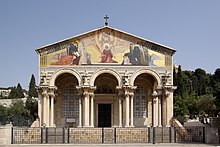
Главные из новозаветных событий - Распятие и Воскресение Господне ; поэтому самым выдающимся христианским объектом в Иерусалиме является Голгофа («Лобное место») – место распятия Христа . Евангелие от Иоанна описывает её, как находящуюся вне Иерусалима. [25] Недавние археологические свидетельства указывают, что Голгофа расположена недалеко от стен Старого города; [26] однако традиционно одним из главных кандидатов на местоположение Голгофы и близлежащей гробницы Иисуса считается территория, ныне занимаемая Храмом Гроба Господня [27] - возможно, самое святое место для христиан, и место их паломничества. [26] [28] [29] Оригинальная церковь была построена Константином I в 336 г. Виа Долороза , или Страстной путь, традиционно считается путём Христа на Голгофу и также является важным объектом паломничества; путь заканчивается в Храме Гроба Господня. Популярным местом паломничества является и Садовая могила возле Дамасских ворот . Чарльзом Джорджем Гордоном было высказано мнение, что именно это место, а не Храм Гроба Господня, является истинным местом нахождения Голгофы.

Деяния святых апостолов и Послания Павла указывают на Иакова Праведного , брата Иисуса, как на лидера ранней иерусалимской церкви. Он и его преемники были центром притяжения иудеев-христиан вплоть до разрушения города императором Адрианом в 135 г. [30] Изгнание евреев из нового города Элия Капитолина привело к назначению епископов из числа не-евреев, под контролем архиепископов Кесарии и, в итоге, Патриарха Антиохии . Общая значимость Иерусалима для христиан вне Святой земли пережила период упадка во времена преследований христиан в Римской империи , но вновь возродилась около 325 г., когда император Константин I и его мать Елена одарили Иерусалим церквями и святилищами, сделав его первостепенным центром христианского паломничества. Согласно церковному историку Сократ Константинопольский [31] ), Елена (оставшаяся в памяти, как святой покровитель археологов ) утверждала, что с помощью епископа Макарий I Иерусалимский нашла Крест Христа , разобрав храм Венеры , построенный поверх соответствующего участка местности. В 325 г. Иерусалим был особо упомянут в VII Каноне Никеи , даже не став ещё столичной епархией. [32]

В середине IV века в Иерусалиме началась византийская эпоха правления, длившаяся до VII века. В этот период было построено большое количество кафедральных соборов, храмов и монастырей по всему округу города Иерусалима. Были открыты теологические кафедры, семинарии и иконописные школы в самом святом для христиан городе. В частности, именно тогда было воздвигнуто первое комплексное архитектурное сооружение вокруг погребальной пещеры Гроба Господнего, Голгофы, Камня Помазания и вдоль всей улицы Виа Долороза. Тогда весь этот комплекс назывался «Святые сады». На каждом святом месте было воздвигнуто по храму, монастырю или часовне. Так, были воздвигнуты монастыри в честь первых христианских мучеников и святых Ветхого Завета: пророка Илии, пророка Иоанна Крестителя, св. Анны, св. Харлампия, св. Стефана, св. Иакова, монастырь Успения Богородицы, монастырь святых Константина и Елены, монастырь Честного Креста, и многих других. Также был построен комплексный монастырь «Святой Софии» на Храмовой горе, где находился разрушенный Иерусалимский храм.
Последующие периоды
В средние века христиане считали, что Иерусалим является центром мира (латинское umbilicus mundi , греческое Omphalos ); именно так город представлялся на так называемых картах Т-О . В византийских гимнах говорится о Кресте, «растущем из центра земли», а образные решения привязаны к концепции смерти и воскресения Иисуса, как направленных во благо всего человечества. На средневековых картах Европы восток («ориент») – Иерусалим - обычно помещался наверху; именно такое расположение привело к использованию термина «ориентировать», что значит «соотносить карту с фактическим направлением по компасу». Небесный Иерусалим является центром видения, описанного в конце Откровения Иоанна Богослова : Совершенный Город, в котором Бог живёт среди своего народа.
С 1099 по 1187 , а также с 1229 по 1244 гг. Иерусалимом владели европейские крестоносцы . Именно они построили в Старом городе большинство церквей и храмов и значительно перестроили уже имевшиеся в тех местах, которые связаны с библейскими событиями.
В 1173 году в Иерусалиме умерла Ефросинья Полоцкая . После канонизации она стала считаться покровительницей Полоцка , а позднее и всей Белоруссии [33] .
В Иерусалиме похоронен Шота Руставели .
Отказ Османской империи предоставить России право распоряжаться христианскими храмами в Иерусалиме и Вифлееме послужил поводом к Крымской войне [34] .
Название города повторяется в названиях многих русских церквей и монастырей ( Воскресенский Ново-Иерусалимский мужской монастырь и т. д.).
В Иерусалиме представлены множество христианских церквей : католическая , греко-православная , армянская , русская православная , сирийская , эфиопская , маронитская католическая , и другие [35] . Традиционными католическими хранителями святых мест являются францисканцы . На 2009 год, по данным иерусалимского института изучения Израиля, из 14 тысяч христиан города, 2.6 тысяч — духовенство и монахи [36]
Иерусалим как аллегория церкви
В христианстве Иерусалим иногда интерпретируется как аллегория или тип Церкви Христовой. Существует колоссальная апокалиптическая традиция, фокусирующаяся на Небесном Иерусалиме вместо фактического и исторического города. Христиане не контролировали реальный город со времён Крестовых походов (за исключением короткого периода сразу же после битвы за Иерусалим ) и полагались в основном на библейские символы и метафоры, описывающие Церковь, как если бы она была истинным живым Иерусалимом. Эта точка зрения заметным образом отстаивается в « О Граде Божьем » Августина, популярной христианской книге V века, которая была написана в период падения Западной Римской империи .
Иерусалим в исламе


| “ | Зейд ибн Сабит сообщает, что Пророк сказал: «Туба для Шама!” Мы спросили: «Почему, о посланник Аллаха?» Он ответил: “Потому что ангелы Милостивого расстилают над ним свои крылья!» Ибн Аббас добавил: «и Пророки жили в нём. Нет ни единого дюйма в аль-Кудсе (Иерусалим), где не молился Пророк или не стоял ангел». | ” |
— хадис Тирмизи (составлено между 864/5-884) | ||

| “ | «Выше всего и вся Тот, Кто перенес раба Своего ночью из священной мечети в мечеть отдаленную, вокруг которой присутствует Божественная благодать.» | ” |
— аль-Исра 17:1 | ||
| “ | «Не следует отправляться в путь (никуда), если не считать трёх мечетей: Заповедной Мечети, мечети посланника и Отдалённейшей мечети.» | ” |
— Рассказано по Абу Хурайра , спутнику пророка Мухаммада [37] | ||
Мусульманами Иерусалим был завоеван в 638 году . Для суннитского ислама Иерусалим является третьим по святости городом, после Мекки и Медины . [38] [39] Часть значимости Иерусалима и его святости для мусульман происходит от его тесной связи с Авраамом , Давидом , Соломоном и Иисусом . Они считаются предшествующими пророками ислама , и их истории упоминаются в Коране . Благодаря этой значимости, в 610 г. н.э. Иерусалим стал первой киблой ислама, - объектом, в направлении которого надлежало совершать мусульманскую молитву ( салат ) [40] . Пока мусульмане находились в Мекке, а также на протяжении 17-18 месяцев в Медине, они молились в направлении Иерусалима. (В 625 г. место киблы навечно заняла Кааба в Мекке [41] [42] [43] ). Первые мечети в Медине были построены обращёнными к Иерусалиму. Исламский пророк Мухаммад предписал Иерусалим, как место паломничества. После Мухаммада, многие из его спутников жили в Иерусалиме, и после своей смерти были там похоронены. [44]
Однако, непреходящее место, занимаемое городом в исламе, связано, главным образом, с историей ночного вознесения Мухаммада (ок. 620 г. н.э.). Мусульмане верят, что однажды ночью Мухаммад был разбужен и чудесным образом перенесен на волшебном скакуне Бураке из Мекки к «возвышенности на краю (الاقصى)» – описание, в котором некоторые толкователи Корана видят Храмовую гору в Иерусалиме. По их толкованию, там он молился, а затем над местоположением разрушенного иерусалимского Храма разверзлись небеса и открылся путь, которым он вознёсся в рай . Там он встречается с предшествующими пророками Ислама (в частности, Авраамом, Моисеем и Иисусом). [45] [46] [47] Этот путь привёл Мухаммада к трону Бога, однако ни ему, ни сопровождавшему его ангелу Джабраилу (Гавриилу) не было дозволено вступить в запредельные области. И хотя непосредственно в Коране название «Иерусалим» не упоминается [48] , - равно как и его арабская версия «Аль Кудс», - исламские тафсиры (комментарии) интерпретируют первый аят суры Аль-Исра и двадцать первый аят суры Аль-Маида , как описание Иерусалима. Мечеть аль-Акса («отдалённейшая мечеть»), определяемая первым аятом суры Аль-Исра, как конечный пункт путешествия Мухаммада [49] , толкуется, как Храмовая гора в Иерусалиме. В 21 аяте суры Аль-Маида говорится о священной земле для евреев, фактически утверждая, что Иерусалим предписан Аллахом народу Мусы :

О мой народ! Ступите на священную землю, которую Аллах предписал вам , и не обращайтесь вспять, а не то вернетесь потерпевшими убыток. [50]
Это также следует из тафсира к этой суре, написанного Абдуррахманом ибн-Насир ас-Саадом :
Аллах оказал Мусе и его народу милость, когда спас их от Фараона и египтян. Аллах спас их из плена и рабства, после чего израильтяне отправились на свою родину, в свои родные дома. Это был Иерусалим и его окрестности… [50]
| “ | Самая святая часть [аль-кудс] земли это Сирия; самая святая часть Сирии это Палестина; самая святая часть Палестины это Иерусалим [Баит аль-макдис]; самая святая часть Иерусалима это Гора; самая святая часть Горы это место поклонения [аль-масджид], и самая святая часть места поклонения это Купол | ” |
— Тавр ибн Язид, c.770 [51] [52] [53] | ||
Кроме того, Иерусалим упоминается во множестве хадисов [54] - записанных изречений пророка Мухаммада – называющих его местом нахождения мечети аль-Акса. [55]
Рассказано Джабиром бин 'Абдуллой : " он слышал, как посланник Аллаха, да благословит его Аллах и приветствует, сказал: «После того как курайшиты объявили мои слова ложью (т.е. рассказ о моём ночном путешествии), я встал в аль-Хиджре и Аллах показал мне Иерусалим, а я начал описывать им приметы (города), рассматривая его.» Сахих аль-Бухари: №3886. [56]
Сегодня Храмовую гору венчают священные для мусульман объекты:
- Al-Aqsa Mosque , whose name is derived from the name mentioned in the Qur'an, is a historical building of Islam, designed to commemorate this event. The third holiest mosque for Sunni Islam, after the mosques al-Haram in Mecca and al-Nabawi in Medina [57] .
- The place on which the Temple stood and from which, according to Muslim beliefs, Muhammad ascended to heaven and received from Allah the five pillars of Islam, which are still used to this day. [58] Abd al-Malik marked this place with the Islamic sanctuary of the Dome of the Rock , which later acquired religious significance as a “female” mosque. [59]
Access to holy places
In addition to the complete denial of Jews access to their holy places, there is a policy of restrictions imposed by Jordan on Christians during its occupation of the city [comm. 2] led to the fact that "their number decreased from 25 thousand people in 1949 to less than 13 thousand in June 1967." The situation has completely changed after the Six Day War. According to former US President Jimmy Carter , there is “no doubt that Israel provided more access to holy places than it did during Jordan’s control. Today, unhindered access to these places is provided. In the years 1948-1967 this was not. " Other sources adhere to this opinion, including Muslim ones [60] .
Notes
- Comments
- ↑ according to Jewish sources - 420 years.
- ↑ Only a small number of Christians were allowed, and then reluctantly, to visit the Old City and Beth-Lehem for Christmas and Easter for a short time. "
- Used literature and sources
- ↑ Kollek, Teddy. Afterword // A Will to Survive - Israel: the Faces of the Terror 1948-the Faces of Hope Today / John Phillips. - Dial Press / James Wade, 1977. - "About 225 acres (0.91 km 2 )."
- ↑ Guinn, David E. Protecting Jerusalem's Holy Sites: A Strategy for Negotiating a Sacred Peace. - 1st. - Cambridge University Press, 2 October 2006. - P. 142. - ISBN 0-521-86662-6 .
- ↑ “Temple Mount, The.” GoJerusalem.com
- ↑ 1 2 From the 10th century BC: [v]
- "The development of Israel into a single nation first started in Jerusalem about 3000 years ago, when King David seized the crown and united twelve tribes from this city ... For a thousand years, Jerusalem was the center of Jewish independence, the place of residence of the kings, the location of legislative councils and courts of the state. in exile, the Jewish nation became associated with the city, which was the location of its ancient capital. Wherever they were, Jews prayed for its restoration. " Roger Friedland, Richard D. Hecht. To Rule Jerusalem , University of California Press, 2000, p. 8. ISBN 0-520-22092-7
- “The Jewish connection with Jerusalem has never been broken. For three millennia, Jerusalem remained the center of the Jewish faith, preserving its symbolic significance for generations.” Jerusalem- the Holy City , Israeli Ministry of Foreign Affairs, February 23, 2003. Accessed March 24, 2007.
- "For the Jews, the city is the exclusive focus of their spiritual, cultural and national life for three millennia." Yossi Feintuch, US Policy on Jerusalem , Greenwood Publishing Group, 1987, p. 1. ISBN 0-313-25700-0
- "The centrality of Jerusalem for Judaism is so strong that even secular Jews show their devotion to the city and their connection with it, and cannot conceive the modern state of Israel without it ... For Jews, Jerusalem is holy simply because it exists ... Although the property of the holiness of Jerusalem already has three millennia ... " Leslie J. Hoppe. The Holy City: Jerusalem in the theology of the Old Testament , Liturgical Press, 2000, p. 6. ISBN 0-8146-5081-3
- "Ever since King David made Jerusalem the capital of Israel 3,000 years ago, the city has played a central role in the existence of the Jews." Mitchell Geoffrey Bard, The Complete Idiot's Guide to the Middle East Conflict , Alpha Books, 2002, p. 330. ISBN 0-02-864410-7
- "Jerusalem became the center of the Jewish people about 3,000 years ago" Moshe Maoz, Sari Nusseibeh, Jerusalem: Points of Friction - And Beyond , Brill Academic Publishers, 2000, p. 1. ISBN 90-411-8843-6
- "The Jewish people are inextricably linked with the city of Jerusalem. No other city has played such a dominant role in history, politics, culture, religion, national life and the consciousness of the people as Jerusalem played in Jewish life and in Judaism. Since about 1000 g "BC, King David defined the status of the city as the capital of the Jewish state, it serves as a symbol and the deepest expression of the national identity of the Jewish people." Basic Facts you should know: Jerusalem Archived January 4, 2013. Anti-Defamation League , 2007. Retrieved March 28, 2007.
- ↑ Korb, Scott. Life in Year One. New York: Riverhead books, 2010. print, 155. ISBN 978-1-59448-899-3 .
- ↑ Goldberg, Monique Susskind Synagogues . Ask the Rabbi . Schechter Institute of Jewish Studies. Date of treatment March 10, 2007. Archived January 31, 2008.
- ↑ 1 2 Segal, Benjamin J. Returning: The Land of Israel as Focus in Jewish History . - Jerusalem, Israel: Department of Education and Culture of the World Zionist Organization, 1987. - P. 124. Archived December 23, 2005 on the Wayback Machine
- ↑ Kaplan, Aryeh. 25: The Messianic Era // Handbook of Jewish Thought , (Volume 2). - New York : Moznaim Publishing, 1992 .-- P. 376.
- ↑ Parshat Re'eh: No Jerusalem in Torah - Israel Opinion, Ynetnews . Ynetnews.com (June 20, 1995). Date of treatment October 17, 2011.
- ↑ 1 2 Kaplan, Aryeh. Beginnings // Jerusalem, the Eye of the Universe. - New York : Mesorah , 1996. - P.: 11–44.
- ↑ The Hebrew injunction to pray toward Jerusalem comes from the section Orah Chaim Shulchan Aruch (94: 1) - “When a person stands up to prayer anywhere in the diaspora, one must pray by turning to face the Land of Israel, and let the prayer also turn to face towards Jerusalem, towards the Temple and towards the Holy of Holies of the Temple. ”
- ↑ Reinoud Oosting, [1] in Google Books BRILL 2012 p. 117-118. Isaiah 48: 2; 51: 1; Nehemiah 11: 1.18; cf. Joel 4:17: Daniel 5:24. The Isaiah section in which they are given refers to deutero-Isaiah.
- ↑ Shalom M. Paul, [2] in Google Books Wm. B. Eerdmans Publishing, 2012 p. 306. 'Holiness' ( kodesh ) is generated by the Temple located in its center: the root of K-D-Sh means the sanctuary. The concept is traced in Mesopotamian literature, and this epithet can be used to distinguish between Babylon, the city of exile, and the city of the Temple, to which they are commanded to return.
- ↑ Golb, Norman Kren Armstrong's Jerusalem — One City, Three Faiths . The Bible and Interpretation (1997). - “Available ancient texts indicate that the concept was formed by one or more personalities belonging to the Jewish spiritual leaders, and that this happened no later than the 6th century. BC.". Date of treatment July 10, 2013.
- ↑ What is the Western Wall? . The Kotel. Date of treatment March 6, 2007. Archived February 2, 2007.
- ↑ JERUSALEM. JERUSALEM IN CHRISTIANITY AND ISLAM . Date of treatment April 13, 2011. Archived August 23, 2011.
- ↑ Isaiah 52: 1 πόλις ἡ ἁγία.
- ↑ Joseph T. Lienhard, The Bible, the Church, and Authority: The Canon of the Christian Bible in History and Theology, Liturgical Press, 1995 pp.65–66: 'The Septuagint is a Jewish translation, and was also used in the synagogue. However, at the end of the first century. AD many Jews stopped using the Septuagint, as the early Christians took it as their own translation, and it began to be considered a Christian translation. '
- ↑ Catholic Encyclopedia: Jerusalem (Before AD 71): III. HISTORY D. Under the Roman Domination; until AD 70: “During the reign of Pontius Pilate, Jesus Christ was arrested and put to death. The Passion , Resurrection, and Ascension of the Divine Savior turned Jerusalem - which was already glorious - into the most revered city in the whole world. The enthusiasm with which, after Pentecost , thousands of Jews proclaimed themselves disciples of Jesus Christ, provoked the brutal persecution of Christians, whose first martyr was Deacon Stephen (Acts 6: 8-15). "
- ↑ “And when the days of their purification according to the law of Moses were fulfilled, they brought him to Jerusalem to represent before the Lord” ( Luke 2:22)
- ↑ “They came to Jerusalem. Jesus, entering the temple, began to expel those who sell and buy in the temple; and overturned tables of exchangers and benches selling pigeons ”( Mark 11:15)
- ↑ 1 2 Bargil Pixner, The Church of the Apostles found on Mount Zion , Biblical Archeology Review 16.3 May / June 1990 [3] Archived March 9, 2018 on the Wayback Machine
- ↑ Boas, Adrian J. Physical Remains of Crusader Jerusalem // Jerusalem in the Time of the Crusades. - Routledge, October 12, 2001. - P. 112. - “Interesting, although unreliable images of the church on the round maps of Jerusalem show two different buildings on Mount Zion: the Church of St. Mary and the Zion's Room (The Last Supper Chapel) are presented as separate buildings . ". - ISBN 0-415-23000-4 .
- ↑ Endo, Shusaku. A Life of Jesus / Richard A. Schuchert. - Paulist Press, 1999 .-- P. 116. - ISBN 0-8091-2319-3 .
- ↑ “This inscription was read by many of the Jews, because the place where Jesus was crucified was not far from the city, and it was written in Hebrew, Greek, Roman.” ( John 19:20)
- ↑ 1 2 Stump, Keith W. Where Was Golgotha? . Worldwide Church of God (1993). Date of treatment March 11, 2007. Archived April 2, 2007.
- ↑ "Holy Sepulcher." Encyclopedia Britannica. Encyclopedia Britannica Online Academic Edition.
- ↑ Ray, Stephen K. St. John's Gospel: A Bible Study Guide and Commentary for Individuals and Groups. - San Francisco, CA: Ignatius Press, October 2002 .-- P. 340. - ISBN 0-89870-821-4 .
- ↑ O'Reilly, Sean. Pilgr File: Adventures of the Spirit. - 1st. - Travelers' Tales, November 30, 2000. - P. 14. - “The general consensus is that the Temple of the Holy Sepulcher marks a hill called Calvary, and that the place of the Crucifixion and the last five stations of the Way of the Cross are located under its large black domes." . - ISBN 1-885211-56-2 .
- ↑ See: Jonathan Bourgel, "'If I forget you, Jerusalem ...': The Jewish Christians' Relationship to the Destroyed Temple Following the Great Revolt", in: From One Identity to Another: The Mother Church of Jerusalem Between the Two Jewish Revolts Against Rome (66-135 / 6 EC) , Paris: Éditions du Cerf, collection Judaïsme ancien et Christianisme primitive, (French), pp. 49-79.
- ↑ Socrates' Church History at CCEL.org: Book I, Chapter XVII: Emperor Elena, arriving in Jerusalem, searches for and finds the Cross of Christ, and builds the Church.
- ↑ Schaff's Seven Ecumenical Councils : First Nicaea: Canon VII : “As habit has established itself, and an ancient tradition to honor the bishop residing in Elya [i.e. Jerusalem]: then yes, he has the following of honor, with the preservation of the dignity assigned to the metropolis. ”; “It is very difficult to determine exactly what the“ preference ”given to Bishop Elya was - just as it is not clear which metropolis is meant in the second paragraph. Most authors, including Häfele, Balsamon, Aristenus and Beveridge, consider Caesarea to be the metropolis; while Zonaras thinks that Jerusalem is implied - a point of view recently adopted and defended by Fuchs; others, again, suggest that this refers to Antioch . "
- ↑ Euphrosyne of Polotsk . Date of treatment April 13, 2011. Archived August 23, 2011.
- ↑ Crimean War of 1853-1856 . Date of treatment April 13, 2011. Archived August 23, 2011.
- ↑ Christian Churches Archived September 21, 2015 at Wayback Machine ( Jerusalem ) - Jerusalem Center for Jewish-Christian Relations
- ↑ David Lev. Study: Christians in Jerusalem Down to Just 2% from 20% . - 2009.
- ↑ 17. Book of prayer in the mosque of Mecca and (mosque) of Medina - Quran and Sunnah
- ↑ :
- Esposito, John L. What Everyone Needs to Know about Islam. - Oxford University Press, 2 November 2002. - P. 157. - “The Night Journey made Jerusalem the third holiest city of Islam.” - ISBN 0-19-515713-3 .
- Brown, Leon Carl. Setting the Stage: Islam and Muslims // Religion and State: The Muslim Approach to Politics. - Columbia University Press, September 15, 2000. - P. 11. - "The third holiest city of Islam - Jerusalem - also occupies a very central position ...". - ISBN 0-231-12038-9 .
- Hoppe, Leslie J. The Holy City: Jerusalem in the Theology of the Old Testament. - Michael Glazier Books, August 2000. - P. 14. - “Jerusalem has always been endowed with prominence in Islam. Jerusalem is often described as the third holiest city of Islam ... ” - ISBN 0-8146-5081-3 .
- ↑ Middle East peace plans by Willard A. Beling: "Aqsa Mosque on Temple Mount is the third holiest site of Sunni Islam after Mecca and Medina."
- ↑ Cambridge History of Islam. - Cambridge University Press, 1986.
- ↑ Cordesman, Anthony H. The Final Settlement Issues: Asymmetric Values & Asymmetric Warfare // The Israeli-Palestinian War: Escalating to Nowhere. - Praeger Security International, October 30, 2005. - P. 62. - ISBN 0-275-98758-2 .
- ↑ Buchanan, Allen (2004), States, Nations, and Borders: The Ethics of Making Boundaries , Cambridge University Press, ISBN 0-521-52575-6 , < https://books.google.com/books?id=bntCSupRlO4C&pg = PA192 & dq = Al-Masjid + Al-Aqsa & sig = ACfU3U15-oGqEXojWUE6QOFaySZfwjO6dg # PPA192, M1 > . Retrieved June 9, 2008.
- ↑ al-Bakar 2: 142
- ↑ Significance of Jerusalem to Jews and Christians Archived June 2, 2010 at Wayback Machine , IslamOnline, July 10, 2002.
- ↑ Brooke Olson Vuckovic. Heavenly journeys, earthly concerns (2004). Routledge
- ↑ Peters, Francis E. Muhammad the Prophet of God // The Monotheists: The Peoples of God. - Princeton University Press, October 20, 2003. - P. 95–6. - ISBN 0-691-11460-9 .
- ↑ Sahih Bukhari . Compendium of Muslim Texts . University of Southern California. Date of treatment September 9, 2011. Archived November 27, 2008. Sahih al-Bukhari , Volume IX, Book 93, Number 608
- ↑ Jerusalem in Christianity and Islam. Electronic Jewish Encyclopedia
- ↑ al-Isra 17: 1
- ↑ 1 2 Sura 5: Al-Ma'ida (Meal)
- ↑ As quoted in Fada'il Bait al-Muqaddas (p. 1019) Abu Bakr Muhammad ibn Ahmad al-Wasiti
- ↑ Jerusalem for the Three Monotheistic Religions. A Theological Synthesis, Alviero Niccacci Archived October 8, 2012 on Wayback Machine
- ↑ The Ḥaram of Jerusalem, 324-1099: temple, Friday Mosque, area of spiritual power, by Andreas Kaplony, 2002
- ↑ Islamic Shrines of Jerusalem
- ↑ Merits of the Helpers in Madinah (Ansaar) - Hadith Sahih Bukhari Neopr . Haditsbukharionline.blogspot.ca. Date of treatment December 7, 2012.
- ↑ Sahih al-Bukhari. 63. A book on the virtues of ansars. Hadith No. 3801-3900
- ↑ Ali (1991), p. 58
- ↑ Me'raj - The Night Ascension . Al-islam.org. Date of treatment December 7, 2012.
- ↑ "Dome of the Rock." Encyclopedia Britannica. Encyclopedia Britannica Online Academic Edition.
- ↑ Mitchell Bard . Myths and facts. A Guide to the Arab-Israeli Conflict (2007). - on the website of the Jewish Virtual Library (JVL) . Date of treatment August 1, 2019. pp. 293-296