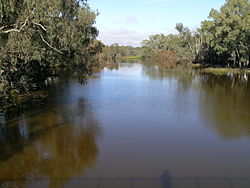
Bogan ( Eng. Bogan River ) - a never-ending river in the areas of and state of New South Wales , Australia .
| Bogan | |
|---|---|
| English Bogan river | |
 In the town of In the town of | |
| Characteristic | |
| Length | 617 km |
| Pool | 18 000 km² |
| Water consumption | 8.1 m³ / s (Gongolgon Dam) |
| Watercourse | |
| Source | Little river |
| • Location | 17 km. northwest of |
| • Height | 305 m |
| • Coordinates | |
| Mouth | Darling |
| • Location | 39 km. northeast of |
| • Height | 111 m |
| • Coordinates | |
| River slope | 0.314 m / km |
| Location | |
| Water system | Darling → Murray → South Ocean |
| A country |
|
| Region | N.S.W. |
| Areas | Central West , Oran |



Content
Geography
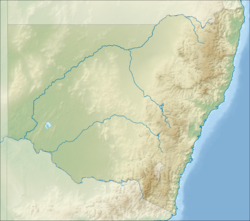
Bogan is part Water . The river originates near the town of . The general direction of the current is from the south-south-east to the north-north-west. Near the town of merges with the Little Bogan River, forming the beginning of the Darling River . Bogan accepts about twenty tributaries [1] . Unlike most other rivers of the region, Bogan has a small slope, a slow flow and is not used for irrigation [2] . The Camilaroi crosses the river [3] .
- Settlements on the river (from source to mouth) [4]
History
There are two versions about the etymology of the name. According to the first, he is rich in translation from the language of the indigenous inhabitants - "the birthplace of the famous leader of a local tribe." According to the second one, in Goidel languages (and among the first European settlers there were many Irish and Scots ) this word means “ high moor ” [5] , and it is in such a reservoir that the Bogan River originates.
The first European to study the river in 1817 was the English traveler John Oxley , who, however, did not give her a name. The name was given to the river by another Englishman, Charles Sturt , during his travels in the region in 1828-1829: he called it New Yers Creek , that is, “New Year's Stream”, as it crossed it on January 1, 1829 [5] . In 1835, the study of the river was continued by the Scottish traveler Thomas Mitchell , who assigned her current name Bogan ; during this expedition on the banks of the river he lagged behind the group and was killed by the natives botanist Richard Cunningham .
In 1928, there was a severe flood on the river [6] . The next major flood occurred in April 1990, when about 2,300 people had to be evacuated. This natural disaster caused damage of $ 47 million [7] , in particular, the state’s main railway artery, the , was damaged.
See also
- Australia River List
Notes
- ↑ Map of the Bogan River (eng.) On bonzle.com
- ↑ Bogan County Consulate - Attractions on the bogan.nsw.gov.au website
- ↑ Bogan River Bridge Replacement HW29 (eng.) At tenders.nsw.gov.au
- ↑ Macquarie and Bogan rivers catchment basin on environment.nsw.gov.au
- ↑ 1 2 Bogan River (English) on gnb.nsw.gov.au
- ↑ The Flood in Bogan River. Waters Rising. Alarm at Nyngan , The Sydney Morning Herald , February 25, 1928
- ↑ Conflict and Cooperation related to International Water Resources: Historical Perspectives - Introduction on unesdoc.unesco.org , August 2001, p. 3
Links
- Macquarie Rivers — Bogan Rivers on environment.nsw.gov.au
- G.L. Muir, W.D. Johnson. Chemistry of the Bogan River, New South Wales, with Special Reference to the Sources of Dissolved Material ( 1978 ) Australian Journal of Marine and Freshwater Research No. 29 (4) 1978, pp. 399–407