The large cow-bird [1] ( Latin: Molothrus oryzivorus ) is a large bird from the genus of bovine cadavers , the only species of the genus that occurs in the dense jungle (inhabits the entire Amazon basin ). In breeding, it uses nesting parasitism , that is, females throw their eggs to other birds, as a rule, black and black cassocks [2] . The eggs of large cowhide birds are of two types: whitish without dots and light blue (light green) with dark speckled dots. In a strange nest, a large cow-bird does not destroy the eggs and chicks of its owner. It usually takes quite a while to find a suitable nest, as their owners live in colonies and actively defend their home.
| Big cow |

Pantanal Swamp, Brazil |
| Scientific classification |
|---|
| No rank : | Bilateral symmetrical |
| Infrastructure : | Passerida |
|
| International scientific name |
|---|
Molothrus oryzivorus ( Gmelin , 1788 ) |
| Synonyms |
|---|
|
| Area |
|---|
|
| Security status |
|---|
Least ConcernedIUCN 3.1 Least Concern : 22724358 |
|
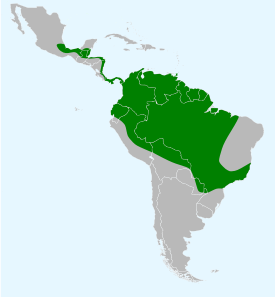
It lives in the northern part of South America, except for the east of Brazil , the west of Peru and the south-west of Ecuador ; along the eastern coasts of all countries of Central America right up to southern Mexico ; on the islands of Trinidad and Tobago , small populations are sometimes found on individual islands of the West Indies [3] . It feeds on insects, less often seeds, especially rice, which is why one of its household names is rice cassica [4] . In Brazil, a large cowbird was seen on capybaras , where it ate the horseflies that attacked them.
The male has a length of 36 centimeters and weighs 180 grams, the color is rainbow black from beak to tail, a large tail and beak, the head is small, the scallop is rising on it. The female is 28 centimeters long [1] and weighs 135 grams, the color is also black, but less iridescent, the crest is missing, which makes the head seem even smaller. The chicks have a black-brown hue, the beak is pale. They hatch faster than the "master's children" and begin to peck different insects of the nest, including the larvae of the , which are dangerous for the "native" chicks, as they have thinner fluff and skin than the stronger chick, foundling [5] .