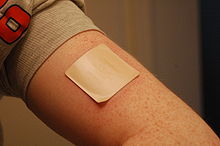

Nicotine replacement therapy (also nicotine replacement therapy , [1] nicotine replacement therapy , abbreviated as NRT ) [2] are methods for delivering nicotine into the body without using tobacco . It is used to reduce withdrawal syndromes (or withdrawal symptoms ) caused by quitting smoking or chewing tobacco . Nicotine replacement therapy is the most studied method for the treatment of nicotine addiction, the effectiveness and safety of which has been studied in 150 clinical studies. [3]
NRT drugs are included in the Standards for the treatment of chronic obstructive pulmonary disease of COPD and chronic bronchitis, as well as in the Guidelines of the Ministry of Health of Russia for the treatment of nicotine addiction in patients with respiratory diseases. [4] In the UK, Nicorette NRT is included in the national smoking control program.
Nicotine replacement therapy reduces the craving for tobacco caused by nicotine addiction in smokers and people who chew tobacco. This helps them stop using tobacco and avoid the negative effects of smoking or chewing tobacco. The habit of smoking and chewing tobacco is both an acquired behavior and physical dependence on nicotine, so counseling and use of nicotine replacement drugs can help those who want to quit smoking. [5] The use of nicotine replacement therapy increases the success rate of quitting smoking by 50-70%. [3]
Nicotine replacement therapy is included in the WHO Model List of Essential Medicines — a list of the most important medicines needed in the basic health care system . [6] The US Health Service lists 7 cessation medications, including 5 nicotine replacement drugs (nicotine patches, chewing gums, resorption tablets, inhalers, and nasal sprays) and 2 oral medications ( bupropion and varenicline ). Other available NRT products include nicotinic oral sprays and sublingual tablets. [7]
Content
- 1 Medical use
- 2 side effects
- 3 mechanism of action
- 4 The effectiveness of various dosage forms
- 5 OTC nicotine preparations
- 6 History
- 7 Trademarks
- 8 See also
- 9 notes
- 10 Links
Medical Use
All forms of NRT increase a person's chances of stopping tobacco use. [3] Studies have shown that nicotine replacement therapy helps people quit smoking for at least 6 months as effectively as bupropion preparations. [8] Studies have also shown that all forms of NRT, including nicotine chewing gums, nasal sprays, inhalers, and resorption tablets, have similar success rates in a person who quits smoking. However, the likelihood of using the methods is different: nicotine patches are most often used, followed by chewing gums, inhalers and nasal sprays. [9]
It should be noted that using a combination of several NRT methods may increase the chances of stopping tobacco use. [8] In addition, the use of nicotine replacement therapy in combination with counseling increases rates of abstinence from tobacco. [5]
Nicotine replacement drugs are of the greatest practical importance for heavy smokers who smoke more than 15 cigarettes per day.
Side Effects
Although there is no evidence that NRT may increase the risk of developing myocardial infarction, [3] a person with a history of cardiovascular disease or recent myocardial infarction should consult a doctor before using NRT. [10]
Persons under 18 years of age should also consult a doctor before starting nicotine replacement therapy. [10]
The use of nicotine during pregnancy can lead to attention deficit hyperactivity disorder (ADHD) and a decrease in learning ability in a child. It also poses a risk of a child's nicotine addiction in the future. [11] Therefore, pregnant and lactating women should consult a doctor before starting NRT. [10] Chewing gum, resorption tablets and nasal sprays are assigned teratogenicity category C; transdermal patch - category D. The transdermal patch is considered less safe for the fetus, because nicotine enters the body continuously during the time the patch is used, unlike chewing gum or resorption tablets, which deliver nicotine periodically. [11] [12]
Mechanism of Action
NRT preparations differ in the time that nicotine needs to penetrate the blood and the total time that nicotine is in the body. [5]
Nicotine patches applied to the skin continuously release a stable dose of nicotine for 16-24 hours. [5] [12] Nicotine from chewing gums, sprays and sublingual tablets quickly enters the body, but there is less time.
Nicotine sprays are considered the most advanced form of NRT due to their speed. As a psychologist at Kings College, Gay Sutherland, explains, “after a cigarette is puffed, nicotine enters the smoker's brain after about 20 seconds. Most forms of NRT begin to act in the range of 30 minutes to three hours, ”while the spray has a proven ability to deliver nicotine to the brain within 60 seconds. [13] [14] [15]
The effectiveness of various dosage forms
Clinical studies indicate a significant increase in the patient's chances of successfully quitting smoking when using an increased dose of nicotine in the patch. Clinical chewing gum doubles the chance of quitting smoking compared to placebo. [16] [17] Clinical trials have shown that a sublingual tablet is 91% more effective than placebo for 6 months. [18] Clinical topical spray showed efficacy 2.5 times higher compared to placebo for 52 weeks. [19]
To increase the effectiveness of therapy with a high and very high degree of nicotine addiction, the use of a combination of nicotine-containing drugs (patch + chewing gum) is recommended. Combination therapy is even more effective than NRT monotherapy and almost 3 times increases the chances of quitting smoking compared to placebo. [twenty]
OTC nicotine preparations
Snus and snuff are also able to supply the body with nicotine without resorting to smoking, [21] however they cause negative health effects.
Electronic cigarettes, also known as vaporizers or electronic nicotine delivery systems (ENDS), often, although not always, reproduce the appearance and mechanism of action of cigarettes. They can be positioned by manufacturers as a less harmful alternative to cigarettes, but they do not have NRT status in any jurisdiction, and evidence of their safety and effectiveness is limited [22] . Nicotine levels in some electronic cigarettes and liquids for refueling are poorly regulated. The negative effects on health and their effectiveness are still being investigated, and medical organizations do not recommend electronic cigarettes as NRT.
The U.S. Food and Drug Administration (FDA) has compiled an additional list of regulated tobacco products, including electronic cigarettes. [23] Research suggests that drugs approved by the FDA, such as a nicotine inhaler, may be a safer way to supply nicotine than electronic cigarettes. [24]
History
The first NRT product was Nicorette chewing gum, developed in the late 1970s by the Swedish company AB Leo . [25] Pioneer of NZT is considered its developer, Swedish researcher Ove Ferno.
Trademarks
Brand names include Nicotex, Nicorette , Nicoderm, Nicogum, Nicotinell, Thrive and Commit Absorption Tablets.
See also
- Nicotine addiction treatment
- World Health Organization Framework Convention on Tobacco Control
- World No Tobacco Day
Notes
- ↑ Practical use of tobacco dependence treatment programs (Unavailable link) . Russian Medical Journal. Date of treatment August 28, 2015. Archived on August 28, 2015.
- ↑ Can nicotine replacement therapy (NRT) help people quit smoking? . The Cochrane Collaboration (November 15, 2014). Date of treatment August 28, 2015. Archived on August 28, 2015.
- ↑ 1 2 3 4 Stead, LF; Perera, R; Bullen, C; Mant, D; Hartmann-Boyce, J; Cahill, K; Lancaster, T. Nicotine replacement therapy for smoking cessation (neopr.) // The Cochrane database of systematic reviews / Stead, Lindsay F. .. - 2012 .-- 14 November ( v. 11 ). - S. CD000146 . - DOI : 10.1002 / 14651858.CD000146.pub4 . - PMID 23152200 . Archived on August 28, 2015.
- ↑ Comprehensive treatment for tobacco dependence and prevention of chronic obstructive pulmonary disease caused by tobacco smoking. Guidelines No. 2002/154. M. 2003
- ↑ 1 2 3 4 Rigotti, NA Clinical practice. Treatment of tobacco use and dependence. (Eng.) // The New England Journal of Medicine : journal. - 2002 .-- February ( vol. 346 , no. 7 ). - P. 506-512 . - DOI : 10.1056 / nejmcp012279 . - PMID 11844853 . Archived on August 28, 2015.
- ↑ WHO Model List of Essential . World Health Organization (October 2013). Date of treatment August 28, 2015. Archived on August 28, 2015.
- ↑ Treating tobacco use and dependence: 2008 update. . US Department of Health and Human Services. Date of treatment August 28, 2015. Archived on August 28, 2015.
- ↑ 1 2 Cahill, K; Stevens, S; Perera, R; Lancaster, T. Pharmacological interventions for smoking cessation: an overview and network meta-analysis. (Eng.) // The Cochrane database of systematic reviews : journal. - 2013 .-- Vol. 5 . - P. CD009329 . - DOI : 10.1002 / 14651858.CD009329.pub2 . - PMID 23728690 . Archived on August 28, 2015.
- ↑ Hajek, Peter; West, Robert; Foulds, Jonathan; Nilsson, Fredrik; Burrows, Sylvia; Meadow, Anna. Randomized Comparative Trial of Nicotine Polacrilex, a Transdermal Patch, Nasal Spray, and an Inhaler (Eng.) // Archives of Internal Medicine : journal. - Vol. 159 , no. 17 . - P. 2033 . - DOI : 10.1001 / archinte.159.17.2033 . Archived on August 28, 2015.
- ↑ 1 2 3 FDA 101: Smoking Cessation Products . US Food and Drug Administration. Date of treatment August 28, 2015. Archived on August 28, 2015.
- ↑ 1 2 Bruin, Jennifer; Gerstein, Hertzel; Holloway, Alison. Long-Term Consequences of Fetal and Neonatal Nicotine Exposure: A Critical Review (English) // Toxicological Sciences : journal. - 2010 .-- 2 April ( vol. 116 , no. 2 ). - P. 364-374 . - DOI : 10.1093 / toxsci / kfq103 . Archived on August 28, 2015.
- ↑ 1 2 Oncken, MD, MPH, Cheryl; Dornelas, Ph.D., Ellen; Kranzler MD, Henry. Nicotine Gum for Pregnant Smokers (Neopr.) // Obstetrics. - 2014 .-- 28 October ( t. 112 , No. 4 ). - S. 859-867 . - DOI : 10.1097 / AOG.0b013e318187e1ec . - PMID 18827129 .
- ↑ Spray your way to a smoke-free New Year . Easier.com (January 5, 2012). Date of treatment July 1, 2015. Archived July 1, 2015.
- ↑ Lifecoach: I'm putting on weight but can't face the gym . The Daily Telegraph (May 4, 2011). Date of treatment July 1, 2015. Archived July 1, 2015.
- ↑ Hansson A et al. Effects of nicotine mouth spray on urges to smoke, a randomized clinical trial. (English) // BMJ Open : journal. - No. 2012 Sep 26; 2 (5) . - PMID 23015605 . Archived on August 28, 2015.
- ↑ Tønnesen P et al. Higher dosage nicotine patches increase one-year smoking cessation rates: results from the European CEASE trial. Collaborative European Anti-Smoking Evaluation. European Respiratory Society. (Eng.) // European Respiratory Journal : journal. - No. 13 (2) . - P. 238-246 . - PMID 10065662 . Archived on August 28, 2015.
- ↑ Garvey AJ et al. Effects of nicotine gum dose by level of nicotine dependence. (English) // Nicotine & Tobacco Research : journal. - No. 2 (1) . - P. 53-63 . - DOI : 10.1080 / 14622200050011303 . - PMID 11072441 . Archived on August 28, 2015.
- ↑ Glover ED et al. A comparison of a nicotine sublingual tablet and placebo for smoking cessation. (English) // Nicotine & Tobacco Research : journal. - No. 4 (4) . - P. 441-450 . - DOI : 10.1080 / 1462220021000018443 . - PMID 12521403 . Archived on August 28, 2015.
- ↑ Tønnesen P et al. Efficacy of a nicotine mouth spray in smoking cessation: a randomised, double-blind trial (English) // European Respiratory Journal : journal. - No. 40 (3) . - P. 548-554 . - DOI : 10.1183 / 09031936.00155811 . - PMID 22323576 . Archived on August 28, 2015.
- ↑ Kate Cahill et al. Pharmacological interventions for smoking cessation: an overview and network meta-analysis (Eng.) // The Cochrane database of systematic reviews : journal. - 2013 .-- 31 May. - DOI : 10.1002 / 14651858.CD009329.pub2. . - PMID 23728690 . Archived on August 28, 2015.
- ↑ Phillips, CV; Heavner, KK Smokeless tobacco: The epidemiology and politics of harm (Eng.) // Biomarkers: journal. - 2009. - Vol. 14 , no. Suppl 1 . - P. 79-84 . - DOI : 10.1080 / 13547500902965476 . - PMID 19604065 .
- ↑ E-cigarette sellers must stop making unsubstantiated claims about their therapeutic effect , World Health Organization (September 19, 2008). Date of treatment August 3, 2014.
- ↑ Electronic Cigarettes (e-Cigarettes) . FDA (June 30, 2015). Date of treatment August 28, 2015. Archived on August 28, 2015.
- ↑ Drummond, MB; Upson, D. Electronic cigarettes. Potential harms and benefits. (Eng.) // Annals of the American Thoracic Society : journal. - 2014 .-- February ( vol. 11 , no. 2 ). - P. 236-242 . - DOI : 10.1513 / annalsats.201311-391fr . - PMID 24575993 .
- ↑ Karl Fagerstöm, Anders Axelsson, Lennart Sorelius. In memoriam of Ove Fernö - the inventor or NRT and The Past, Present, and Future of NRT . Society for Research on Nicotine and Tobacco Newsletter, September / October 2008, vol. 14, No. 3. - “During the late 1960s and 70s he was responsible for the development of the first NR product - a chewing gum." Date of treatment September 22, 2015. Archived December 25, 2014.