St. Anne's Church (German Annenkirche ) is a Lutheran church in Dresden , located southeast of the Postal Square (German Postplatz ). Built in the 1760s. in late baroque style . Belfry is one of the few examples of classicism architecture in Dresden .
| church | |
| Church of sv. Annas | |
|---|---|
| Annenkirche | |
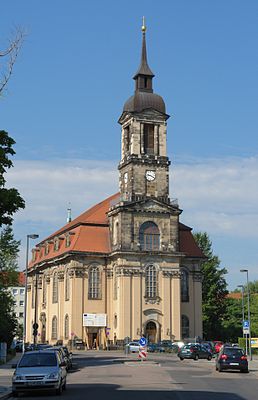 Church of sv. Annas | |
| A country |  Germany Germany |
| Location | Dresden |
| Denomination | evangelical lutheran |
| Diocese | Evangelical Lutheran Land Church of Saxony |
| Architectural style | baroque , classicism |
| Architect | Johann Georg Schmidt |
| Building | 1764 - 1769 years |
History
Like many other churches in Dresden, Annenkirche was built in order to meet the needs of an increasing number of parishioners - the Dresden outskirts grew rapidly in the 16th century. Annenkirche, the church of St. Anne, got its name in honor of the wife of Elector Augustus , which was popularly called “Mother Anna”. She was considered an imperious and active woman, intervened in state affairs, and personally maintained the household of her husband with whom she lived for 35 long years inseparably. A monument to her still decorates the square in front of the church.
The predecessor of the current Annenkirche stood on this spot from 1578 until the Seven Years War . At the entrance of this military conflict, Dresden was besieged by the troops of Frederick II , and Prussian artillery ruthlessly fired at the Wilsdruff suburb. Annenkirche, among many other buildings, was destroyed.
Dresden architect Johann Georg Schmidt (a student of Georg Ber , architect of the Church of the Virgin ) created the project of today's church, which was consecrated in 1769. The bell tower, performed in the style of classicism, appeared only in 1824. [1] At the beginning of the 20th century, the Annenkirche was significantly reconstructed, primarily its interior. Interior decoration done in modern style . The church also received a new body.
The tragic night of February 13 , despite the completely burnt-out roof, was miraculously survived in the church’s walls by a thousand Dresdens, which still resembles a memorial plaque. Restoration work in Annenkirche was completed in the early 1950s, but it was not until 1997 that the dome of the bell tower was finally restored over the Annenkirche, and in the new millennium, the territory adjacent to the temple was refined.
Notes
- ↑ Fritz Löffler: “Das alte Dresden. Geschichte seiner Bauten "EA Seemann Verlag, Leipzig, 17th ed. 2012. - p. 236.