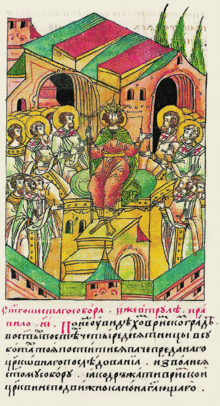
Trulli Cathedral ( Greek Σύνοδος ἐν τῶ τρούλλω τοῦ βασιλικού παλατίου ), also the Fifth-sixth Cathedral ( Greek Πενθέκτη Σύνοδος ) - the Church Cathedral in Constantinople in 691 - 691 ; convened by Emperor Justinian II in 691 ; his documents are extremely important as a source of internal church law for Orthodox churches , which consider them as documents of the Sixth Ecumenical Council .
| Trull Cathedral | |
|---|---|
| date of | 692 year |
| Recognized | Orthodoxy |
| Previous Cathedral | Third Cathedral of Constantinople |
| Next cathedral | Second Nicene Cathedral |
| Convened | Justinian II |
| Number of people gathered | 215 |
Content
- 1 History
- 2 Status in the West and East
- 3 Participants in the cathedral and signatures on its decisions
- 4 notes
- 5 Links
History
The Fifth and Sixth Ecumenical Councils did not make any definitions, focusing on the dogmatic needs of the Church and the fight against heresies .
But in view of the fact that the decline in discipline and piety was intensifying in the Church, a decision was made to convene an additional Council to the previous ones, which would unify and supplement church norms .
The cathedral sat in the same room as the Sixth Ecumenical Council, the hall of the palace with arches, the so-called trulls , therefore officially it was given the name Trullsky in the documents.
Status in the West and East
The 102 canons adopted by the Thrull Council are sometimes called in the Orthodox Church the decisions of the Sixth Ecumenical Council , since he considered himself to be a continuation of it.
Many of the canons of the Council of Thrull were polemically opposed to the deep-rooted practice of the Roman Church. Thus, the 2nd Rule affirms the canonical authority of the 85 Rules of the Apostolic , as well as some local Eastern Councils, which the Roman Church did not consider obligatory. In the Roman Church, 50 Apostolic Rules were recognized in the translation of Dionysius the Small, but they were not considered binding.
The 36th Rule confirmed the 28th rule of the Council of Chalcedon , not accepted by Rome:
“By renewing the law of the hundred and fifty Holy Fathers who gathered in this God-preserving and reigning city, and six hundred and thirty gathered in Chalcedon, we determine that the throne of Constantinople has equal advantages with the throne of ancient Rome, and moreover, may it be magnified in church matters, being the second ; after all, the throne of the great city of Alexandria is listed, then the throne of Antioch, and after that the throne of the city of Jerusalem . ”
The 82nd rule forbade depicting Jesus Christ in the form of a lamb, and instead prescribed that He be represented on icons " according to human nature. " According to the art critic and theologian L.A. Ouspensky , this rule laid the foundation for the folding of the icon-painting canon [1] .
The 13th Rule condemned the celibacy of the clergy; 55th - post adopted by Catholics on Saturday.
The 11th rule forbade various relations with Jews under pain of excommunication, including the ban on going to baths with them:
“None of those belonging to the holy rite, or of the laity, should by any means eat unleavened bread given by the Jews, or enter into a commonwealth with them, nor call them into illnesses, and accept medicine from them, or wash themselves in bathhouses. If anyone dares to do this: let the cleric be erupted, and let the layman be excommunicated. ”
Cathedral Participants and Signatures of Decisions
In total, there were 227 bishops at the cathedral. There were no legates of the Pope in Constantinople. Under the decisions of the council there is not a single signature of Western, Latin bishops.
The decisions of the cathedral were signed by the emperor and four patriarchs:
- Flavius Justinian , faithful in Christ Jesus God emperor of the Romans.
- Paul , the unworthy bishop of Constantinople, the new Rome.
- Peter , bishop of the great city of Alexandria.
- Anastasius , the humble bishop of the holy city of Jerusalem.
- George , the humble bishop of Antioch.
and other eastern bishops [2] .
Among the signatures is the following: “Basil, bishop of Gortyna , the metropolis of the Christ-loving island of Crete , and defining the place of the whole cathedral of the holy church of Rome, having determined, he signed” (Cretan Gortyna refers to Illyria , who used the Latin rite in worship and was part of the pope’s diocese), but, firstly, this signature is in the middle, among other signatures (the signatures of legates at the cathedrals always stood in the first place), and secondly, there is no evidence that Basil was a legate of the pope.
Acts of the Council of Thrull were sent to Rome so that they could be signed by the Pope. But Pope Sergius flatly refused to sign them, calling them delusions. Troll Cathedral is not recognized in the Western Church to date.
Notes
- ↑ V. The Fifth-Sixth Council and its doctrine of the church image , Church and Scientific Center "Orthodox Encyclopedia" . Date of appeal September 15, 2019.
- ↑ Acts of the Ecumenical Councils, Volume 6
Links
- Concilium Constantinopolitanum a. 691/2 in Trullo habitum . H. Ohme (ed.) Acta conciliorum oecumenicorum, Series Secunda II: Concilium Universale Constantinopolitanum Tertium, Pars 4. ISBN 978-3-11-030853-2 . Berlin / Boston Oktober 2013.
- The rules of the Sixth Ecumenical Council of Constantinople with commentary
- Kartashev A.V. Ecumenical Councils . Paris, 1963 // Chapter: 6th Ecumenical Council (680–681)