Liu Renjing (( Kit. Ex . 刘仁静 , Pinyin : Liú Rénjìng ), March 4, 1902 - August 5, 1987) - one of the founders of the CPC , later a Trotskyist.
| Liu Renjing | |
|---|---|
| 刘仁静 | |
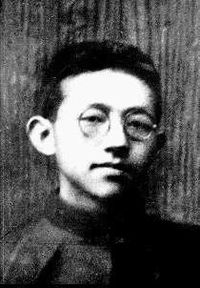 Liu Renjing in his youth. | |
| Date of Birth | |
| Place of Birth | |
| Date of death | |
| Place of death | |
| Occupation | Politician |
| Education | |
| The consignment | PDA |
| Main ideas | Trotskyism |
Biography
As a student at Peking University, he joined the Marxist group, headed by Li Dazhao . He was very well read, Zhang Gotao called him a “bookworm” [1] . In July 1921, he was a delegate to the founding congress of the CPC . At 19, he was the youngest participant in the convention. He proposed to include in the party program a provision that only the dictatorship of the proletariat can save China [2] . In 1922 he took part in the 4th Congress of the Comintern . From 1923 to 1925 he was secretary of the Chinese Communist Youth Organization ("Komsomol"). Starting in 1926, he spent three years in the Soviet Union, where, under the name of Lensky, he studied at the International Lenin School and got on the platform of the left opposition.
Returning to China, he met Alfred Rosmer in Paris in 1929, which gave him the opportunity to meet with Trotsky in Turkey. Trotsky's work “The Political Situation in China and the Tasks of the Bolshevik-Leninists (Opposition)” addressed his discussion with Liu.
After the trade union conference in May 1931, Liu's influence declined.
In 1934, he assisted Harold Isaacs in collecting materials in preparing the book The Tragedy of the Chinese Revolution. Beginning in 1935, when he was arrested, and until the amnesty of 1937, he was in the Kuomintang prison. There he made statements about Sun Yat-Senism , which his comrades perceived as surrender. By the spring of 1938, he tried to oppose Trotsky to justify his behavior. He later broke with the Chinese Trotskyists and began working as an anti-communist propagandist.
After the Chinese revolution in 1949, Liu had to adapt to new circumstances. He spoke with self-criticism, after which he was able to teach at Peking University. During the Cultural Revolution, Liu was arrested and held in custody for more than ten years. In the early eighties, he published several articles in China. In 1987, he died after an accident.
Links
- Leo Trotzki . Schriften über China. Band 2 (1928–1940). ISBN 3-89136-390-7
- Pierre Broué . Chen Duxiu and the Fourth International, 1937–1942
Notes
- ↑ Chang Kuo-t'ao . The Rise of the Chinese Communist Party. Vol. 1, p. 92. Cit. by: Alexander Pantsov . Mao Zedong. M .: Young Guard. Pp. 148–149.
- ↑ Alexander Pantsov . Mao Zedong. M .: Young Guard. Pp. 148–149.