The Canadian Cossack [1] ( lat. Branta canadensis ) is a waterfowl from the duck family.
| Canadian Goose | |||||||||||||||||||||||||||||||||||||||||
 Canadian Goose Brown Cry, Dorset , March 1966 | |||||||||||||||||||||||||||||||||||||||||
| Scientific classification | |||||||||||||||||||||||||||||||||||||||||
|---|---|---|---|---|---|---|---|---|---|---|---|---|---|---|---|---|---|---|---|---|---|---|---|---|---|---|---|---|---|---|---|---|---|---|---|---|---|---|---|---|---|
| |||||||||||||||||||||||||||||||||||||||||
| International Scientific Name | |||||||||||||||||||||||||||||||||||||||||
Branta canadensis ( Linnaeus , 1758 ) | |||||||||||||||||||||||||||||||||||||||||
| Area | |||||||||||||||||||||||||||||||||||||||||
 Summer area (local view) Year-round area (local view) Winter area (local view) Summer range (introduced species) Year-round range (introduced species) Winter range (introduced species) Summer Range ( Small Canadian Goose ) | |||||||||||||||||||||||||||||||||||||||||
| Security status | |||||||||||||||||||||||||||||||||||||||||
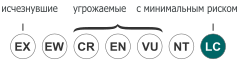
| The Red Book of Russia status not defined | |

Content
General characteristics
Appearance
Despite the fact that the Canadian goose is usually unmistakably determined by the characteristic details of the plumage, its length and the ratio of proportions between individual parts of the body show significant differences in different parts of the range. In accordance with these signs, taxonomists traditionally considered 11–12 subspecies, with the largest of them, such as maxima and leucopareia , with their appearance, in particular their long and thin necks, and their long beaks have much in common with geese . On the contrary, the half-smaller northwestern forms of minima and leucopareia are comparable with the average size of a duck, like mallards , have a short neck and a small beak [2] . Since the mid -2000s , most of the authors, as well as the American Society of Ornithologists , have divided these two main groups into two distinct species, leaving the former name for the larger subspecies, and the small forms ( hutchinsii , leucopareia , minima , taverneri, and extinct asiatica ) as Branta hutchinsii [3] . If all variations are considered as one species, then the total length will vary from 55 to 110 cm, wingspan from 122 to 183 cm, weight from 2 to 6.5 kg [2] .
The head and neck are shiny black with large white patches on the sides of the head, exciting the cheek, chin and throat. Occasionally a small white mark is also present on the forehead. The chest, upper part of the belly and sides vary from grayish or almost white to a wavy chocolate brown or brown; the lower part of the belly and undertail are white. In the Aleut form of leucopareia, a white collar is developed on the border of the dark areas of the plumage in the lower part of the neck. The back and shoulders are dark brown with light ocher tips of the feathers, the tail is blackish, the tail is black or black and brown. The beak and legs are black; In young birds, the black color in the plumage is replaced with pale brown, the markings on the chest and sides are shaped like rounded spots rather than stripes. Downy chicks are yellowish-brown [4] .
Voice
Canadian brant can often be heard in flight, when she publishes a friendly deep gaggle, heard at a great distance. It is transmitted as a two-syllable "a-honk" or "a-ronk", in which the emphasis is placed on the second, higher syllable. On the ground, one can hear the difference between the sounds made by males and females [5] .
Spread
Breeding habitat
The homeland of the Canadian geese is North America , where at present the bird nests mainly in Alaska and Canada , including on the Arctic coasts and islands of the Canadian Arctic Archipelago . The bird was once numerous in the northern states of the United States, where it nests to the south to northeastern California , Utah , Kansas, and Massachusetts [6] .
Aleutian Canadian geese inhabit the Aleutian Islands , where today there are about 20,000 individuals. In the past (before the beginning of the 20th century) it also nested on the Kuril and Commander Islands , where it was completely exterminated. Canadian goose has also been successfully relocated to the UK , North-Western Europe and New Zealand .
Habitats
Canadian geese live on the banks of rivers, reservoirs, marshes, in flooded lowlands. The brant goes very well on the ground and swims well, and flies worse than other geese.
Power
Like other geese, Canadian geese feed on plant food. The basis of their diet are sedge, plantain, fescue, bukharnik. On agricultural fields willingly eats corn and barley.
Reproduction
Canadian goose nests mainly on islands located in the middle of reservoirs, arranges nests in tall grass and only in exceptional cases on trees. Sexual maturity comes in 2 years, sometimes later. Despite the fact that geese nest in colonies, they still try to arrange nests far away from each other. In laying of Canadian goose from 4 to 7 eggs.
Commercial Value
Canadian goose is a favorite object of hunting - due to its size and taste of meat. Each year, during the hunting season in the USA and Canada, about 400,000 representatives of this species are shot. In Russia, hunting for a Canadian goose that lives only in the Aleutian Islands is prohibited.
Systematics
The famous American ornithologist Paul Johnsgard lists 11 modern and one extinct subspecies of the Canadian goose [7] :
- Branta canadensis leucopareia (Brandt, 1836) - An average Canadian brant [8] , inhabits the Aleutian Islands (at present Buldyr Island and possibly Amchitka Island ). It is now considered a subspecies of the small Canadian goose Branta hutchinsii leucopareia (Brandt, 1836) [9] [10] .
- † Branta canadensis asiatica Aldrich, 1946 - dwelled on the Commander and Kuril Islands , now also considered a subspecies of the small Canadian geese Branta hutchinsii asiatica Aldrich, 1946 [9] [10] .
- Branta canadensis minima Ridgway, 1885 - the western part of Alaska from Nushagak Bay to the east to the area of the town of Weinwright ( Eng. Wainwright, Alberta ) [11] , is also currently considered as a subspecies of the Canadian Goose Branta Branta hutchinsii minima Ridgway, 1885 [9] [ 10] .
- Branta canadensis taverneri Delacour, 1951 — Alaska's interior areas east to the Mackenzie Delta. Intersects with subspecies B. c. parvipes . Today, it is also considered a subspecies of the small Canadian Goose Branta hutchinsii taverneri Delacour, 1951 [9] [10] .
- Branta canadensis occidentalis (Baird, 1858) - Dark - breasted Canadian Goose [8] , northwestern Alaska (coast of the Prince Wilhelm Strait and Cook Bay , in the interior of the mainland in the Copper Basin to the east to the Bering Glacier).
- Branta canadensis fulva Delacour, 1951 - nests along the coasts and on the islands of British Columbia and southern Alaska north to Glacier Bay National Park, where it is sympathetic to B. c. occidentalis .
- Branta canadensis parvipes (Cassin, 1852) - from central Alaska through northern Canada east to the Hudson Bay , south to the Canadian Prairies , where it intersects with subspecies B. c. moffitti and B. c. maxima .
- Branta canadensis moffitti Aldrich, 1946 - the area of the Great Basin . In the north, it intersects with subspecies B. c. parvipes , in the east with subspecies B. c. maxima .
- Branta canadensis maxima Delacour, 1951 - originally nested in the Great Plains from Manitoba and Minnesota to the south to Kansas , Missouri , Tennessee and Arkansas . Currently preserved only in protected areas, where it is grown in nurseries and then released into the wild.
- Branta canadensis hutchinsii (Richardson, 1832) - Canadian Arctic Archipelago : Melville Peninsula, Southampton Islands, Baffin Island , Victoria , as well as western Greenland and possibly the Anderson Delta. Since the mid-2000s, taxonomists often view this form as a nominative subspecies of the independent species Small Canadian Geese ( Branta hutchinsii (Richardson, 1832)) [9] [10] .
- Branta canadensis interior Todd, 1938 - Northern Quebec , Ontario and eastern Manitoba north to the city of Churchill
- Branta canadensis canadensis (Linnaeus, 1758) - Eastern Labrador , Newfoundland , Antiquity and Madeleine Islands
Photo Gallery
Canada goose ( Branta canadensis )
Canada goose with chicks
Canada goose with chicks
Notes
- ↑ Boehme RL , Flint V. Ye. The five-language dictionary of animal names. Birds. Latin, Russian, English, German, French / Under total. ed. Acad. V.E. Sokolova . - M .: Rus. lang, "RUSSO", 1994. - p. 32. - 2030 copies. - ISBN 5-200-00643-0 .
- ↑ 1 2 Koblik, 2001 .
- ↑ Hanson, Harold C. Volume 1 // The White-Cheeked Geese: Taxonomy, Ecophysiographic Relationships, Biogeography, and Evolutionary Considerations. - AVVAR Books, 2006. - 420 p. - ISBN 0970850433 .
- ↑ Johnsgard, 2010 , p. 78
- ↑ Bergmann el al., 2008 , p. 38
- ↑ Stepanyan, 2003 , p. 43.
- ↑ Johnsgard, 2010 , pp. 76-77.
- ↑ 1 2 Dementiev G. P., Gladkov N. A. and others. Birds of the Soviet Union. Volume 4. - M .: Soviet science, 1952. - P. 344. - 642 p.
- ↑ 1 2 3 4 5 Koblik E. A., Red'kin Ya. A. The Basic List of Anseriformes of the World Fauna // Kazarka, №10 (2004). - P. 15—46.
- 2 1 2 3 4 5 Anseriformes // World Birds Taxonomic List: Genera and species with citations. Version 9.027 (2011.10.19).
- ↑ Johnsgard, 2010 , p. 77.
Literature
- Bellrose, Frank C. Ducks, Geese & Swans of North America. - Stackpole Books, 1980. - 568 p. - ISBN 0811705358 .
- Bergmann, Hans-Heiner; Helb, Hans-Wolfgang; Baumann, Sabine. Die Stimmen der Vögel Europas - 474 Vogelporträt mit 914 Rufen und Gesängen auf 2.200 Sonogrammen. - Aula-Verlag, 2008. - ISBN 978-3-89104-710-1 .
- Carboneras, C. 1992. Family Anatidae (Ducks, Geese and Swans) in del Hoyo, J., Elliott, A., & Sargatal, J., eds. Vol. 1. // Handbook of the birds of the world. - Barcelona: Lynx Edicions, 1992. - ISBN 84-96553-42-6 .
- Johnsgard, Paul A. Ducks, Geese, and Swans of the World. Revised Edition. - University of Nebraska, 2010. - 404 p. - ISBN 0803209533 .
- E. Koblik. A variety of birds (based on materials from the exposition of the Zoological Museum of Moscow State University. - Ed. Moscow State University, 2001. - Vol. 3 (Detachments Owls, Goat-like, Strified, Bird-mice, Trophoriform, Torch-shaped, Dyat-shaped, Sparrows) (family Drevolazovye- Mockingbird)). - 358 p. - ISBN 5-211-04072-4 .
- Stepanyan, LS. Synopsis of the ornithological fauna of Russia and adjacent territories. - M .: Academkniga, 2003. - 808 p. - ISBN 5-94628-093-7 .
Links
- Vertebrates of Russia: Canada Goose
- Media files (photo, audio and video) with the participation of the Canadian geese . The Internet IBC Bird Collection . ibc.lynxeds.com. The date of circulation is January 2, 2012. Archived May 19, 2012.