Tahitian sandpit [1] ( lat. Prosobonia leucoptera ) - an extinct species of birds of the snipe family. Endemic to Tahiti .
| † Tahitian Sandbox |
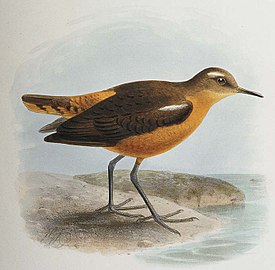
Lithograph by J. G. Kölemans |
| Scientific classification |
|---|
| No rank : | Bilateral symmetrical |
| Suborder : | Scolopaci Stejneger , 1885 |
|
| International scientific name |
|---|
Prosobonia leucoptera ( Gmelin , 1789 ) |
| Security status |
|---|
Extinct speciesIUCN 3.1 Extinct : 22693330 |
|
|---|
|
Image of RMNH 87556 at Naturalis Museum, Leiden
Content
A Tahitian sandbox was discovered in 1773 during the second Pacific voyage of Captain James Cook . It is likely that only one specimen was collected, which is now in the Naturalis Museum, which is located in Leiden , the Netherlands .
Two (possible) samples collected by William Anderson between September 30 and October 11, 1777 on the island of Moorea , formed the basis for the description of the sandbox Prosobonia ellisi . The three copies that were mentioned in 1787 by John Latham are all different. The surviving specimen (Naturalis Museum, RMNH 87556) cannot be clearly defined, nor can the history of its appearance in the museum be traced with complete certainty. Perhaps in 1819 it was acquired along with other Forster specimens (Stresemann, 1950). In addition, there is a drawing by Georg Forster and a lithographic reconstruction of Johannes Gerard Kölemans .
The Tahitian sandbox reached a length of 17.5 cm. The length of the wing was 11.3 cm, the length of the tail was 5.4 cm and the leg was 3.4 centimeters.
The top of the head was blackish brown. The color of the neck and sides of the head was dark brown. The bridle and ear coverts were reddish with a white spot behind the eyes. The cheeks were rusty red, the throat was brownish-white. The back and wings were blackish brown. Characteristic was a small white spot in the form of a crescent on the bend of the wing, which was formed by some feathers from small wing coverts. The two middle tail feathers were blackish brown, the rest reddish brown with a black edging. The underside was rusty red and without stripes. The iris and beak were black. The legs were greenish.
Birds nested on the ground and kept mainly near small rivers.
In 1777, William Anderson, a ship's physician on Cook's third voyage, described the species as frequent. Since the Cook team was annoyed by rats and cockroaches on this journey, James Cook ordered the ropes to be pulled to the coast of Tahiti to get rid of the parasites. The Tahitian sandbox nesting on the ground has become easy prey for rats. A couple of years after 1777, the species disappeared.
- ↑ Vinokurov A.A. Rare and endangered animals. Birds: Ref. allowance / ed. V. E. Sokolova . - M .: High School, 1992. - S. 56. - 446 p. : ill. - 100,000 copies. - ISBN 5-06-002116-5 .
- James Cowan Greenway: Extinct and Vanishing Birds of the World. Dover Publications Inc., New York 1967, ISBN 0-486-21869-4 .
- Errol Fuller: Extinct Birds. 2000, ISBN 0-8160-1833-2 .
- David Day: The Doomsday Book of Animals. Ebury Press, London 1981, ISBN 0670279870 .
- Dieter Luther: Die ausgestorbenen Vögel der Welt. Westarp Wissenschaften, 1986, ISBN 3-89432-213-6 .
- Walton Beacham: World Wildlife Fund Guide to Extinct Species of Modern Times. 1997, ISBN 0933833407 .

 Play media file