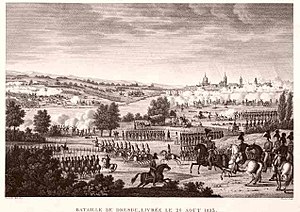
The battle of Dresden ( German: Schlacht von Dresden , French Bataille de Dresde ) is a battle that took place from August 26 to 27, 1813 during the Sixth Coalition War between the French army under the command of Napoleon I and the Bohemian Allied army under the command of Karl Schwarzenberg at Dresden .
| Battle of Dresden | |||
|---|---|---|---|
| Main Conflict: Sixth Coalition War | |||
 Battle of Dresden | |||
| date | August 26 - 27, 1813 | ||
| A place | Dresden , Saxony | ||
| Total | Napoleon's victory | ||
| Opponents | |||
| |||
| Commanders | |||
| |||
| Forces of the parties | |||
| |||
| Losses | |||
| |||


The battle lasted two days. On the first day, August 26 , the Allied forces stormed Dresden , but were repelled by the approaching army of Napoleon. On the second day, August 27 , Napoleon went on the offensive and threw the allies back to Bohemia .
Background
After the unsuccessful results of the Russian campaign of 1812, Prussia rebelled against Napoleon, however, after the first successes, the Russian-Prussian troops were defeated at Lutzen and Bautzen . In June 1813 , a truce was concluded between the opponents, during which Austria joined the allies. The 6th coalition was formed against Napoleon, which also included Sweden and England. On August 11, Austria declared war on France, and hostilities resumed.
The coalition forces attacked Napoleon with three large armies (Bohemian in the south, Silesian in the east, North in the north), the largest of which was the Bohemian army (more than 230 thousand, 670 guns) under the command of the Austrian field marshal Schwarzenberg and half consisting of Austrians. It also included the Russian-Prussian army (120 thousand, 400 guns) under the command of Barclay de Tolly , but in the same place, duplicating Barclay and Schwarzenberg, Tsar Alexander I also ordered. The lack of unity of command was one of the main problems of the coalition, but was a necessary political condition for its existence.
Napoleon, because of poor intelligence, considered Blucher's Silesian army to be the strongest, against which he went with the main army, leaving Saint-Cyr’s corps in Dresden. Blucher, learning about the movement of Napoleon, retreated according to the Trachenberg plan . Napoleon’s nomination proved useless.
Around the same time, the Bohemian army moved from the Czech Republic to Leipzig in order to go on the flank of the French group operating against the Silesian army. The right column under the command of Wittgenstein passed by Dresden and intercepted the message of Saint-Cyr, from which it became known about the weak cover of the city. In addition, two regiments of the Westphalian cavalry moved to the Allies, who reported the details of the location of the French in Dresden. The Allies decided to change the goal of the offensive and turned towards Dresden.
Napoleon, learning about the movement of the Bohemian army to Dresden, hastened to defend the city.
Dresden, the capital of Saxony, was the largest city, spread on both banks of the Elbe, and was the central supply hub of the Napoleonic forces in Central Europe. It collected reserves for the long-term maintenance of a huge army. Napoleon once said about the importance of Dresden: "Let me be cut off from the Rhine, if only they would not cut me off from Dresden . " He was surrounded by a dilapidated wall, as well as several redoubts with artillery batteries mounted on them.
The forces of the Bohemian army, which took part in the battle, are estimated from 170 to 230 thousand soldiers. The last figure is given in the work of the military historian Bogdanovich according to the staff lists, however, it is known that not all units came directly to Dresden. Also, Napoleon’s forces in battle are not precisely defined. Calculations were made approximately on the basis of the nominal number of corps and divisions, which was significantly different from the actual one. All historians agree on only one thing: that the Allied forces far outnumbered the troops at the disposal of Napoleon.
On August 25, the Allies approached Dresden, which was defended by the 14th Infantry Corps of Marshal Saint-Cyr and the garrison, up to 30 thousand soldiers and about 70 guns.
Eve
Alexander I , following the opinion of his advisers, wished for an immediate assault, but the Austrian side preferred to correctly surround the city and wait for the approach of all the forces stuck with convoys in the mountain passages. Against Saint-Cyr, the Allies could put up 87,000 soldiers that day, but Schwarzenberg considered the superiority of forces insufficient to assault the fortified positions.
Mikhailovsky-Danilevsky , who served at the General Staff, so transfers the position in command of a huge army:
The lack of one-man management was all the more unpleasant, because there were three monarchs and each was surrounded by advisers who submitted opinions that were often contradictory, and the commander in chief Prince Schwarzenberg did not have enough weight to coordinate everyone and take such measures that would satisfy everyone. The place where the monarchs stood with their headquarters and convoy was likened to a noisy public meeting. What difference did it seem to be from the war of 1812, where one prince Kutuzov, sitting on a bench, raised his voice; silence reigned near him, and woe to the one who, without calling him, offered advice.
On this day, Napoleon forced marches threw his army from Silesia to Dresden. When he approached the fork in the roads leading to Dresden and the bridge to the left bank of the Elbe in the Königstein area, he sent General Hurgo to inquire about the situation in Dresden. Königstein was located 27 km southeast of Dresden. Napoleon’s initial plan was to ferry troops in Königstein, bypass deeply and subsequently strike the rear of the Allied armies storming Dresden. It took 2-3 days to maneuver. However, Hurgo returned at 11 o’clock in the evening with information that Dresden would not last 24 hours in the event of an assault. If Dresden falls, Napoleon’s army would be cut off from its rear. Napoleon moved to Dresden, leaving to fulfill his plan of entering the rear of the Allies 30-thousandth building of General Wandam [1] .
Battle
August 26
Napoleon with the Old Guard arrived in Dresden before noon. The rest of it pulled itself up.
The Allied attack on Dresden began with five columns from different directions, but inconsistently. According to the disposition drawn up at night, the attack was supposed to start at 4 p.m., however, the disposition was not delivered to the troops on time and most of the corps began the attack in the early morning. Austrian units marched on the left flank, Prussians in the center, Wittgenstein's Russian corps acted on the right flank. The first early morning went on the attack on the suburbs of the Austrian units, but stuck in the battle for the fortifications. Upon learning of the arrival of Napoleon, Schwarzenberg suspended the attack. Moreover, Alexander I insisted on the abolition of the assault. However, the cancellation order was not delivered to the troops, and at 4 o'clock a signal came for a general assault.
The assault troops did not have fascines and assault ladders, which greatly reduced their capabilities. By 5 pm, the Austrians captured a couple of redoubts and 6 guns, stopping in front of the city wall, and the Prussians captured the Great Garden. At this moment, Napoleon’s Young Guard divisions, crossing the Elbe, entered Dresden.
Russian troops launched the attack at 4 pm, first with cavalry, then with infantry. Stepping along the left bank of the Elbe, they came under the crossfire of batteries of redoubts and 30 guns from the right bank. The counterattacks of the French cavalry stopped their advance.
Prussian troops reached the redoubts in the center, where they were driven back by fresh French reinforcements.
At about 6 pm Napoleon, going beyond Dresden, attacked the allies and forced them to retreat along the entire front to the heights around the city. The approaching night stopped the battle at 9 o’clock in the evening.
August 27
The Allies took a defensive position in a semi-ring near the city. The strongest point of the position was the center, located on the heights. However, the best escape routes were on the flanks: on the right (for the Russians) the road along the Elbe to Pirna , on the left (for the Austrians) - to Freiberg . Roads passing through the center were secondary. Napoleon decided to attack the flanks of the allies. His task was facilitated by the fact that the left flank of the Austrian location ( Gyulai corps with the rearguard of Klenau corps) was divided by the impenetrable channel of the Vayseritz river [2] .
From the early morning of August 27, heavy rain began, affecting the course of the battle. At night, the French 2nd (Marshal Victor ) and 6th (Marshal Marmont ) infantry corps came up, about 53 thousand soldiers in total.
From 7 o'clock in the morning, Napoleon resumed attacks on the left flank of the Allies (the Austrian Corps of Giulai) with Murat's cavalry and the corps of Marshal Victor. Not fearing for his center, sufficiently covered by the Dresden fortified camp and the Marmont corps, he also attacked the right flank of the allies (the Russian corps of Wittgenstein and the Prussian Kleist) with the forces of the corps of Ney , Saint-Cyr and the Young Guard. The Old Guard remained in reserve.
French columns, bypassing the fortified villages, squeezed the Austrians.
In the ongoing rain the guns could not shoot, the decisive role was played by artillery fire and cavalry attacks.
At about 2 p.m., the core crushed the legs of the celebrated French general Moro , who became the trusted adviser to Alexander I and a likely candidate for the post of commander in chief of the allied forces. At this moment, Moreau on horseback was next to Alexander I.
While the infantry of Marshal Victor attacked the Austrian corps of General Giulai along the front, Murat’s cavalry, using the weather, quietly surpassed the positions of the 3rd light Austrian division of Metsko from the Giulai corps. The neighboring Austrian corps of General Hesse-Gomburg was connected in battle with the corps of Marshal Marmont, moreover, he was behind the Vayseritz river and could not help the extreme left flank. Due to rain, the Austrians could not shoot back. Infantry Mecko, having built in a square, began a retreat. Under the attacks of the French cuirassiers and under the fire of equestrian artillery, the Austrian troops mixed in disorder, were pressed to the steep bank of the river Vayseritz. Up to 10 thousand of them (including from other Austrian divisions) surrendered together with the commander of the 3rd division, General Metsko. Baron Marbo cited the following story of the defeat of the Austrians [3] :
The cuirassier division of General Bordesul faced the Austrian division built in the square. Bordesul invited the Austrians to surrender, which was rejected by the Austrian general. Then Bordesoul told the general that none of his guns could fire. To this, the Austrian general objected that his people would fight back with bayonets, and the French horses bogged in the mud on their hooves and could not crush with pressure.
“ I'll smash your square with artillery .”
“ But you don't have her.” The guns are stuck in the mud.
“ Well, if I show you the tools behind my regiment, will you give up?”
- I will have no other choice, because I can not defend myself.
Then the French general brought down 6 guns, their attendants held burning wicks, preparing for the opening of fire. Only then did the Austrian division lay down its arms.
Murat sent a message to Napoleon: " Your cavalry captured 15 thousand prisoners and took 12 guns and 12 banners, one lieutenant general, two generals and a large number of senior officers and others in our hands ."
On the right flank, the Russians retreated from the Elbe, but counterattacked the advancing French squares by the hussar regiments. Having hacked into the punishment of the Young Guard, the commander of the cavalry brigade, dashing hussar General Melissino , died. Having gained a foothold in the heights, the Russians stopped the further advance of the French. The French corps, advancing on the right flank of the allies, moved away from the line of their troops, so the allied monarchs (tsar and the Prussian king) decided to inflict a flank attack by the forces of the Prussian corps of Kleist and the Russian guard. Barclay de Tolly was ordered to pull artillery from heights to help the right flank, as well as to attack the advanced French cavalry reserve from the front. Barclay refused to obey the order, citing the fact that in case of failure he would not be able to take the guns back along the slippery slope [4] . He also pointed out to the tsar the uselessness of using cavalry against the closed columns of the French infantry, because they were under the cover of the fortifications of Dresden.
The Allies still had a lot of fresh reserves, but then they received information about a deep roundabout maneuver behind the Elbe by their location by the French corps of Vandam, whose forces the Allies considered for 40 thousand (actually 32–35 thousand) [5] . Commander-in-Chief Schwarzenberg, fearing to be cut off from his rear, insisted on an immediate retreat to Bohemia . At 5 pm, the Allies began a systematic departure.
Summary
The total losses of the allies are estimated by different sources at 20-28 thousand soldiers and only 26 guns [6] . Of the 12-15 thousand prisoners, the majority were Austrians. In the memoirs of the French generals and the English ambassador Wilson , an estimate of the losses of the allies of 40 thousand soldiers is found.
According to the inscription on the 41st wall of the Cathedral of Christ the Savior , about 1300 people retired from the Russians, two major generals ( Lukov and Melissino ) were killed.
Losses of the French lead in the range of 9-12 thousand soldiers.
The Allies retreated mainly along the road through Dippoldiswalde and Altenberg to Teplice in Bohemia.
The first was the Russian guard, standing in the rear in reserve. Some of the Austrians retreated along the western road through Freiberg. Napoleon did not immediately understand that the Allies decided to retreat, he had the impression that the Allies were ready to resume the battle. The approaching twilight and fatigue of the French troops did not allow Napoleon to organize an immediate pursuit of the still superior enemy forces.
The 1st Infantry Corps of the French General Vandam crossed the Elbe at Königstein, but was unable to block the mountain crossings through the Ore Mountains in the Teplice region, through which the Allies retreated. On his way was the 10-thousandth guard detachment of Count Osterman-Tolstoy . As a result of the battle of Kulm on August 29-30, the Vandam corps was surrounded and destroyed about 45 km south of Dresden .
The Bohemian army entrenched itself in the Ore Mountains and, after the fresh forces approached, went on the offensive in early October 1813 .
Notes
- ↑ John Mitchell . The Fall of Napoleon: An Historical Memoir . - 1845. - V. 2. - P. 58.
- ↑ The Wayseritz River in the sources is called Plauen. The river itself was shallow, its steep steep banks represented the barrier.
- ↑ The Memoirs of Baron de Marbot, Vol. 2, Ch. 36.
- ↑ An eyewitness to the events of A.I. Mikhailovsky-Danilevsky in his notes describes this:
The sovereign ordered the Russian reserves, which stood in complete inaction and only in vain lost people from the French batteries, to descend from the mountains and attack the enemy. Miloradovich had already begun to change the front of the grenadiers with the right flank back, as Schwarzenberg appeared with an eloquent objection to the danger of this movement and arrived Barclay de Tolly. He began to prove that if it was unsuccessful, we would lose all the artillery, which, because of the dirt, could not be taken up to the mountains again ... Their beliefs worked.
- ↑ Eyewitness Katkart in his work “Comments on the War in Russia and Germany in 1812 and 1813” (1850) reports that the Allies mistakenly decided that Viktor’s corps also joined Wandam, in the amount of up to 50 thousand soldiers.
- ↑ John Mitchell . The Fall of Napoleon: An Historical Memoir. - 1845. - V. 2. - P. 64 .: the allied losses figure of 25 thousand is indicated, however, it is noted that later many missing persons joined their units