Wilhelm I the Evil ( Italian: Guglielmo I il Malo ; 1126 - May 7, 1166 , Palermo ) - the second king of Sicily from 1154 from the Otvile dynasty. The fourth son of Roger II and Elvira of Castile . After the death of his elder brothers, he became heir to the throne and duke of Apulia (in 1148), crowned as co-regent of his father for Easter in 1151. Inherited Roger II on February 26, 1154 , re-crowned April 4, 1154 .
| Wilhelm I Evil | |||||||
|---|---|---|---|---|---|---|---|
| ital. Guglielmo i il malo | |||||||
 | |||||||
| Coronation | April 4, 1154 | ||||||
| Predecessor | Roger II | ||||||
| Successor | William II the Good | ||||||
| Birth | 1126 Sicily | ||||||
| Death | May 7, 1166 Palermo , Sicily | ||||||
| Burial place | cathedral monreale | ||||||
| Kind | Fuck off | ||||||
| Father | Roger II | ||||||
| Mother | Elvira of Castile | ||||||
| Spouse | Margarita of Navarre | ||||||
| Children | , , and | ||||||

Wilhelm the Evil Personality
The fourth son of Roger II , William was not intended as a father for state activities. Unlike older brothers, who were elevated to princely or ducal dignity from their youth and ruled over various parts of the kingdom, William did not receive lands and titles from his father. Having become the heir to the throne after the elder brothers' unexpected death, Wilhelm never gained the necessary skills to govern the country. A man of tremendous physical strength (contemporaries claimed that he bent horseshoes and once alone raised a fully loaded freight horse), who had shown unprecedented courage in battles, he preferred to spend time in conversations with sages about art and sciences, leaving state affairs to his own ministers [1] .
Contemporaries were also struck by the king’s lifestyle, worthy of the eastern sultans: in his suburban palaces he contained harems and was surrounded by unprecedented luxury. Prone to laziness and measuredness, William I put off making decisions, if there was a possibility to avoid this, he never took up problems that, in his opinion, could be solved on their own. In the case when his peace and pleasures were in imminent danger, Wilhelm I threw all his strength to an early resolution of the problem in order to quickly return to his former way of life. In this case, the king again showed eastern cruelty, inexorably dealing with troublemakers, which forever tied the nickname "Evil" to his name [2] .
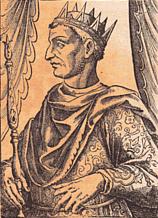
Intravital portraits of William the Evil, except for images on coins, have not been preserved. There is only a verbal description of the king in the chronicles, representing him as a very pale man with a huge black beard, which terrified contemporaries [1] .
Troubles in the kingdom and Byzantine intervention (1154–1156)
Wilhelm the Evil was completely trusted in government affairs by the emir of emirs Mayo from Bari , the son of a merchant and judge from Bari , whose activities aroused the envy and anger of the barons who lost access to the king. Mayo, an Italian by birth, who occupied the post, previously always belonging to the Greek community, ostentatiously removed Norman barons and Greeks from the court, bringing Italians and Muslims closer to him. The discontented barons of Southern Italy soon united around the cousin of King Count Robert de Loritello , who entered into negotiations with the Byzantine commander Michael Paleolog [3] .
Emperor Manuel I Comnenus , who managed to cope with the problems on the borders of his own empire, but who lost his ally in the West with the death of Conrad III , decided to conquer southern Italy for Byzantium, without the help of foreign allies, with the support of the rebellious Italian barons. In August 1155, the Byzantine army, teamed up with the Apulian rebels, took possession of Bari , a predominantly Greek city taken at the time by the Normans after a three-year siege in 1071 . The inhabitants of Bari themselves opened the gates to the Byzantines, and the Sicilian citadel in the city center was razed to the ground. Success in Bari inspired the Byzantine army and the rebels: the neighboring cities of Trani and Giovinazzo were also soon taken. The main Sicilian continental army under the command of Askletin was in Campania and managed to arrive at the scene in Puglia only at the end of September 1155 and was immediately blocked in Barletta . The main battle took place at Andria , which was heroically defended by the Byzantines Count Richard of Andria . However, Andria fell, and her count was killed on the battlefield [4] .
In September 1155, the side of the Byzantines was taken by Pope Adrian IV , who also invaded the kingdom with the army. Prince Robert II of Kapuan, who returned from his many years of exile, again received Kapuy from the hands of the pope, and the barons who supported him recognized him as one of the overlords of Adrian IV. By the end of 1155, of all the mainland possessions, only Calabria remained under the control of William the Evil. In Puglia, Byzantine domination was restored, the campaign was controlled by Adrian IV and the barons sworn to him [5] .
Meanwhile, William I, who was in Sicily, dispassionately watched the loss of continental possessions. From the state of apathy he was brought out by the Baron revolt in Buter, which had already begun in Sicily, and unrest in Palermo , whose participants demanded the expulsion of Mayo from Bari . William I, having gathered an army, proceeded to Butera, whose defenders did not expect a royal attack and therefore were forced to surrender to the mercy of the king. The rebels saved their lives and property, but were sentenced to expulsion from the country. Now William was ready to start a war on the continent [6] .
Restoration of Sicilian kingdom power on the continent
In April 1156, the army and fleet of William I met in Messina , where it was supposed to launch an attack on the continent. Askletin , summoned to Messina, was convicted of his inaction and thrown into prison, where he later died, and his estates were confiscated [7] .
At the end of April, the army of William I crossed over to Calabria, from where they marched on a march to Apulia . The king’s fleet from Messina sailed to Brindisi , the last city of Puglia, not subdued by the Byzantines. The commander of the Byzantine army, John Duca (his predecessor, Michael Paleologus, had died by this moment) took possession of the city, but could not take the inner citadel. In addition, the Norman barons, led by Robert de Loritello, quarreled with the Greeks and left Brindisi, and after them the mercenaries who had not received the desired increase in salary were deserted from the Greek army. The Sicilian fleet blocked the exit from the harbor, the army of William I besieged the city, and the remains of the Byzantine army and navy were blocked in Brindisi. In the ensuing bloody battle of May 28, 1156, the Greeks were destroyed. The invasion of 1155 - 1156 was the last attempt of Byzantium to regain the lost South Italian possessions, the Byzantine army and navy never invaded the Apennine peninsula [8] .
Having freed Brindisi, William I quickly rushed to Bari . Residents of the city, a year earlier who sided with Byzantium and abandoned it to their fate, begged the king for mercy. William, pointing them to the ruined Sicilian stronghold, refused them mercy. After giving the citizens two days to save the property, William I completely destroyed Bari on the third day, preserving only the cathedral of St. Nicholas and several temples [9] .
From Bari, William I moved to Campania . Robert de Loritello with some rebel barons fled under the protection of the pope, while others were thrown into prisons and deprived of fies. According to Hugo Falkand , the king ordered the captive barons to be thrown into the pit with snakes, and their wives and daughters were sent to the harem or forced into prostitution. Prince Robert II of Capuan , one of the most stubborn opponents of royal power since Roger II , was sent in chains to Palermo , where he was blinded and sentenced to life imprisonment [10] .
The Benevente Pact of 1156 with Pope
Adrian IV preferred to avoid an open war with William I and on June 18, 1156 concluded a peace treaty with him in Benevento . William I took Adrian IV a vassal oath and recognized the authority of the pope in church affairs in his continental possessions. These were the only concessions of the triumphant king. For the first time since Innocent II , whose successors preferred to forget about the papal approval of the creation of the Sicilian kingdom , the pope officially recognized William I as king of Sicily, duke of Apulia and prince of Capua . The lands in Abruzzi and Marc , conquered by the sons of Roger II after 1139 , were recognized as part of the Sicilian kingdom. Adrian IV recognized the legacy of William I in Sicily, inherited by the Sicilian kings from Roger I. The pope refused the right to send other legates to Sicily and accept complaints from the Sicilian clergy. The king was entrusted with the right to approve bishops on the island and make the final decision on permitting or prohibiting the Sicilian clergy from traveling to Rome at the call of the papal curia [11] .
The Benevento Treaty of 1156 was the biggest victory of Otvile over the papacy. Remaining formally a papal vassal, William I finally established the border between his possessions and the Papal region , which remained unchanged until 1861 , and achieved almost unlimited power over the Sicilian church.
Loss of possessions in North Africa
The war with Byzantium and the turmoil in Puglia caused the Sicilian kingdom to lose possessions in North Africa. In 1156, Sfax revolted, Djerba followed his example, in 1159 the power of the Sicilians was overthrown in Tripoli . The small Christian population of these cities was slaughtered or fled to Mahdia - the last stronghold of the Sicilian kingdom in northern Africa [12] .
On June 20, 1159, Mahdia was blocked from the sea and land by the forces of the Almohad empire. An attempt by the Sicilian fleet to break the blockade was unsuccessful, after which the city was abandoned by William I and Mayo from Bari to their fate. After making sure that help would not come from Sicily, the garrison of Mahdia capitulated on January 11, 1160 [13] .
Mayo’s possessions were lost to Mayo almost without a fight, since they ceased to interest him. Mayo focused on difficult negotiations with the pope and the Lombard cities, which laid the foundation for the future Lombard League . Switching in foreign policy to confrontation with Frederick Barbarossa in Italy, Mayo did not want to sacrifice the country's forces to keep the strongholds that became useless in North Africa [14] .
The political crisis of 1160–1161
The Mayo Murder
After the end of the turmoil on the peninsula in 1156 and the massacre of the rebels, William I again withdrew from political life, spending a life of laziness and bliss in his palaces. In fact, power was in the hands of Mayo from Bari and his close baptized eunuch Arabs, which aroused discontent among the aristocracy and clergy. Soon, the dissatisfied united around Matteo Bonnellus , the alleged son-in-law of Mayo, who enjoyed his unlimited trust. On November 10, 1160, Mayo, returning almost without protection from the Archbishop of Palermo Hugo, was killed by Bonnellus and his accomplices. The killers, fearing the possible consequences of their act, fled from Palermo to the castle of Caccamo . But the bewildered William I, who did not represent the true size of the conspiracy, preferred not to punish the killers, but to make peace with them. Bonnellus, which gained great popularity among the aristocracy and citizens of Palermo, returned to Palermo, was received by the king and took a high position at court [15] .
March 1161
However, the conspirators did not trust the forgiveness of the king and decided to eliminate it. The conspirators could not penetrate the palace, which was well guarded by Muslim guards. Therefore, on March 9, 1161, the conspirators, having bribed one of the guards of the prison located directly in the palace, managed to free the participants of the rebellion of 1155 - 1156 there . The freed captives, including Roger II's illegitimate son Simon and Wilhelm’s nephew Tancred de Lecce , managed to take control of the palace and let their allies into it. William I, his wife and children were taken into custody, palace guards and eunuchs close to the king were killed. The palace was looted, many priceless works of art, including the silver planisphere of al-Idrisi , disappeared. The news of the coup led to the first pogroms of Muslims in the history of the Sicilian kingdom [16] .
The conspirators announced the deposition of William I and the enthronement of his nine-year-old son Roger . Meanwhile, the townspeople and the clergy, seeing the atrocities of the conspirators, refused to support them. On March 11, 1161, the highest clergy, including Archbishop Salerno Romuald and Bishop of Syracuse Richard Palmer , called on the townspeople to release William I from custody. Now the conspirators were trapped and begged William I for mercy. Still in their hands, William I vowed not to pursue them and, going to the balcony, urged the townspeople to let the running rebels pass without harm. After the rebels escaped to Kakkamo, William I regained freedom and power [17] .
The coup attempt cost the king dearly. In the turmoil on March 11, 1161, his eldest son Roger died from a stray arrow, and the enemies of the king, including his chronicler Hugo Falkand , attributed the death of the child to Wilhelm himself, who allegedly did not forgive his son for becoming an involuntary banner of the coup. The tremendous wealth accumulated by the predecessors of William Roger I and Roger II were plundered. The majority of Palermo Muslims, traditionally close to the courtyard of Otvile, were killed. In addition, in the first time after the March events, Wilhelm was again forced to flirt with his failed killers, who took refuge in Caccamo [18] .
Reprisal in Sicily
The arrival of the army and navy from Messina allowed William to resolve the crisis. The rebels surrendered and were mostly expelled. Bonnellus, again bargaining for himself and arrogantly returning to the court in Palermo, was soon arrested. His supporters again tried to revolt, but were now easily defeated. This time, William I, who completely conquered the situation, brutally cracked down on his opponents: some were executed, others, including Bonnellus, were mutilated and sentenced to life imprisonment [19] .
End of Reign
The subsequent revolt of March 1161, the rebellions of the displeased barons were crushed by William I with extraordinary cruelty. In Sicily, the cities of Piazza and Butera , sheltering the escaping supporters of Bonnellus, were taken and destroyed by the king during 1161. On the continent, pacified by the royal army in 1162, captured rioters were hanged, drowned, maimed, and fines were imposed on rebellious cities and regions - "redeeming money." The capital of Apulia Salerno , who in 1161 sided with the rebel barons, was also to be destroyed by order of William. Archbishop Salerno Romuald states in his chronicle that the city was saved by the Apostle Matthew , his patron, who sent a terrible storm to the royal camp in the middle of a clear day [20] .
During his stay on the continent in 1162, William left his baptized eunuch Martin as his viceroy in Sicily. Martin and his friends, former or true Muslims, launched real terror on the island, taking revenge on Christians for the Muslims who died during the March 1161 coup and the subsequent rebellion of Bonnellus supporters. Heinrich Aristippus , Mayo's successor to Bari , accused of having kidnapped several women from the royal harem in March 1161 and died in custody was a victim of terror. The growth of inter-religious hostility, unprecedented in Sicily since the time of Roger I , was stopped only by the return of William I to Palermo in the summer of 1162 [21] .
Confiscations of rebel property and “redeeming money” allowed William I to repair the damage caused to the treasury by the crisis of 1160–1161 . Enemies of the king were either expelled, or repressed, or intimidated.
The last years of the reign of the king ( 1163 - 1166 ), as, indeed, the reign of his son William II , were a time of tranquility and prosperity. After 1162, William I again removed himself from power, indulging in pleasures in an oriental spirit. His most beloved residence was the Ziza Palace, built by his order near Palermo and is an interesting monument of Norman secular architecture [22] .
William I died of dysentery in Palermo on May 7, 1166 . He was originally buried in the Palatine Chapel in Palermo. After the construction of the cathedral in Montreal was completed, the body of William I was moved there and placed in a luxurious porphyry sarcophagus [23] .
Family and Children
William I was married (about 1150) to Margarita of Navarre (+1182), daughter of Garcia VI the Restorer , King of Navarre (1134–1150). At least three sons from this marriage are known:
- Roger ( 1152 - March 11, 1161 ), Duke of Puglia, was killed during the March 1161 coup.
- William II Good ( 1154 - November 18, 1189 ), King of the Sicilian Kingdom since 1166.
- Henry (1159–1171), Prince of Capua .
William I had one illegitimate daughter, Marina, who married Admiral Margarita from Brindisi .
Literature
- Wilhelm I the Evil // Brockhaus and Efron Encyclopedic Dictionary : in 86 volumes (82 volumes and 4 additional). - SPb. , 1890-1907.
- Norwich, John . The heyday and sunset of the Sicilian kingdom. Normans in Sicily. 1130-1194. - Moscow: Centerpolygraph, 2005 .-- S. 168-245. - 399 p. - ISBN 5-9524-1752-3 .
- Vasiliev A. A. History of the Byzantine Empire . - SPb. : Aletheia, 2000 .-- T. 2 .-- 593 p. - ISBN 5-89329-200-6 .
Notes
- ↑ 1 2 Norwich, John . The heyday and sunset of the Sicilian kingdom. Normans in Sicily. 1130-1194. - Moscow: Centerpolygraph, 2005 .-- S. 169-170. - 399 p. - ISBN 5-9524-1752-3 .
- ↑ Norwich John . The heyday and sunset of the Sicilian kingdom. Normans in Sicily. 1130-1194. - S. 170—171.
- ↑ Norwich John . The heyday and sunset of the Sicilian kingdom. Normans in Sicily. 1130-1194. - S. 172-174.
- ↑ Norwich John . The heyday and sunset of the Sicilian kingdom. Normans in Sicily. 1130-1194. - S. 187-190.
- ↑ Norwich John . The heyday and sunset of the Sicilian kingdom. Normans in Sicily. 1130-1194. - S. 190—191.
- ↑ Norwich John . The heyday and sunset of the Sicilian kingdom. Normans in Sicily. 1130-1194. - S. 191-194.
- ↑ Norwich John . The heyday and sunset of the Sicilian kingdom. Normans in Sicily. 1130-1194. - S. 194-195.
- ↑ Norwich John . The heyday and sunset of the Sicilian kingdom. Normans in Sicily. 1130-1194. - S. 195-196.
- ↑ Norwich John . The heyday and sunset of the Sicilian kingdom. Normans in Sicily. 1130-1194. - S. 197.
- ↑ Norwich John . The heyday and sunset of the Sicilian kingdom. Normans in Sicily. 1130-1194. - S. 197-198.
- ↑ Norwich John . The heyday and sunset of the Sicilian kingdom. Normans in Sicily. 1130-1194. - S. 199-201.
- ↑ Norwich John . The heyday and sunset of the Sicilian kingdom. Normans in Sicily. 1130-1194. - S. 211-212.
- ↑ Norwich John . The heyday and sunset of the Sicilian kingdom. Normans in Sicily. 1130-1194. - S. 212-214.
- ↑ Norwich John . The heyday and sunset of the Sicilian kingdom. Normans in Sicily. 1130-1194. - S. 211, 215.
- ↑ Norwich John . The heyday and sunset of the Sicilian kingdom. Normans in Sicily. 1130-1194. - S. 217-221.
- ↑ Norwich John . The heyday and sunset of the Sicilian kingdom. Normans in Sicily. 1130-1194. - S. 224-227.
- ↑ Norwich John . The heyday and sunset of the Sicilian kingdom. Normans in Sicily. 1130-1194. - S. 227-229.
- ↑ Norwich John . The heyday and sunset of the Sicilian kingdom. Normans in Sicily. 1130-1194. - S. 229-230.
- ↑ Norwich John . The heyday and sunset of the Sicilian kingdom. Normans in Sicily. 1130-1194. - S. 231-234.
- ↑ Norwich John . The heyday and sunset of the Sicilian kingdom. Normans in Sicily. 1130-1194. - S. 234-237.
- ↑ Norwich John . The heyday and sunset of the Sicilian kingdom. Normans in Sicily. 1130-1194. - S. 237-238.
- ↑ Norwich John . The heyday and sunset of the Sicilian kingdom. Normans in Sicily. 1130-1194. - S. 238-240.
- ↑ Norwich John . The heyday and sunset of the Sicilian kingdom. Normans in Sicily. 1130-1194. - S. 243-244.
Links
- Miroslav Marek. de Hauteville . GENEALOGY.EU . Date of treatment April 6, 2009. Archived on August 25, 2011.
- Architectural heritage . - A site dedicated to the Norman heritage, including in southern Italy. Date of treatment April 6, 2009. Archived January 28, 2012.
| Predecessor: Roger II | King of sicily 1154 - 1166 | Successor: William II the Good |