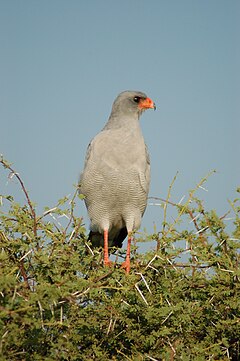
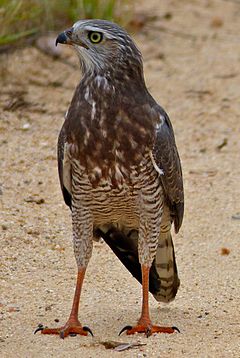
Song hawks ( LatinMelierax ) is a genus of birds of prey from the hawk family. Previously included in the hawk subfamily, but now isolated in the monotypic subfamily Melieraxinae. The genus includes 3 species: light , gray and dark song hawks. The song hawks got their name for the melodic song that the males sing during the mating season. In addition, birds can scream like other hawks. The color of all species is gray with transverse stripes on the lower side of the body. . Song hawks feed on small vertebrates and insects . They can be found in the savannahs and open woods of Africa. .
Song hawks
Adult Light Song Hawk
Young Dark Singing Hawk
Scientific classification
Domain:
Eukaryotes
Kingdom:
Animals
Kingdom :
Eumetazoi
No rank :
Bilateral symmetrical
No rank :
Secondary
Type of:
Chordate
Subtype :
Vertebrates
Infratype :
Maxillary
Overclass :
Tetrapods
Grade:
Birds
Subclass :
Real birds
Infraclass :
Newborn
Squad:
Hawk-like
Family:
Hawk
Subfamily :
Melieraxinae
Gender:
Song hawks
International scientific name
MelieraxGR Gray , 1840
Content
1Etymology and systematics
2Description
2.1Appearance
2.2Voice
2.3Types
3Reproduction
4Power
5Distribution
6notes
7Literature
8References
Etymology and Systematics
The scientific name of the genus Melierax in translation means "song hawk", which corresponds to the Russian name of the genus [1] . Formed from two Greek words: μελος (melos) - song and ἱερακος (hierax) - hawk [2] . Such a name was given to these birds for their rare (among birds of prey) ability to make melodious cries.
Previously, the genus of song hawks was part of the subfamily hawks (Accipitrinae), but now it is in its own subfamily - Melieraxinae [3] .
Description
Appearance
All representatives of the genus are large birds with a body length of 45–55 cm, a wing length of 30–36 cm, and a mass of 500–850 g. The beak is relatively small, and the legs and tail are long. The plumage of the plumage of young birds is brown, adults - gray. The lower side of the body is transversely streaked with light stripes, the tail from the bottom is also streaked [4] .
Voice
The male’s song during the breeding season consists of a series of melodic whistles, sounding like a flute. During danger warns with sharp screams, the same as with other hawks [4] .
Melierax metabates(Heuglin, 1861) - The Dark Song Hawk ,
Melierax poliopterus(Cabanis, 1869) - Gray song hawk .
Earlier, the genus included the chanting hawk-gabar ( Micronisus gabar(Daudin, 1800) ) [ syn.Melierax gabar(Daudin, 1800) ] [5] .
Reproduction
Like many birds of prey, song hawks build nests on top of trees. Typically, birds choose low trees, such as acacia. The female lays 1-3 eggs with a blue and white shell. Only the female incubates. Chicks hatch in 30–33 days, and in another 35–38 days they will learn to fly [4] .
Nutrition
The diet of song hawks includes small mammals (often rodents), lizards, snakes and large insects (locusts). Their hunting method is interesting: catching prey, birds quickly run and jump like an American running cuckoo[4] .
Distribution
Song hawks live in Africa. They can be found in open spaces and in sparse forests [4] .
Notes
↑Boehme R. L. , Flint V. E. The Bilingual Dictionary of Animal Names.Birds.Latin, Russian, English, German, French / Ed.ed.Acad.V. E. Sokolova .- M .: Rus.lang., "RUSSO", 1994. - S. 46. - 2030 copies.- ISBN 5-200-00643-0 .
↑James A. Jobling, 2010 , p.249.
↑Lerner, Heather RL .
↑ 12345Galushin, 1991 , p.79.
↑Song gabar hawk(English) .The IUCN Red List of Threatened Species .
Literature
Galushin V.M., Drozdov N.N., Ilyichev V.D., Konstantinov V.M., Kurochkin E.N., Polov S.A., Potapov R.L., Flint V.E., Fomin V E. Fauna of the world.Birds.Directory.- M .: Agropromizdat, 1991 .-- 311 p.- ISBN 5-10-001229-3 .
James A. Jobling.The Helm Dictionary of Scientific Bird Names.- London: A&C Black Publishers Ltd, 2010 .-- 432 p.- ISBN 978-1-4081-2501-4 .