
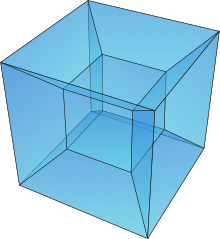
In geometry, the Schlegel diagram is a projection of a polytope from at through a point beyond one of its faces . The resulting figure in combinatorially equivalent to the original polytop. The diagram is named for Victor Schlegel , who proposed in 1886 this method for studying the combinatorial and topological properties of polytopes. In dimensions 3 and 4, the Schlegel diagrams are the projection of the (3-dimensional) polyhedron into a flat figure and the projection of the in three-dimensional space, respectively. As such, Schlegel diagrams are often used to visualize four-dimensional polyhedra.


Content
Build
The most elementary description of the Schlegel diagram for a polyhedron is given by Duncan Sommerville [1] :
- A very useful method for representing a convex polyhedron is a flat projection. If this projection is made from an external point, since each ray intersects the polyhedron twice, it will be represented by a polygonal region divided twice into polygons. There is always a suitable choice of the projection center so that the projection of one of the faces contains the projections of all the other faces. This is called the Schlegel diagram of a polyhedron. The Schlegel diagram fully represents the morphology of the polyhedron. Sometimes it’s convenient to make a projection of a polyhedron from a vertex. The vertex is projected to infinity and does not appear on the diagram, the edges going to it are represented by rays going to infinity.
Sommerville also considered the case of a simplex in four-dimensional space [2] : "The Schlegel diagram of a simplex in S 4 is a tetrahedron divided into four tetrahedra." In a more general case, a polytop in n-dimensional space has a Schlegel diagram constructed using perspective projection through a point outside the polytop, above the center of the face. All vertices and edges of a polytope are projected onto the hyperplane of this face. If the polytop is convex, there is a point near the face at which this face becomes external, and all other faces appear inside it, while the edges will not intersect.
Examples
| Dodecahedron | Centenary |
|---|---|
| 12 pentagonal faces on the plane | 120 dodecahedrons (cells) in 3-dimensional space |
Different types of visualization of the icosahedron
| perspective | scan | projection |
| Petrie | Schlegel | Vertex figure |
See also
- Sweep is another approach to visualization through polyhedra of smaller dimensions, in which the faces are disconnected and unbent until all faces are in the same hyperplane. This representation preserves geometric dimensions and shape, but it is more difficult to consider topological connections.
Notes
- ↑ Sommervill, 1929 , p. 100.
- ↑ Sommervill, 1929 , p. 101.
Literature
- Duncan Sommervill. Introduction to the Geometry of N Dimensions. - EP Dutton, 1929. Reprint 1958 by Dover Books .
- Victor Schlegel . Theorie der homogen zusammengesetzten Raumgebilde . - Druck von E. Blochmann & Sohn in Dresden, 1883 .-- T. Nova Acta, Ksl. Leop.-Carol. Deutsche Akademie der Naturforscher XLIV. Archived March 12, 2007. Archived March 12, 2007 on Wayback Machine
- Victor Schlegel. Ueber Projectionsmodelle der regelmässigen vier-dimensionalen Körper. - Waren, 1886.
- HSM Coxeter . . - Methuen and Co., 1948 .-- S. 242.
- Regular Polytopes . - 3rd edition. - Dover edition, 1973. - ISBN 0-486-61480-8 .
- Branko Grünbaum . Convex polytopes / Volker Kaibel, Victor Klee, Günter M. Ziegler. - 2nd. - New York, London: Springer-Verlag , 2003 .-- ISBN 0-387-00424-6 .
Links
- Weisstein, Eric W. Schlegel graph on Wolfram MathWorld .
- Weisstein, Eric W. Skeleton on Wolfram MathWorld .
- George W. Hart: 4D Polytope Projection Models by 3D Printing
- Nrich maths - for schoolchildren as well as for teachers.