The 9th Galician Infantry Regiment ( German: Galizisches Infanterie-Regiment Nr. 9 ) is the Galician (Ruthenian or Ukrainian) infantry regiment of the Unified Army of Austria-Hungary .
| 9th Galician Infantry Regiment (Austria-Hungary) | |
|---|---|
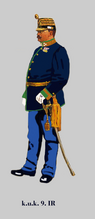 Colonel of the 9th Infantry Regiment | |
| Years of existence | 1725 - 1918 |
| A country |  Austrian Empire Austrian Empire  Austria-Hungary Austria-Hungary |
| Subordination | 1914: 10th Corps, 24th Infantry Division 1918: 26th Corps, 4th Infantry Division |
| Included in | 1914: 47th Infantry Brigade 1918: 7th Infantry Brigade |
| Type of | infantry |
| Number | 4 battalions |
| Dislocation | Przemyьl (headquarters) [1] Stryi (recruitment site) |
| Nickname | Galician |
| Patron | Baron Paken von Kilstedten, Earl of Clerfeith |
| Colors | green apple |
| Participation in | Austro-Turkish Wars Seven year war Napoleonic Wars [2] The revolution of 1848-1849 in Hungary Austro-Prussian-Italian War [3] World War I |
| Commanders | |
| Famous commanders | Felix Kiprus-Sobolevsky |
Content
History
It was founded in 1725. Headquarters - Przemysl . The set was carried in Stryi. He participated in the Austro-Turkish wars, in the Seven Years War, in the Napoleonic Wars and the Austro-Italo-Prussian War, as well as in the Hungarian uprising. At different times, the patrons of the regiment were Baron Paken von Kilstedten and Count Klerfeit [4] .
The regiment consisted of 4 battalions: the 1st and 4th were based in Przemysl before the start of the WWII, the 2nd in Stryi , the 3rd in Radymno . The national composition of the regiment as of 1914: 73% - Ukrainians, 20% - Poles, 7% - other nationalities [5] .
In 1914, the regiment went to the Italian front of the First World War [6] . He also fought on the Eastern Front , was one of the participants in the battles for Mount Makovka .
During the so-called reforms of Konrad since June 1918 the number of battalions was reduced to three [7] , and the 4th battalion was disbanded [8] .
Commanders
- 1859: Colonel Franz Thun-Hohenstein [9]
- 1865: Colonel Adolf Baumbach [10]
- 1873: Colonel Rudolf Kreutner von Tatenburg
- 1879: Colonel Heinrich Pelican [11]
- 1903: Colonel Baron Karl Daublesky von Sternek zu Ehrenstein
- 1904-1907: Colonel Richard Schreyer
- 1908-1910: Colonel Ritter Franz Streiter von Schwarzenfeld [12]
- 1911-1914: Colonel Felix Kiprus-Sobolevsky von Sobolow [1]
Notes
- ↑ 1 2 Weltkriege.at - Infanterieregimenter der ö.u. Armee im Mai 1914 vom kuk Heer
- ↑ Philip Haythornthwaite: Austrian Army of the Napoleonic Wars: Infantry (1986), str. 22-24.
- ↑ Darko Pavlović: The Austrian Army 1836-1866: Infantry (1999), str. 16-17.
- ↑ kuk Infanterieregimenter (German)
- ↑ Infanterie-Regimenter 1 - 102 as at July 1914.
- ↑ Isonzofront.com - Austro-Hungarian Regiments (link not available)
- ↑ Austro-hungarian-army.co.uk - Austro-Hungarian Infantry 1914-1918
- ↑ Peter Jung: The Austro-Hungarian Forces in World War I (2): 1916-18 (Osprey, 2003), str. 12.
- ↑ Austro-hungarian-army.co.uk - Regimental Commanders 1859
- ↑ Austro-hungarian-army.co.uk - Regimental Commanders 1865
- ↑ Austro-hungarian-army.co.uk - Regimental Commanders 1879
- ↑ Austro-hungarian-army.co.uk - Regimental Commanders 1908
Literature
- Tomasz Nowakowski, Armia Austro-Węgierska 1908-1918, Warszawa: “Feniks” 1992, ISBN 83-900217-4-9 .
- Maciej Krotofil, Ukraińska Armia Halicka 1918-1920, Toruń 2002, ISBN 83-7322-156-5 .
- Schematismus für das Kaiserliche und Königliche Heer und für das Kaiserliche und Königliche Kriege-Marine für 1895. Wiedeń: KK Hof- und Staatsdruckerei, 1894.
- Schematismus für das Kaiserliche und Königliche Heer und für das Kaiserliche und Königliche Kriege-Marine für 1900. Wiedeń: KK Hof- und Staatsdruckerei, 1889.
- Österreich-Ungarns bewaffnete Macht 1900-1914
- Austro-Hungarian Land Forces 1848-1918 By Glenn Jewison & Jörg C. Steiner