Clever Geek Handbook
📜 ⬆️ ⬇️

Inca Streptopelia

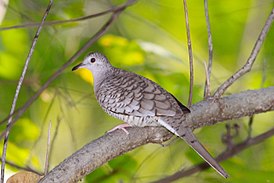
Inca Streptopelia ( lat. Columbina inca ) - a species of birds of the pigeon family . Genus Earthy Streptopelia ( lat. Columbina ). It is listed in the IUCN Red List as a species of least concern (LC) [1] . Distributed in Guatemala , Honduras , Costa Rica , Mexico , Nicaragua , El Salvador and in the southwestern United States . Despite its name, the bird does not inhabit and did not inhabit the territory of the Inca Empire.

Inca Streptopelia
Inca Dove (8258748456) .jpg
Inca Streptopelia
Scientific classification
Domain:Eukaryotes
Kingdom:Animals
Kingdom :Eumetazoi
No rank :Bilateral symmetrical
No rank :Secondary
Type of:Chordate
Subtype :Vertebrates
Infratype :Maxillary
Overclass :Tetrapods
Grade:Birds
Subclass :Real birds
Infraclass :Newborn
Squad:Pigeon-shaped
Family:Pigeon
Subfamily :Midgets
Gender:Earthen Dove
View:Inca Streptopelia
International scientific name

Columbina inca Lesson , 1847

Security status
Status iucn3.1 LC ru.svg Виды под наименьшей угрозой
Least Concerned
IUCN 3.1 Least Concern : 22690762

The size of the neck is 16.5–23 cm in length. Weight - 30-58 grams [2] . They have a gray-brown plumage with a contour. The tail is long and square, framed by white feathers that are noticeable during flight. Under the wings, the color of the feathers is reddish, as in other earthen doves. When take off, the wings produce a characteristic quiet rattling noise.

They live in flocks. Shrub steppes are their natural habitat , where they feed on seeds. Often they come to cities and villages for food.

The song of the bird is a loud coo, sounding like "kaul-ku" or "pu-pap." In winter they spend the night together, clinging to each other and creating a "pyramid", which allows them to keep warm. The “pyramids" can include up to twelve birds [3] .

Males and females erect their nests together on trees and shrubs. Nests made of twigs, grass, leaves are compacted by the feces of the chicks [4] .

Notes

  1. ↑ Columbina inca . The IUCN Red List of Threatened Species . Date of treatment November 26, 2013.
  2. ↑ “Inca dove” on the All About Birds website. Cornell lab of ornithology
  3. ↑ Robertson, Paul B .; Schnapf, Ann F. Pyramiding Behavior in the Inca Dove: Adaptive Aspects of Day-Night Differences (Eng.) // The Condor : journal. - Cooper Ornithological Society, 1987. - Vol. 89 , no. 1 . - P. 185-187 .
  4. ↑ Mueller, Allan; Mueller, Allan J. Inca Dove (Columbina inca) // The Birds of North America Online / Alan Poole. - Ithaca, NY: Cornell Lab of Ornithology, 2004 .-- DOI : 10.2173 / bna . 28 .

Literature

  • Sibley, David. The Sibley Field Guide to Birds of Western North America. - 2003. - ISBN 0-679-45121-8 .
  • Stiles, F. Gary. A Guide to the Birds of Costa Rica / F. Gary Stiles, Alexander F. Skutch. - Comstock Publishing Associates, 1989 .-- ISBN 0-8014-9600-4 .

Links

  • Inca dove - Columbina inca on USGS Patuxent Bird Identification InfoCenter
Source - https://ru.wikipedia.org/w/index.php?title=Ink_Gorlitsa&oldid=100880813


More articles:

  • Henry II (king of Cyprus)
  • Rhodium (III) Acetylacetonate
  • Seniors of Thira
  • Lithuanian women's field hockey team
  • Rural settlement “Gorno-Zerentuyskoye”
  • Kingang, Pierre
  • Plate Armor
  • Balansen
  • Sansevieria
  • Ramus (commune)

All articles

Clever Geek | 2019