The civil war in Finland ( Fin. Suomen sisällissota ) was part of the national and social ferment caused by the First World War in Europe . The Finnish Civil War was one of the many national and social conflicts in post-war Europe, it went from January 27 to May 15, 1918 between the " Reds " ( Finnish punaiset, punikki ), radical left , led by the Council of People's Commissioners of Finland ; and " white " ( Fin. valkoiset ), the bourgeois - democratic forces of the Finnish Senate . The Reds were supported by the Russian Soviet Republic , while the Whites received military assistance from the German Empire and, unofficially, from Sweden ( Swedish volunteers , military contingent and fleet forces on the Åland Islands).
| Civil war in Finland | |||
|---|---|---|---|
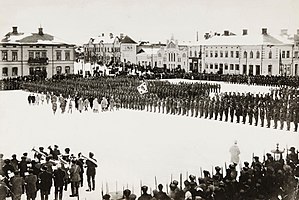 Parade in honor of the return of Finnish rangers from Germany to Vaasa , February 1918. | |||
| date | January 27 - May 16, 1918 | ||
| A place |  Finland Finland | ||
| Total | The victory of the whites, the retreat of the Red Guard to Russia, the deployment of white terror | ||
| Opponents | |||
| |||
| Commanders | |||
| |||
| Forces of the parties | |||
| |||
| Losses | |||
| |||


During the war, Finland was on the verge of starvation due to a constant lack of food. Both sides of the confrontation resorted to extrajudicial executions and terror.
Title
The civil war has several names that reflect different political, social and ideological views on this conflict: “liberation war” , “class war” , “red rebellion” , “peasant revolt” , “civil war” , “revolution” , “uprising” " , And " fratricidal war . " At the first mention of this conflict, the Council of People's Commissioners of Finland used the name "Revolution" . The Reds also used the terms "class war" and "rebellion" , in addition, the phrase "battle for freedom" is often present in obituaries and on the graves of the Red Guards. The expression "civil war" was widely used during the war by both sides. White used the terms “red rebellion” and “rebellion” . At the end of the war, when describing it, they began to emphasize the national character of the war of liberation against Russia and the Reds supported by it. Currently, in historical studies, the term “internal warfare” ( Fin. Sisälissota ) is mainly used , which is neutral and also implies the participation of other states .
Background
Background
The February Revolution of 1917 in the Russian Empire with great force kindled the hope of independence in the Grand Duchy of Finland , due to the fact that after the forced abdication of the throne on March 2 (15), 1917, of Emperor Nicholas II , who also bore the title Grand Prince of Finland, in favor of his brother Michael Alexandrovich and the latter’s non-acceptance of the throne, there were no pretenders to either the Russian or the Finnish throne.
In addition, in March, in Petrograd , the Provisional Government of Russia, Prince George Lvov, was formed, which on March 7 (20), 1917 issued a special manifesto on Finland [6] , as the Russian emperor had done before. The manifesto declared the restoration to the full extent of the so-called Finnish constitution ( Act on the form of government of Sweden in 1772 and ), limited to this by a number of manifestos and decrees of the Russian Empire. With this act, the Provisional Government of Russia “solemnly confirmed” “to the Finnish people, on the basis of its constitution, the unshakable preservation of its internal independence, the rights of its national culture and languages” [6] . In Finland, they respected the manifesto, as before, the royal decrees [7] .
March 13 (26), 1917 to replace the Russified Senate of Borovitinov , a new one was formed - the Finnish coalition senate of Tokoya . It included representatives of the Social Democratic Party of Finland and the bloc of bourgeois parties ( , Mladofinsky Party , Land Union (Peasant Union, Agrarian League) , Swedish People's Party ). In relation to Russia, senators were divided into two areas - compromisist and constitutional. The deputy chairman was the Social Democrat, the head of the unions Oscari Tokoi . The Finnish Senate was still chaired by the Russian Governor General of Finland . The Provisional Government on March 31 appointed Mikhail Stakhovich to this post.
The Provisional Government of Russia approved the Tokoy Senate, which began operations as a loyal representative of the Russian Provisional Government. The legitimacy of the Finnish Senate proceeded from the legitimacy of the Russian Provisional Government. The participation of socialists in the Finnish Senate was necessary to prevent possible unrest of workers, although it made it difficult to cooperate with the Provisional Government of Russia, where representatives of the Constitutional Democratic Party , the cadets, dominated. At the same time, the policy of the parties that entered the Finnish Senate coincided with the policy of national independence and parliamentarism. The revolution in Finland took place mainly within the walls of the Senate, bearing a constitutional character.
The Tokoy Senate introduced a bill to the Provisional Government of Russia “On the transfer of the decision of certain cases to the Senate and the Governor General.” The expansion of autonomy was outlined by dividing the power of the Grand Duke of Finland: the Senate of Finland - the solution of Finnish affairs, except for all-Russian, and concerning Russian citizens and institutions; the rest, including the convening and dissolution of parliament, to the Provisional Government of Russia. The bill was consistent with the Act of March 7 (20) and was legally invulnerable, but the Russian Provisional Government of the first composition rejected it. The response was an increase in Finnish separatism.
In April, the first government crisis erupted in Petrograd, in June a second one occurred, in July a third. On July 8 (21), 1917, Georgy Lvov was replaced by A.F. Kerensky , who also retained the post of military and naval minister, as minister-chairman. At the height of the July crisis, the Finnish parliament proclaimed the independence of the Grand Duchy of Finland from Russia (officially the Russian Empire) in internal affairs and limited the competence of the Provisional Government of Russia to military and foreign policy issues. On July 5 (18), 1917 , when the outcome of the Bolshevik uprising in Petrograd was not clear, the Finnish parliament approved a social-democratic project on transferring supreme power to itself. However, this law on the restoration of autonomous rights of Finland was rejected by the Provisional Government of Russia, the Finnish parliament was dissolved, and Russian troops occupied its building.
On September 1 (14), 1917, the Provisional Government of Russia adopted a decree according to which the bourgeois-democratic Russian Republic was proclaimed in the territory of the former Russian Empire and the monarchical government in Russia was finally abolished (before the convening of the Constituent Assembly). The main law of Finland, determining the supreme power, remained the law of 1772, on the contrary, which claimed absolutism . The same law in § 38 provided in the absence of a candidate for the throne, the election of a new higher authority (“new dynasty”) by the House of Representatives, which was subsequently used.
Despite this, the Provisional Government of Russia continued to consider Finland as part of Russia, and on September 4 (17), 1917 he was appointed the new Governor-General of Finland - Nikolai Vissarionovich Nekrasov . And on September 8, the last Finnish Senate was formed, which had Russian control over itself - the Setyal Senate .
Declaration of independence
On November 28, 1917, the Finnish parliament took over the supreme power in the country and formed a new composition of the government - the Senate of Finland under the leadership of Per Ewind Svinhuvud (see the Senate of Svinhuvud ), which authorized its chairman to represent the House of Representatives (Eduscunt - the Finnish parliament, or “the Sejm” as they called it in the Russian Empire) the draft of the new constitution of Finland.
Submitting the draft new constitution for consideration by the Finnish parliament on December 4, 1917, Senate Chairperson Per Ewind Svinhuvud announced a statement to the people of Finland by the Senate announcing the intention to change the Finnish political system (to adopt a republican way of government) and submit a new constitution of Finland, and also contained an appeal "to the authorities of foreign countries" [8] (in particular, to the Constituent Assembly of Russia [8] ) with the request for recognition of political independence and vereniteta people of Finland (which was later called the "Declaration of Independence of Finland" ) [8] . At the same time, the Senate submitted to Parliament “a number of other bills designed to facilitate the implementation of the most urgent measures to reform the state before the new constitution enters into force ” [8] .
On December 6, 1917, the said statement (declaration) was approved by the Finnish parliament by a vote of 100 against 88. This day became the national holiday of Finland Independence Day . On December 18 (31), 1917, the state independence of the Republic of Finland was first recognized by the Council of People's Commissars (government) of the Russian Soviet Republic , headed by V. I. Lenin [9] .
On December 22, 1917 ( January 4, 1918 ), the resolution of the Council of People's Commissars was officially ratified by the All-Russian Central Executive Committee of the Soviets of Workers 'and Soldiers' Deputies (the highest legislative, administrative and regulatory body of state power of the Russian Soviet Republic). [9]
During the first week of 1918, eight countries recognized independent Finland: January 4 - Russia, France and Sweden, January 5 - Greece, January 6 - Germany, January 10 - Norway and Denmark, January 11 - Switzerland. Information about this came to Helsinki with a delay, for example, the decision of France became known on January 6 [10] .
Food situation
Animal husbandry occupied a large share of Finland’s agriculture , which is why the country imported 60% of grain from abroad, primarily from Germany. They did not manage to establish their own grain production in Finland. The food situation worsened with the outbreak of the First World War, import became possible only from Russia, but the railroads of the Russian Empire set a higher priority for military cargo. The only way to solve the food problem was to control and regulate consumption. In February 1917, food cards were introduced in Finland, and food committees were set up on the ground to try to stave off price increases.
On July 27, 1917, Väinö Tanner and Väinö Vuoljoki concluded an agreement with the Provisional Government of Russia to supply 62,000 tons of grain to Finland by October, the Senate agreed to an advance payment of 60 million marks. Similar deals were made with the United States. Since there was no certainty in grain supplies, on May 16, Parliament approved a food law, which became the basis of Finland's food policy until 1920. The law violated the inviolability of property and free trade, gave the government the right to confiscate food and set prices [11] .
On June 5, 1917, compulsory seizures of surplus grain stocks began, which should be sold to the state. The seized grain was handed over to food committees, and they distributed it on cards. In the summer of 1917, this concerned up to 50% of the population, in 1918 - over 60%. In September, a check of the warehouses showed that the stocks were not enough to winter. Hopes for the supply of grain from the USA did not come true because of the war, Germany also waged an underwater war with the Entente and drowned sea transports; There were also no people who wanted to deliver grain to Scandinavia.
In December, a new organization began work - the food department, headed by V. A. Lavonius. It drew up a plan for resolving the food problem, but on January 22, 1918, members of the department submitted a request for resignation to the Senate - they did not see the necessary support from the government. The request remained pending - a coup d'etat occurred .
The food problem primarily affected the lack of grain. Workers and their families were most in need; their diets accounted for only 15–20% of the norm of grain products. Especially severely affected food shortages, although it was felt everywhere. At the same time, there was no famine in Finland: wheat was not the only food product for the Finns, and meat, fish, potatoes and root crops did not rise in price so much. Seizures of surplus of other products were made less zealously, and they looked at smuggling through fingers.
With the outbreak of the civil war, white and red had to solve the food problem independently. The Reds were forced to provide food to large cities, and due to poor relations with local producers they had to get grain from Russia. Both parties were forced to reduce the rate of flour on the cards [11] . On March 30, a train with Siberian wheat arrived in Helsinki, agreed by Toka. The train ran for five weeks and did not reach completely: when crossing the border, part of the cars had to be unhooked and left in Russia. The grain situation in the capital took on a desperate scale, but the arrival of the train was only of local importance.
The food supply for the whites was better organized; local committees were still responsible for the supply of civilians. They received food from Denmark, Germany and Sweden, but it was also not enough.
Supply continued to deteriorate after the war: a small increase in production could not compensate for the significantly increased demand. The worst situation was in the summer of 1918, when all food supplies ran out and no new ones arrived from abroad. The worst situation was in the camps of captive Red Guards. The food shortage disappeared only in the spring of 1919, when American wheat arrived, the supply of cities was facilitated, and the authorities were able to refuse to withdraw the surplus. The distribution of food received from local producers was discontinued during 1919, and that of imported food in 1921.
The growth of tension in society
However, tensions in the country increased.
Schutzkor emerges in 1917 almost throughout Finland under the pretext that the police allegedly ceased to maintain order. After the October Revolution, the Finnish Red Guards (“Reds”) began to confront the Shutskor troops (“ white ” ), which often led to armed clashes. [12] A number of Shyutkorov detachments in the territory occupied in 1918 by the Red Army were called "fire brigades" for conspiracy.
12 января 1918 года буржуазное большинство парламента Финляндии (Эдускунта) уполномочило Сенат Финляндии принять жесткие меры по наведению порядка в стране. Сенат поставил эту задачу перед генералом Маннергеймом [13] , прибывшим в Гельсингфорс лишь за месяц до событий. Начальной задачей Маннергейма было лишь организовать верные правительству войска [13] . Получив полномочия, он отбывает в Ваасу [14] .
18 февраля 1918 года Маннергейм ввёл всеобщую воинскую обязанность , одновременно используя отряды шюцкора, как костяком создаваемой им армии. 25 января Сенат провозгласил все формирования шюцкора законными войсками правительства Финляндии. [13]
Кадровые вопросы решились с возвращением из Германии 25 февраля 1918 года основной группы финских егерей . Армия получила командиров и преподавателей военного дела . Рядовой состав состоял главным образом из крестьян-частников, интеллигентов и других гражданских.
Начало противостояния
В то же время, умеренные и радикалы Социал-демократической партии Финляндии (СДПФ) приняли важное решение — 22 января 1918 г. на заседании Совета СДПФ был наконец образован высший революционный орган — «Исполнительный комитет финляндских рабочих» [15] , который подготовил план переворота. Переворот было решено осуществить с помощью военной помощи, обещанной Лениным уже 13 января 1918 г. (спустя всего две недели после признания финской независимости), для чего нужно было обеспечить доставку оружия в Гельсингфорс, что и было сделано 23 января 1918 года [16] .
Несмотря на то, что план восстания был подготовлен Исполнительным комитетом рабочих, сформированным на заседании Совета СДПФ, революционное восстание началось «не дожидаясь руководства социал-демократии», силами пролетариата Гельсннгфорса [15] . Сигналом к началу революции был красный флаг , поднятый в Гельсингфорсе вечером 27 января 1918 г. на башне Народного дома [17] (по другим источникам — «красный свет», который зажёгся вечером 26 января «над домом рабочих» [16] ). (Народные дома в Финляндии были аналогичны подобным заведениям в других скандинавских странах. Находились под контролем СДПФ и осуществляли образование, просветительство и культурную деятельность «среди рабочего населения» [17] .)
В первый день восставшим удалось захватить только железнодорожный вокзал. Полностью столица была под их контролем уже на следующий день, 28 января. Красная гвардия заняла столицу и был создан революционный Совет народных уполномоченных Финляндии ( фин. Suomen kansanvaltuuskunta ) [18] , который в тот же день принял декларацию «К рабочим и гражданам Финляндии!», где объявил себя революционным правительством страны [19] [20] .
Декларация была опубликована на следующий день, 29 января 1918 года, в газете «Рабочий» ( фин. Työmies ) [20] [19] . В ней содержалась программа революции, которая, была заявлена, как социалистическая [20] [19] , но, по сути, программа была буржуазно-демократической [17] . На практике, по инициативе рабочих стал осуществляться слом прежних государственных учреждений, устанавливаться рабочий контроль на железных дорогах, заводах, и т. п. Этот значительный революционный подъём заставил Совет народных уполномоченных проводить более решительную политику, в ходе которой был установлен контроль над частными банками, закрыта контрреволюционная пресса, создан Верховный революционный суд ( фин. vallankumouksellisen ylioikeuden [21] ). Рабочие советы предприятий стали органами диктатуры пролетариата .
Восставшие пришли к власти и во многих других южных городах [16] , таких как Або , Таммерфорс , Пори , Котка , Лахти , Выборг и других, в которых проживало около 2/3 населения страны. Под контролем прежнего правительства оставались, хотя и бóльшие по территории, но гораздо меньше населенные Север и значительная часть центральной Финляндии.
Для наблюдения за исполнительной властью 14 февраля 1918 г. был создан Верховный совет рабочих Финляндии (или Центральный Рабочий Совет [19] , фин. Työväen pääneuvosto [22] ), который состоял из 40 [22] народных депутатов, призванных контролировать деятельность Совета народных уполномоченных. Председателем Верховного Совета рабочих был Вальфрид Перттиля [21] [23] , в состав Совета входили [22] :
- 15 человек от СДПФ;
- 10 человек от профсоюзов;
- 10 человек от Красной гвардии;
- 5 человек от Гельсингфорсского Союза Рабочих.
Начало Гражданской войны можно определить весьма условно. Красные считали, что революция началась 27 января в 23:00, белые — что 28 января в 03:00. Но и это тоже условно — военные действия в некоторых местах начались задолго до января, особенно в Карелии. Причина этого в том, что ни одна из сторон полностью не контролировала своих сторонников.
The workers' executive committee ordered the arrest of 46 people, but the operation to detain them could not be called successful, in particular, all senators safely disappeared [24] . The Reds came to power in many other southern cities [13] . On January 28, a revolutionary Council of People's Commissioners of Finland ( Fin. Suomen kansanvaltuuskunta ) was created, headed by Kullervo Manner [18] .
Since there was a danger of shelling the capital from Sveaborg fortress and from the sea, the center of defense was moved to Vaasa . The Svinhuvud Senate moved there. The united front between the white and the red was established at the beginning of the war along the lines of Pori - Ikaalinen - - Vilpula - Lankipokhya - Padasyoki - Heinola - Mantyuharya - Savitaypale - Lappeenranta - Antrea - Rauta . Both sides in the rear remained centers of resistance, which were cleared of the enemy by the end of February 1918. In the rear of the whites it was Oulu , Tornio , Kemi , Raahe , Kuopio and Varkaus . In the rear of the Reds are Uusikaupunki , Siuntio Kirkkonummi and the Porvo region.
The war of 1918 was “railway”, since railways became the most important ways of moving troops. The parties fought for the main railway junctions, such as Haapamyaki , Tampere , Kouvola and Vyborg . White and red had between 50,000 and 90,000 soldiers. The Red Guards troops were assembled mainly from volunteers, on the white side there were only 11,000-15,000 volunteers. The main motives for voluntarily joining the troops from both sides were material (ration and ration), as well as ideological reasons, as well as the influence of the environment and coercion . A special feature of the Reds was the creation of, first of all, in industrial centers, women's detachments, with a total number of about 2000 people. The second feature on both sides was the participation of minors, mainly 15-17 year olds, among whom the Reds also had girls. The backbone of the white army was the peasants and intelligentsia, the Reds fought, first of all, the workers and the rural poor.
White Finland
The government of the Republic of Finland moved from the rebellious capital to Vaasa, subsequently receiving the name Vaasov Senate because of this. On January 26, the Senate decided to send three senators to Vaasa. A. Frey, E. Yu. Pekhkonen and H. Renwal departed the same evening and arrive in Vaasa on January 28. On the same day, Mannerheim was appointed commander in chief [24] . On February 1, 1918, the Senate issued an appeal to the people, urging citizens under the leadership of the government to resist the rebels. The appeal also referred to the powers received by Mannerheim and that armed resistance to government forces would be assessed as treason to the country [24] [25] . Later, the Senate in Vaasa included Per Swinhuvud and J. Castrén [13] . Senate Chairperson Swinhuvud tried to fly to Vaasa with a Russian fleet, but the Finnish pilot lost control and, as a result, Swinhuvud had to get to Revel on the Tarmo icebreaker, and from there through Germany and Sweden to northern Finland. Some senators and bourgeois politicians, including Kaarlo Juho Stolberg , Lauri Ingman and Kyusti Kallio remained underground in Helsinki until the Germans arrived [13] . A total of 6 senators took part in the work of the Senate in Vaasa.
Simultaneously with these events, Mannerheim organized the planned disarmament of the Russian garrisons in the north for a long time and took control of Pohyanmaa .
As early as the beginning of 1918, the Soviet government ordered Russian military garrisons, who found themselves in already independent Finland, to remain neutral. Despite this, the Russian command in Pohyanmaa acted in close cooperation with the Finnish Guard Corps. So, Vice Admiral Nikolai Podgursky led the defense of the coast of the Gulf of Bothnia . Thanks to this, the disarmament of Russian troops in the north from January 29 to January 31, 1918 was easy and peaceful. The local committees representing Russia in Finland informed the Finnish Senate that the “demobilization program” is progressing well. Podgursky personally assisted General Mannerheim in disarming the garrison in Vaas [26] . In response, Mannerheim organized payments to Russian officers, their accommodation, and the right to freely move around the city. The Russian garrisons in the north of the country showed almost no resistance, and most of the military were able to go disarmed home, and self-defense units (the Guard Corps of Finland) were able to get weapons. In addition to the reliable rear, the senate had its own armed army, whose strength was about 70,000 people. It was based on self-defense units (security units); they, in essence, were a militia and their military use was problematic. As a result, Mannerheim secured himself by introducing universal military duty on February 18, 1918. On February 25, 1918, the bulk of the Finnish rangers battalion that fought there on the German side returned from the Baltic , and the army finally received military commanders and teachers. The army consisted mainly of individual peasants, as well as officials and other civilians. Also, whites received help from Sweden and Germany. In early February, a group of 84 officers arrived from Sweden, who made up the headquarters of the Finnish army, planned operations and organized communications. Mannerheim had hoped to get from Germany only officers, weapons and equipment, but Germany secretly intended to end the ceasefire with Soviet Russia and include Ukraine , the Baltic countries and Finland in its sphere of influence. In pursuit of this goal, Germany offered these countries assistance in the fight against the Bolsheviks ; Finnish representatives in Berlin, having received an offer to ask for a German military group to be sent to the country, accepted it. Mannerheim and the Senate learned about this only at the beginning of March 1918 [13] .
The main goal of the senate in Vaasa was to restore legal authority in the south of the country. After the victory, they intended to ensure state power and independence from Russia with the help of a strong own or German army, as well as a possible return to a monarchical form of government. The moderate and socialists , of course, were against the monarchy and German intervention , especially at the beginning of the war. The military command had similar disputes between General Mannerheim and the commanders of Finnish rangers. Well aware of the poor condition of the Red Army and the Finnish Red Guards, Mannerheim critically assessed the need for German support. The Finnish huntsmen, for their part, adhered to a pro-German orientation.
Red finland
The uprising and the Red Guards were led by the “revolutionary government” of the Council of People's Commissioners of Finland [27] [28] . A month later, only Soviet Russia recognized the new government: on March 1, 1918, the only international treaty was concluded in which the name Finland Socialist Workers Republic was used with respect to Finland [29] . In another message from Russia, the name “Finnish socialist government” is used [30] . In Finland itself, these names were not used by either “white” or “red” [31] .
The Council of People's Commissioners was faced with serious problems, the most important of which was sabotage . Only a small part of the government apparatus continued their work, the majority went on strike, as a result of which the Reds lost control over finances and food. In addition, Council leaders lacked government experience. Some officials even collaborated with the whites, for example, in the railway department there was a secret telegraph [13] , with the help of which information was transmitted through the front line. On the territory controlled by the Reds, including in Helsinki, there were groups of the white underground, led, in particular, by Elmo Kayloi . Some researchers believe that the terror practiced by the Reds turned against themselves - they began to lose the confidence of the majority of the population [13] .
The defeat in Tampere and the news of the German landing in Hanko destroyed the Reds' plans. On April 6, 1918, the Council of People's Commissioners held the last meeting in Helsinki and decided to retreat gradually to Vyborg. In fact, gradualism meant moving to Vyborg as quickly as possible, and from there at the end of April 1918 - by ship to Petrograd . The troops tried to fight to the end, but this only led to vain casualties [13] .
Russian troops in Finland
Due to the collapse of the Russian army and fatigue from the war, the participation of Russian soldiers in battles on the fronts, with the exception of the Karelian Isthmus , was insignificant. The number of the old tsarist army in Finland in the autumn of 1917 was about 100 thousand people. Starting from November-December 1917, their number began to decline both due to regrouping and demobilization, as well as due to the decline in discipline and the growth of desertion.
At the beginning of the Finnish civil war on January 27, 1918, there were 60–80 thousand Russian soldiers, who were overwhelmingly demoralized and incapable of war as a result of long Bolshevik anti-war propaganda during the First World War and because of the “ Peace Decree ” announced in Russia was still October 26 ( November 8 ) 1917 , the day after the October Revolution .
Shortly after the entry into force of the Brest-Litovsk peace on March 3, 1918, only about 30 thousand Russian soldiers remained in Finland, most of which also did not want to fight. By the end of March 1918, the bulk of the old army was withdrawn from Finland.
More or less active participation in hostilities directly on the side of the Finnish Red Guard was taken by only about 7-10 thousand Russian soldiers (both those who were in Finland earlier, and taking into account the Petrograd Red Guards who specially arrived to help the Finnish comrades) [32] [33] . The active use of more significant Russian forces was not approved in Soviet Russia itself. On March 30, the German Ministry of Foreign Affairs sends a note to the Bolsheviks stating that according to information received from Finland, the Red Guards from Petrograd are still "sending in large groups." The note expressed protest and the threat to take the necessary measures if the Soviet government did not withdraw its Red Guards from Finland in accordance with the agreement. When the note was delivered, the German landing in Hanko was already in full swing. Under pressure from Germany, on April 1, 1918, Lenin banned the official sending of soldiers to help the Council of People's Commissioners of Finland [34] .
Only 1-4 thousand soldiers at times fought in detachments of 100-1000 people on both sides. On the contrary, until the end of 1918, some Russian officers led the actions of the Red Guards: among them Mikhail Svechnikov in the west of Finland and I. Eremeev in the east. Collaboration went badly, the matter was complicated by the language barrier and mutual distrust. The number of Russian soldiers participating in the civil war, and their importance is decreasing, starting from February 18, when hostilities between Germany and Soviet Russia resumed. The troops of the former Russian army either disbanded or transferred to the defense of Petrograd, after which Soviet support for the Finnish Reds was limited to arms supplies.
The military activities of the Soviet Russian military continued until the end of the civil war on the Karelian Isthmus , but the main task was to defend Petrograd. From other parts of Finland, most of the Russian soldiers were withdrawn before the onset of the Finnish White Army [35] .
On May 11, 1918, about 2100 former Russian citizens remaining in Helsinki were expelled from the city. This was one of the requirements of Germany (Article VI of the Brest Peace Treaty ) [36] . Some left voluntarily, others had to be delivered to ships by police. Among them were both civilian and military: among the military there are especially many who did not want to go to Soviet Russia [37] .
Interchange in Tampere
The attempt of the red offensive at the end of February failed and the initiative passed to the whites. March 15, 1918 begins the offensive to the south in the direction of Tampere, the most important center of the Red Defense. Military operations began in the north-east of the city in Langemäki and developed along the line Viipula- -Kuroskoski-Suodenniemi. The city was surrounded after the battle in Lempäälä on March 24 and the capture of Siuro on March 26. The battle of Tampere became the largest and most fierce not only during the Finnish civil war, but throughout the history of Scandinavia . It was attended by 16,000 people from the whites and 14,000 from the reds.
The defense ability and skill of the Red Guards has increased markedly. The White Command sent the best troops to Tampere, including the new Jäger commanders. In the battle at the Kalevankangas cemetery on March 28, on the so-called “Bloody Holy Thursday ” , some parts of the whites lost 50% of their personnel. Killed 50 rangers, a team of Swedish volunteers irretrievably lost 10% of the composition and fifty wounded. The commander of the 2nd Swedish battalion Volke Bennich-Björkmann was killed. The Swedes were saved from defeat by the attack of the 2nd regiment of Finnish rangers under the command of Major Gabriel von Bonsdorff. Of the nearly 350 Swedish “bayonets” that launched the offensive, approximately 250 people were able to cross the front line of enemy fortifications. A decisive attack on the center of Tampere began on the night of April 3, followed by powerful artillery support. In Finnish history, this was the first ruthless battle in the city: quarter against quarter. The city was taken on April 6. At the same time, White achieved an important victory in Rautu on the Karelian Isthmus.
German troops and battles for southern Finland
On March 5, 1918, the German fleet arrived at the Åland Islands and by the end of May German troops were gradually replaced by the Swedish troops that landed on the islands in February [1] [38] . The islands became the basis for German intervention in Finland . On April 3, 1918, in Hanko, Germany unhindered the landing of its expeditionary force, numbering 9.5 thousand people under the command of General Rüdiger von der Goltz, and began its advance towards Helsinki.
On April 7, detachment Otto von Brandstein, numbering 2,500 German soldiers, arrived from Revel, landed in Loviisa , further complicating the position of the Reds. The total number of German soldiers in Finland was 14-15 thousand people.
After the flight of the leadership of the defense of Helsinki, local Red Guards took up. There were two more military forces in the city: warships of the Russian Soviet fleet were in the port, and there was artillery in the fortress of Sveaborg. But there was no help from them red: the ships left the city on the basis of an agreement with the Germans, and the artillery was without locks. The combat readiness of the German troops was incomparably higher than the enemy, Germany did not even make any statement about the start of hostilities against red Finland, since it considered the Reds inept and weak rebel troops that stood in the way of the German plans.
On April 12-13, German troops easily conquered Helsinki and held a parade on April 14, passing the city to representatives of the Finnish Senate .
On April 19, the Loviisa brigade captured Lahti and cut the message between the western and eastern Reds. Hyvinkya was taken on April 21, on April 22 - on the Rihimäki , on April 26 - on the Hymenlinna .
On the night of April 26, the red government of Finland escaped by sea from Vyborg to Petrograd. The civil war in Finland was actually over. German troops significantly accelerated the defeat of the Reds and reduced the time of the war, but this led Finland into the sphere of influence of Kaiser Germany [39] .
Symbolic completion
16 мая 1918 года в Хельсинки состоялся парад победы — по центральным улицам города церемониальным маршем прошли представители всех пехотных полков, артиллеристы, егеря, сапёры, волонтёры шведской бригады, а в конном строю — эскадрон кавалеристов Нюландского драгунского полка ( ). Возглавлял эскадрон генерал Маннергейм, главнокомандующий молодой национальной финской армии. Среди участников парада был 17-летний Урхо Кекконен , будущий президент Финляндии , воевавший в Партизанском полку Каяани [ significance of fact? ] .
Немецкие войска в Хельсинки
Бойцы Охранного корпуса в Хельсинки 13 апреля 1918, сразу после взятия столицы.
Парад победы немецких и финских отрядов в Хельсинки, май 1918.
Победившая сторона ознаменовала итог гражданской войны установкой в Тампере Статуи Свободы [40] .
В остальной части Российской империи, в отличие от Финляндии, гражданская война в России в 1918 году не окончилась, а началась.
Двоякая роль Швеции
22 февраля в Стокгольме делегация финских крестьян, в соответствии со старой традицией, просила помощи у шведского короля. Король Густав V отказался оказать официальную военную помощь, ссылаясь на нейтральность страны, но пообещал помощь добровольцев. В тот же день в Швеции рассматривается вопрос о захвате Аландских островов [41] . Первоначально значительную помощь белой стороне оказали 84 шведских офицера-добровольца, позже на сторону правительственных войск отправился собранный из шведских солдат-добровольцев отряд численностью в 400 человек под командованием Ялмара Фриселя . Отряд получил название Шведская бригада . Подготовка волонтёров была очень хорошей [42] . Численность бригады оценивается в 250−560 человек, что больше соответствует усиленному батальону. Всего, в том числе, для восполнения потерь, в бригаду было направлено около 1100 (1000 [43] ) человек, из которых около 600 были профессиональными военными (200 офицеров и 400 унтер-офицеров), а остальные 500 — граждане самых разных профессий из таких отраслей, как сельское и лесное хозяйство, ремесленничество, индустрия, торговля, служащие и представители прочих или неопредёленных занятий Впоследствии почти все шведские офицеры и унтер-офицеры вступили непосредственно в ряды финской армии, поскольку в финской армии не было офицеров кроме генерала Маннергейма, нескольких финских граждан-офицеров Российской императорской армии и тех, кто воевал в составе германского батальона финских егерей [44] . Шведские офицеры занимали ключевые позиции в качестве командиров подразделений, а также в штаб-квартире финской армии. Финская артиллерия была построена целиком под шведским командованием.
Дополнительно к добровольцам, шведы 15 февраля 1918 года отправили флот и военный отряд на Аландские острова. Формальной мотивацией для этого стала просьба о помощи со стороны жителей островов, в подавляющем большинстве этнических шведов . Таким образом, общая численность шведских войск, направленных в Финляндию, достигла около 2000 человек. 5 марта к островам подошёл германский флот, после чего шведские войска начали постепенно покидать острова, окончательно их оставив к концу мая 1918 года [38] .
Впоследствии часть шведских добровольцев воевала на стороне Финляндии и Эстонии в ходе Первой советско-финской войны (15 мая 1918 — 14 октября 1920) и Эстонской войны за независимость (29 ноября 1918 — 2 февраля 1920) .
Несмотря на это, в Швеции, также на добровольных началах, был создан Комитет против белого террора в Финляндии ( швед. Kommittén mot den finska vita terrorn ), главной целью которого было формирование общественного мнения в Швеции по противостоянию проводившимся в Финляндии жестоким репрессиям, а также осуществление политического давления на правительство Швеции с целью предоставления убежища жертвам белого террора в Финляндии.
Миротворцы
Мировая пресса приняла известие о независимости Финляндии и о бескровном выходе страны из под юрисдикции России с удивлением. Но уже 28 февраля делегация шведской социал-демократической партии прибывает в Хельсинки, чтобы предложить посредничество между противоборствующими сторонами и подготовить отправку гуманитарной помощи в Финляндию. По мнению делегации вооружённый переворот был ошибкой, которая нанесёт ущерб европейской социал-демократии. Совет народных уполномоченных Финляндии отверг помощь посредников [45] .
20 марта генеральный консул Великобритании Монтгомери Грув потребовал, чтобы Великобритания и Франция оказали давление на Швецию, убедив последнюю в необходимости военной интервенции в Финляндию. По его мнению, у Великобритании есть замечательная возможность стать спасителем Финляндии из сложившейся ситуации. Грув также счёл, что гражданская война приведёт страну к голоду и хозяйственной разрухе, и предсказал, что последствиями войны станет месть и кровопролитие, независимо от того, кто останется победителем [46] .
24 марта американская делегация посетила фронт в районе Пори, безуспешно пытаясь убедить воющие стороны прекратить кровопролитие [47] .
Красный террор
В ходе гражданской войны в Финляндии красные казнили на подвластной территории 1400−1650 гражданских . С конца января по конец февраля было расстреляно около 700 человек, в марте — 200. Террор усилился в апреле 1918 и в начале мая, перед явным поражением, когда было убито около 700 человек. Мотивами политического насилия были уничтожение руководителей противника, а также личная агрессия. Большая часть казнённых были активными членами отрядов самообороны, владельцами усадеб и крестьянских хозяйств, политиками, полицейскими, учителями, высшими чиновниками, руководителями и владельцами предприятий. Среди жертв террора также 90 лиц, относящихся к красным и умеренным социалистам.
Хотя церковь не была основной целью террора, всего за время войны было убито десять пасторов (из общего числа 1200 человек). Их казнили по идейным мотивам, но также потому, что сельское духовенство открыто выступало за сохранение традиционного государственного устройства.
Во время войны происходили многочисленные массовые убийства, такие как в Суйнуле , в Пори , в Лоймаа . Самые ужасные из них произошли в конце войны. 19 апреля 1918 года в Куриле Туомас Хюрскюмурто приказал казнить 23 студента сельскохозяйственного университета города Мустила . В Лапперанте расстреляли 19 белых заключённых [48] . Последнее массовое убийство произошло в Выборге в местной тюрьме , в которой под руководством командира Ялмара Капиайнена ночью 27-28 апреля 1918 года 30 человек было убито гранатами или застрелено [49] [50] .
Белый террор
Террор против красных и их сторонников превзошёл по масштабам красный террор. Главной целью были командиры красногвардейцев, а также участвовавшие в ведении красного террора и боевых действий. Относительно сильный упор был на российских солдат. Всего от белого террора погибших было значительно больше, чем от красного: порядка 7000−10 000 человек . Количество казней изменялось со временем, как и соответствующее насилие со стороны красных. В начальной стадии войны в феврале 1918 года казнили около 350, в марте — около 500, в апреле — около 1800, в мае — 4600, в июне — около 300 человек. В начале войны значительным происшествием было кровопролитие в Варкаусе 21 февраля 1918 года, когда казнили 80-90 красных, прозванное «Лотереей в Хуруслахти». В том же Варкаусе к середине марта казнили 180−200 человек. Символичным стало кровопролитие в больнице Хармойнен 10 марта, когда белые казнили почти всех раненых в полевом госпитале Красного Креста и часть персонала. Пик террора пришёлся на конец апреля — начало мая 1918, когда две недели подряд ежедневно происходило по 200 казней, и всего погибло 2500-3000 человек. Часть жертв погибла в ходе выборгской резни 27 апреля 1918 года. Так только отряд Ханса Кальми с 1 по 31 мая расстрелял в Лахти 150−200 принадлежащих к красным женщин . Всего в войну было расстреляно 300−600 женщин. В белом терроре до сих пор остаётся невыясненным, кого из красногвардейцев убили во время боя, а кого после.
Масштаб террора был настолько большим, что в Швеции был создан Комитет против белого террора в Финляндии ( швед. Kommittén mot den finska vita terrorn ) — организация, ставившая своей целью мобилизовать общественное мнение для противостояния репрессиям , проводить сбор средств на гуманитарную помощь жертвам белого террора и осуществлять давление на правительство Швеции целью предоставления политического убежища финским беженцам . Одним из трех руководителей Комитета был Свен Линдерут . Комитетом сумел собрать 21 851 530 шведских крон , 14 518 730 из которых переданы финским беженцам в Швеции, 6920 направлены в Финляндию , а остальные потрачены на печать 100 000 листовок, озаглавленных «Правда о Финляндии». Также Комитетом было проведено более ста митингов [51] .
Наиболее одиозные проводники белого террора — Вейкко Сиппола , Йоханнес Фром , Яльмари Саари — были привлечены к ответственности за бессудные расправы . Фром и Сиппола в 1921 осуждены на пожизненное заключение, однако быстро амнистированы .
По мнению историка, исследователя советского периода И. Ратьковского события в Финляндии стали причиной ответного «красного террора» в России [52] .
Последствия войны
В последней стадии войны около 10 000 красногвардейцев и членов их семей скрылось в Советской России [53] .
К окончанию войны 5 мая 1918 года в плену оказалось 76 000 красных. Сенат и руководство армии долго спорили о действиях по разрешению проблемы. В конце концов было принято решение рассматривать каждый случай индивидуально, а до суда содержать пленников в заключении. Решение оказалось роковым: нехватка продовольствия и скученность людей в лагерях повлекли высокую смертность. С другой стороны, укрывшееся в Петрограде руководство лишилось в Финляндии сторонников [54] .
Лагеря военнопленных
Big [ уточнить ] часть лагерей находилась летом 1918: в Суоменлинне (крепость Свеаборг , 13 300 чел.), Хяменлинне (11 500 чел.), Лахти (10 900 чел.), Выборге (10 350 чел.), Таммисаари (8700 чел.), Риихимяки (8500 чел.) и Тампере (7700 чел.). 29 мая 1918 года Парламент принял закон о государственной измене, однако судебные процессы не отвечали принципу беспристрастности, став частью программы репрессий победителей. К тому же, принятый 20 июня закон предполагал судебное заседание, что заняло почти все суды в стране. Процессы были долгими и тяжёлыми, и смогли начаться лишь 18 июня. Это привело к гибели множества заключённых [54] .
В мае в лагерях умерло 600−700 человек, в июне уже 2900, в июле — 4800−5250. В августе цифры уменьшились — 2200 жертв, в сентябре около 1000. Причиной снижения смертности стало то, что власти обратили внимание на происходящее и освободили так называемых безопасных узников по условному приговору. Всего за лето 1918 в лагерях умерло от голода и болезней 11 000−13 500 человек, из них 5000 или почти 40 % были 15−24-летними. Примечательно то, что многие голодные заключённые, около 60-700 человек, погибли уже после освобождения, жадно начав есть. Наивысшая смертность была в лагере Таммисаари: почти 34 %. В других лагерях умирало 5−15 % от числа содержавшихся. Из болезней особенно много жертв забрала испанка , оспа , дизентерия и другие инфекционные болезни, ослабляющие узников. Лагеря содержания красногвардейцев и их условия привлекли международное внимание, судебные процессы над военнопленными рассматривали в шведской и английской прессе [55] .
| Жертвы гражданской войны [4] | ||||
|---|---|---|---|---|
| Place of death | Красные | Белые | Other | Total |
| Павшие в бою | 5199 | 3414 | 790 | 9403 |
| Казнённые, расстрелянные, и пр. | 7370 | 1424 | 926 | 9720 |
| Умерли в лагерях | 11 652 | four | 1790 | 13 446 |
| Умерли после освобождения из лагеря | 607 | - | 6 | 613 |
| Пропавшие без вести | 1767 | 46 | 380 | 2193 |
| Другие причины | 443 | 291 | 531 | 1265 |
| Total | 27 038 | 5179 | 4423 | 36 640 |
Приговоры
За государственные преступления было осуждено около 70 000 человек, большая [ уточнить ] часть за государственную измену. К смерти приговорили 555 человек, но лишь 113 приговоров привели в исполнение. Различные сроки наказания были определены для 60 000 граждан, из которых 10 200 помиловали 30 октября 1918. Для некоторых узников дело было прекращено за отсутствием состава преступления. Бо́льшая часть приговоров (40 000) была лёгкой и изменена позднее на условное наказание. В конце 1918 года в тюрьмах содержалось 6100 человек, в 1921 году — около 100 человек. В 1927 году правительство Вяйнё Таннера помиловало последних 50 заключённых. В 1973 году финское правительство выплатило компенсации 11 600 бывшим красным узникам [56] .
После гражданской войны под влиянием прогерманских сил осенью 1918 на недолгое время было создано Королевство Финляндия . С 17 июля 1919 года Финляндия вновь стала республикой.
see also
- Гражданская война на Балтийском море
- Мятеж в Мянтсяля
- О межгосударственном размежевании России и Финляндии в 1917−1920 годах
Notes
- ↑ 1 2 См. ниже раздел Двоякая роль Швеции
- ↑ См. ниже раздел Русские войска в Финляндии
- ↑ Manninen O., 1992−1993 , Osa 2, s.145.
- ↑ 1 2 3 Vuoden 1918 sodan sotasurmat kuolintavan ja osapuolen mukaan // Suomen sotasurmat 1914−1922 ( «Национальный архив — жертвы войны» ) (фин.)
- ↑ Surmansa saaneiden nimiluetteloita // Suomen sotasurmat 1914−1922 ( «Национальный архив — жертвы войны» подробно ) (фин.)
- ↑ 1 2 «Манифест об утверждении конституции Великого княжества Финляндского и о применении её в полном объёме»
- ↑ Кетола Э. Революция 1917 года и обретение Финляндией независимости: два взгляда на проблему. — 1993.
- ↑ 1 2 3 4 К народу Финляндии. (Декларация независимости Финляндии) (рус.) Перевод с английского.
- ↑ 1 2 Постановление Совета Народных Комиссаров № 101 от 18 декабря 1917 и выписка № 321 от 23 декабря 1917 из протокола заседания Всероссийского Центрального Исполнительного Комитета Советов рабочих и солдатских депутатов Российской Советской Республики от 22 декабря 1917 о признании государственной независимости Финляндской Республики
- ↑ Viikko 2 (5.1.-11.1.1918) Marko Jouste . Itsenäisyyden tunnustuksia ja sodan valmisteluja (2-я неделя 1918) (фин.)
- ↑ 1 2 "Suomi 80. Itsenäistymisen vuodet 1917–1918", 1997 , Merja Kukkola, Eveliina Lahtinen. Elintarviketilanne (Продовольственная ситуация) (фин.) .
- ↑ Zetterberg S. et al. , 1992 , s. 351.
- ↑ 1 2 3 4 5 6 7 8 9 10 Zetterberg S. et al. , 1992 .
- ↑ Viikko 3 (12.1. - 18.1.1918) Kirsi Hautamäki. Mannerheim saa tehtävän (см. 18 января 1918) (фин.)
- ↑ 1 2 Гафурова Б.Г., Зубока Л.И. , 1960 , см. преамбулу статьи «Декларация Совета Народных Уполномоченных Финляндии. 29 января 1918 года» .
- ↑ 1 2 3 Zetterberg S. et al. , 1992 .
- ↑ 1 2 3 Стенквист Бьярне. «Чёрная месть белых» // « Svenska Dagbladet » : газета. — Стокгольм, 26 января 2008.
- ↑ 1 2 «Suomen vallankumoushallitus. Annettu Helsingissä, 28 päivänä tammikuuta 1918» 1918. Suomen asetuskokoelma (Punaisten julkaisemat numerot) N:o 10 (ensimmäinen) (фин.)
- ↑ 1 2 3 4 Гафурова Б.Г., Зубока Л.И. , 1960 , см. текст самой «Декларации Совета Народных Уполномоченных Финляндии. 29 января 1918 года» .
- ↑ 1 2 3 «Suomen Kansanvaltuuskunnan Julistus. Annettu Helsingissä, 28 päivänä tammikuuta 1918. Suomen työmiehet, kansalaiset!» (фин.)
- ↑ 1 2 «Esikunnan tiedusteluosaston luettelo A» = Разведывательное управление Генерального штаба. Список А. Лица, принявшие значительное участие в красном восстании, подлежащие розыску в первую очередь, а, в том случае, если они уже заключены в тюрьму, ни при каких обстоятельствах не подлежащие освобождению (фин.) — Helsinki, 25.04.1918. — 35 s.
- ↑ 1 2 3 Miettunen Katja-Maria. Punaisen Suomen valtiomuoto // © «Suomi 80. Itsenaistymisen vuodet 1917—1918» Tampereen yliopiston historiatieteen laitoksа (фин.) (www.uta.fi) (Проверено 17 марта 2013)
- ↑ Osmo Rinta-Tassi . Kansanvaltuuskunta punaisen Suomen hallituksena. Valtion painatuskeskus — Helsinki, 1986. — ISBN 951-860-079-1 . — S. 153. (фин.)
- ↑ 1 2 3 Viikko 5 (26.1.-1.2.1918) Katja-Maria Miettunen . Vallankumous alkaa (5-я неделя 1918) (фин.)
- ↑ Сенат Финляндии. Обращение к народу от 28.01.1918. (Национальный архив Финляндии)
- ↑ Meinander, 1999 , s. 11–52; Manninen O., 1992−1993 , Osa 2, s.40–73: Westerlund, 2004 , s. 9, 87; Jussila, 2007 , s. 276–291; Mattila & Kemppi, 2007 , s. 72–75; Ylikangas, 2007 , s. 211–232
- ↑ Гафурова Б. Г., Зубока Л. И. Хрестоматия по новейшей истории в трех томах. Том I. — М., 1960. — см. текст самой «Декларации Совета Народных Уполномоченных Финляндии. 29 января 1918 года»
- ↑ «Suomen Kansanvaltuuskunnan Julistus. Annettu Helsingissä. 28 päivänä tammikuuta 1918. Suomen työmiehet, kansalaiset!» (фин.)
- ↑ «Договоръ между Россійской и Финляндской Соціалистическими Республиками. Заключенъ въ гор. Петроградѣ (16-го Февр.) 1-го марта 1918 г.» Сборникъ Постановленій Великаго Княжества Финляндскаго (повстанческий вариант) 1918. № 31
- ↑ Поздравление Совету Народных Комиссаров и ответное поздравление
- ↑ Koukkunen Jussi. «Puolueeton aikansa kuvastin? Suomen Kuvalehden näkökulma sisällissotaan, sen osapuoliin ja tilanteeseen sodan jälkeen vuosina 1918−1919» Jyväskylän yliopisto Historian ja etnologian laitos Suomen historian pro gradu — tutkielma, Huhtikuu, 2008 /Коккунен Юсси «Беспристрастное зеркало своего времени? Изображение гражданской войны в Финляндии, анализ прессы, политики и ситуации в послевоенные годы, 1918−1919» Диссертация на степень магистра истории — Университет Ювяскюля, департамент финской истории и этнографии, апрель 2008. (фин.)
- ↑ Tanskanen Aaatos. Venäläiset Suomen sisälissodassa vuonna 1918. Acta Universitatis Tamperensis. Ser.A. Vol.91. — Tampere: Tampereen ylopisto, 1978. — s.73 (фин.)
- ↑ Manninen O., 1992−1993 , Osa 2, s.73.
- ↑ Viikko 14 (30.3.-5.4.1918) Janne Kurkinen. Saksalaiset nousevat maihin, Tampere valkoisille (14-я неделя 1918) (фин.)
- ↑ Manninen O., 1992−1993 , Osa 2, s. 40–73; Lappalainen, 1981 ; Upton, 1980–1981 , Osa II; Keränen, 1992 , s.44 ja 78, Ylikangas, 2/1993 $ Manninen 1995; teoks. Aunesluoma & Häikiö, toim., s. 21-32; Mattila & Kemppi, 2007 , s.180
- ↑ «Мирный договор между Советской Россией, с одной стороны, и Германией, Австро-Венгрией, Болгарией и Турцией, с другой стороны», г. Брест Литовский, 3 марта 1918 г.
- ↑ События по дням. Проект Университета Тампере (фин.)
- ↑ 1 2 Upton, 1980–1981 , Osa II; Keränen, 1992 ; Mattila & Kemppi, 2007 , s.135; Hoppu 2008 s. 101
- ↑ Manninen O., 1992−1993 , Osa 2, s. 355–410; Upton, 1980–1981 , Osa II; Arimo 1991; Ahto 1993; Aunesluoma & Häikiö 1995; Mattila & Kemppi, 2007 , s.180
- ↑ Vapaudenpatsas 1921
- ↑ Viikko 8 (16.2. — 22.2.1918) Maiju Lassi. Taistelut kiihtyvät (8-я неделя 1918) (фин.)
- ↑ Den Svenska Brigaden © www.mannerheim.fi (швед.)
- ↑ Axel Boëthius . Svenska brigaden — 1920. — p. 258.
- ↑ Flink 2004, s. 69f
- ↑ Viikko 9 (23.2. — 1.3.1918) Pekka Salmi. Aloite siirtyy lännessä vähitellen valkoisille (9-я неделя 1918) (фин.)
- ↑ Viikko 12 (16.3. — 22.3.1918) Katja-Maria Miettunen. Epäusko hiipii punaisten mieliin (12-я неделя 1918) (фин.)
- ↑ Viikko 13 (23.3. — 29.3.1918) Janne Kurkinen. Suurhyökkäys kohti Tamperetta jatkuu (13-я неделя 1918) (фин.)
- ↑ Marko Tikka & Antti O. Arponen . Koston kevät: Lappeenrannan teloitukset 1918. WSOY, 1999. ISBN 951-0-23450-8
- ↑ Jaakko Paavolainen. Poliittiset välivaltaisuudet Suomessa 1918 I, Punainen terrori. s. 160−165. Tammi, 1966
- ↑ Pekka Suvanto «Maanviljelysneuvos Alfred Kordelin (1868−1917)», julkaistu 5.9.2009 © Biografiakeskus, Suomalaisen Kirjallisuuden Seura, PL 259, 00171 Helsinki (фин.)
- ↑ Olsson, Knut. Internationalisten — fredskämpen, in Sven Linderot (1889−1956) — partiledaren — internationalisten — patrioten. Göteborg: Fram bokförlag, 1979. p. 34−35.
- ↑ Интервью Елены Киряковой с историком Ильёй Ратьковским на портале Накануне. RU «В ходе белого террора рубили всех подряд, включая женщин и детей»
- ↑ Manninen O., 1992−1993 , Osa 3, s.252−472; Keränen, 1992 ; Pietiäinen 1992; Vares 1993; Vares 1998 s. 96−100, Uta.fi/Suomi80
- ↑ 1 2 Manninen O., 1992−1993 , Osa 2, s.448−467; Paavolainen 1971; Upton, 1980–1981 , Osa II; Kekkonen 1991; Keränen, 1992 ; Eerola & Eerola 1998; Tikka 2006 s.164−178; Uta.fi/Suomi80
- ↑ Paavolainen 1971; Keränen, 1992 ; Eerola & Eerola 1998; Westerlund, 2004 ; Uta.fi/Suomi80, Linnanmäki 2005
- ↑ Manninen O., 1992−1993 , Osa 2, s.448−467; Eerola & Eerola 1998; Uta.fi/Suomi80, Suomen sotasurmat; Jussila et al. 2006; Tikka 2006 s.164−178.
Sources
- Сенат Финляндии. Обращение «К народу Финляндии» (Декларация независимости) . — Хельсинки, 4 декабря 1917. ;
- Постановление «Совѣта народныхъ Комиссаровъ, Петроградъ, „18“ декабря 1917 г., No 101» «О признании государственной независимости финляндской Республики» ;
- Всероссійскій Центральный Исполнительный Комитетъ совѣтовъ рабочихъ и солдатскихъ депутатовъ. Петроградъ. «23» декабря 1917 г. No 321. «Выписка изъ протокола засѣданія центральнаго исполнительнаго комитета отъ 22-го Декабря 1917 года» (О признании государственной независимости Финляндской Республики) ;
- Seppo Zetterberg; Allan Tiitta; Seppo Aalto; et al. Suomi kautta aikojen. — Helsinki: Otava, Oy Valitut Palat − Reader's Digest Ab, 1992. — 576 p. — ISBN 951-8933-60-X . — ISBN 9789518933604 . (фин.)
- Lappalainen Jussi T. Punakaartin sota, osat I-II. — 1981. — ISBN 951-859-071-0 .
- Manninen Ohto. Itsenäistymisen vuodet 1917–1920. Osa 1-3. — Helsinki: (Toimittanut) VAPK-kustannus 1992, Painatuskeskus 1993, 1992−1993. ( фин. )
- Meinander Henrik. Tasavallan tiellä. Siteet katkeavat. — 1999. — ISBN 951-50-1055-1 .
- Lars Westerlund toim. Sotaoloissa vuosina 1914–1922 surmansa saaneet. — VNKJS 10/2004, 2004. — ISBN 952-5354-52-0 .
- Jussila, Osmo. Suomen historian suuret myytit. — WSOY, 2007. — ISBN 978-951-0-33103-3 .
- Keränen, Jorma. Suomen itsenäistymisen kronikka. — Jyväskylä: Gummerus, 1992. — ISBN 951-20-3800-5 .
- Jukka I. Mattila & Jarkko Kemppi. Suomen vapaussota 1918. — 2007. — ISBN 978-952-5485-03-5 .
- Договор между Российской и Финляндской социалистическими республиками (фин.)
- Tampereen yliopiston historiatieteen laitoksа. "Suomi 80. Itsenäistymisen vuodet 1917–1918" = Суоми 80. Независимость 1917–1918 годы. События по дням и неделям. Проект Университета Тампере. — Tampere, 1997. ( фин. )
- Upton, Anthony F. Vallankumous Suomessa 1917–1918. Osa I,II. — 1980–1981. , Osa I (1980) ISBN 951-26-1828-1 , Osa II (1981) ISBN 951-26-2022-7 .
- Ylikangas Heikki. Sisällissota. — Historiallinen Aikakauskirja, 2/1993. — verkossa .
- Ylikangas Heikki. Suomen historian solmukohdat. — 2007. — ISBN 978-951-0-32864-4 .
Literature
- Валь Э. Г., фон . Война Белых и Красных в Финляндии в 1918 году. — Таллин, 1936.
- Вестерлунд Л. Мы ждали вас как освободителей, а вы принесли нам смерть. — 2013. — 128 с. — ISBN 5-93768-060-X .
- Itsenäinen Suomi-Seitsemän vuosikymmentä ansakunnan elämästä. — Helsinki: Otava, Oy Valitut Palat -Reader's Digest Ab, 1987. — 312 p. — ISBN 951-9079-77-7 . ( фин. )
- Nordisk familjebok / Uggleupplagan. 35. Supplement. Cambrai — Glis / 835—836 (швед.)
- Гафурова Б.Г., Зубока Л.И. Хрестоматия по новейшей истории в трех томах. — М. : Издательство социально-экономической литературы, 1960. — Т. I. 1917−1939 документы и материалы.
- Сюкияйнен И. И. Революционные события 1917—1918 гг. в Финляндии. — Петрозаводск: Карельской книж-ное издательство, 1962. — 309, [3] с.: ил.
References
- 1918 Kansalaissodan kuvia. Kuvia kansan arkiston kokoelmista. /фотографии гражданской войны/ © Kansan arkisto (фин.)