Arsinotheria [1] ( lat. Arsinoitherium ) is a genus of ungulates from an extinct detachment of embrytopods . The latest and largest representatives of the detachment. These animals lived in the Eocene - Oligocene ( 41.2-23.03 million years ago) on the territory of North Africa and the Arabian Peninsula [2] . 3 species are known.
| † Arsineuria |
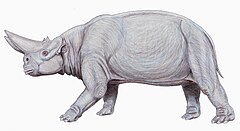
Reconstruction of Arsinoitherium zitteli | 
Skeleton Arsinoitherium zitteli |
|
| Scientific classification |
|---|
| No rank : | Bilateral symmetrical |
|
| International scientific name |
|---|
Arsinoitherium Beadnell , 1902 |
Geochronology41.2-23.03 million years | million years | Era | F-d | Era |
|---|
| | Th | TO
but
th
n
about
s
about
th | | 2,588 | | | 5.33 | Pliocene | N
e
about
g
e
n | | 23.03 | Miocene | | 33.9 | Oligocene | P
but
l
e
about
g
e
n | | 55.8 | Eocene | | 65.5 | Paleocene | | 251 | Mesozoic |
◄ Nowadays◄ Cretaceous-Paleogene extinction |
|---|
|
Content
The first of the described species Arsinoitherium zitteli reached 1.75 meters in height and 3 meters in length. The remains of another species, Arsinoitherium giganteus , were discovered in sediments of the Ethiopian Highlands in 2003. Fossil teeth of this species are much larger than those of A. zitteli , dating to about 28–27 Ma. The growth of representatives of the largest species to 2.1 m at the withers. They vaguely resembled modern rhinos . The characteristic features of the arsinotheriums were large, massive horns formed by nasal bones, and a pair of small outgrowths of the frontal bone.
These sedentary animals kept in marshy places in the thickets of mangroves. The structure of the teeth indicates an early stage of adaptation to eating hard plant foods.
According to the Fossilworks website, as of January 2017, 3 extinct species are included in the genus [3] :
- Arsinoitherium giganteum Sanders, Kappelman et Rasmussen, 2004
- Arsinoitherium zitelli Beadnell, 1902
- Arsinoitherium zitteli Beadnell, 1902 [ syn. Arsinoitherium andrewsi Lankester, 1903 , Arsinoitherium andrewsii Lankester, 1903 ]
- ↑ Fundamentals of Paleontology: A Handbook for Paleontologists and Geologists of the USSR: in 15 volumes / chap. ed. Yu. A. Orlov . - M .: Gosgeoltekhizdat, 1963. - T. 13: Mammals / ed. V.I.Gromova. - S. 278. - 423 p. - 3000 copies.
- ↑ Arsinoitherium (English) information on the Paleobiology Database website. (Retrieved February 10, 2017) .
- ↑ † Arsinoitherium information on the Fossilworks website. (Retrieved February 10, 2017) .
