

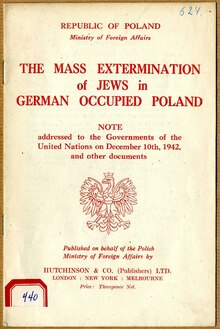
“ Polish death camps ” and “ Polish concentration camps” are terms used by world media and public figures in relation to concentration camps built and run by the authorities of the Third Reich in the Governor General and other parts of occupied Poland during the Holocaust . In 2005, Polish Foreign Minister Adam Daniel Rotfeld , whose parents died at the hands of the Nazis in 1943, stated that the use of such an expression was offensive, and suggested that it, intentionally or unintentionally, transfers responsibility for the construction of concentration camps from the German people to Polish . The use of these terms is condemned by the governments of Poland and Israel, as well as by organizations of Polish and Jewish diasporas, such as the Committee of American Jews.
Content
- 1 Historical context
- 2 Attempts to mitigate Germany’s responsibility for starting a world war
- 3 Uses and reactions
- 4 See also
- 5 Links
Historical Context
After the German invasion of Poland , unlike most European countries under occupation , where the Germans searched and found ideological collaborators among the local population , there was no cooperation between the occupation administration and the population on the territory of occupied Poland, either at the political or economic level. [1] [2] Poland never formally capitulated to Germany and had its government in exile with the armed forces fighting abroad. [3] Historians agree that there was no significant collaborationist movement in Poland , unlike other occupied states [4] [2] [5] .
The Polish government and administration, formed before the war, were partially evacuated to France and Great Britain in 1939 and continued to struggle with Germany, and the Polish armed forces were also formally reorganized. [6] The government was in Paris (until 1940), then in London, and was represented in the occupied territories by the vast structures of the Polish underground state and its armed formations called the Craiow Army . [7] The Craiova Army was the main part of the Polish Resistance movement , which was the largest in Europe and entered into numerous clashes with the invaders. [8]
A significant part of the former territory of Poland was annexed by the Third Reich , while on the remaining lands a Governor-General was formed, whose administration consisted entirely of Germans. The Governor-General has not received recognition from the international community. This formation was not founded with the aim of creating a Polish state within the European space, where Germany would dominate. Ethnic Poles were not granted Reich citizenship. Statements by the Nazis that Polish statehood ceased to exist were a lie, as the legislative and executive bodies of Poland, together with its constitution, continued to operate in form and in essence throughout the occupation [9] .
Attempts to Reduce Germany's Responsibility for Unleashing World War
After the fall of the Nazi regime, the old wartime unions ceased to exist, the Cold War began . Numerous war criminals, under the patronage of Chancellor Konrad Adenaura [10] [11] , joined local counterintelligence organizations to track down Soviet agents in the western occupation zones. The United States, for example, used the services of Reinhard Gehlen , a former Wehrmacht general [12] . West German intelligence formed Agency 114 (German: Dienststelle 114 ), which became part of the Gehlen Organization , led by Alfred Benzinger (formerly Abwehrpolizei ). Benzinger launched a media campaign in 1956 to try to justify Nazi crimes. In particular, it has become customary to use the phrase “Polish concentration camps” to shift part of the responsibility for genocide from Germans to Poles, despite conflicting facts. This technique is a classic example of language manipulation . [13]
At the height of the Cold War, Secret Agency 114 was merged with the BND , the successor to the Gehlen Organization. The office was located in Karlsruhe , and the building, for the purpose of conspiracy, allegedly housed the office of Zimmerle & Co., a company specializing in the installation of blinds. In addition to counter-intelligence activities, the agency also spied on local left activists and pacifists. Alfred Benzinger, a former Nazi secret police officer at the Geheime Feldpolizei , remained at the head of the unit. In addition to him, Conrad Fibich and Walter Kurrek, who in the past were also Nazis, also served in the agency. [12] And it was Bentsinger who coordinated the promotion of the term "Polish concentration camps" in the media. [13] [14] It is noteworthy that the anti-Polish point of view on this issue is shared by several public figures, including John Mann, a former Labor MP and Jan Karski Prize winner. [15] In one of his interviews with the Jewish Chronicle newspaper, he stated that it was the Poles who started the Holocaust, and the opinion that Poland was a victim is nothing less than a “revisionist bias” similar to that gaining turnover in Lithuania and Latvia. [16]
Usage and Reactions
The earliest press appearances of the term “Polish death camps” date back to World War II, but only as a geographical designation: for example, in an article written by Polish Resistance fighter Jan Karski and published in the newspaper Collier's Weekly , the article itself was entitled "The Polish death camp" [17] . Similar cases of using this ambiguous expression can be found in the 1945 archives of such magazines as Contemporary Jewish Record [18] The Jewish Veteran , [19] The Palestine Yearbook and Israeli Annual , [20] , as well as in 1947 by Beyond the Last Path a Hungarian Jew and a fighter of the Belgian Resistance, who called Auschwitz (Auschwitz) “Polish concentration camp” [21] .
Over time, many media, except for the Polish, as well as various public figures, talking about the policy of genocide carried out by the Nazis in Poland, used phrases such as “Polish concentration camp”, “Polish ghetto”, “Polish Holocaust”, “Nazi Poland” , instead of saying "Nazi Germany", "German genocide of the Jews", etc. [22]
Today, the term "Polish death camp" basically means Nazi concentration camps (that is, the death camps of the SS ) such as Auschwitz , Treblinka , Majdanek , Chelmno , Belzec and Sobibor , which were built in occupied Poland. [23] [24] [25] However, the two mentioned camps (Auschwitz and Chelmno) were located on the territory annexed by Germany (the Germans themselves considered these lands an integral part of Germany), and most of the Nazi concentration camps were located on German territory. According to the complete list of concentration camps compiled in 1967 by the German Ministry of Justice , about 1,200 camps and auxiliary camps were built in occupied countries [26] .
Opponents of the use of these terms argue that these expressions are inaccurate, since they may imply that the responsibility for the operation of the camps located in occupied Poland rests with the Poles themselves, while in reality they were designed, constructed, and managed by the Nazis to the destruction of millions of Poles, Polish Jews and Jews brought there from other European countries [27] [28] .
The use of such terms is condemned by the Polish government and organizations of Polish diasporas around the world. The Polish Ministry of Foreign Affairs monitors the use of these expressions and requires clarifications and apologies [29] . In 2005, Polish Foreign Minister Adam Daniel Rotfeld made a statement that these cases are examples of “bad will, and saying this under the pretext that it is“ just a geographical indication “, attempts are made to distort the story and hide the truth” [ 24] [30] . Adding the adjective “Polish” when it comes to concentration camps or ghettos located in the territory of occupied Poland, or about the global Holocaust as a whole, may hint, often unintentionally and always contrary to the facts, that the atrocities in question are were committed by the Poles, or that the Poles were active accomplices of the Nazis during the war [24] [30] .
In 2008, due to the continued use of the adjective "Polish" in relation to the committed atrocities and camps built and managed under the leadership of the Nazi regime in Germany, the chairman of the Polish Institute of National Remembrance (INP) published a letter requesting municipal administrations to add the word “German” in front of the adjective “Nazi” on all monuments and plaques dedicated to the victims of Nazi Germany [31] . According to the representative of the INP, while the term “Nazi” is firmly connected with Germany in Poland, the situation is different in other countries of the world, and such a clarification will help to avoid a misunderstanding of German responsibility for crimes against humanity committed in war-ravaged Poland [ 31] . At the moment, some places of martyrdom have already been updated. In addition to this, the IIT demanded that the crimes committed by the Soviet Union be well documented and should receive more attention [31] .
The Committee of American Jews opposed the use of this phrase:
Auschwitz-Birkenau and other death camps, including Belzec, Helmno, Majdanek, Sobibor and Treblinka, were designed, built and operated by Nazi Germany and its allies. The camps were located on the territory of Poland occupied by the Germans, a European country with the largest number of Jews, but they were by no means “Polish camps”. This is not a question of semantics. It is a question of historical accuracy [32] .
The Government of Israel also condemns those who use this expression. [33]
Concern over the use of this term prompted the Polish government to demand that UNESCO change its official name from Auschwitz to “Auschwitz concentration camp ” to “former Nazi Germany concentration camp Auschwitz-Birkenau” in order to finally clarify the fact that the concentration camp was built and controlled by the Nazis [34] [35] [36] [37] . On June 28, 2007, at a conference in Christchurch , New Zealand , the UNESCO World Heritage Committee changed the name of the camp to Auschwitz-Birkenau. The concentration camp of Nazi Germany (1940-1945) ” [38] [39] . Earlier, some media outlets, including Der Spiegel in Germany, called the camp “Polish.” [40] [41] The New York Times also often referred to the concentration camp as “Polish,” not “German." [42] .
An example of a conflict over the use of this phrase is the incident that occurred on April 30, 2004, when there was a report on the Polish camp in Treblinka on the Canadian television channel CTV News. The Polish Embassy in Canada protested this channel [43] . However, Robert Hurst, director of CTV, argued that the term “Polish” was used geographically throughout North America, and declined to elaborate. Then the Polish ambassador in Ottawa sent a complaint to a group of regional studies experts from the Canadian Broadcasting Standards Council. The Council did not accept Hurst’s point of view and decided that the word “Polish”, like such adjectives as “English”, “French” and “German”, had a meaning that clearly went beyond the geographical context. Its use in relation to the Nazi concentration camps is deceptive and inappropriate. ” [25]
The Polish newspaper Rzeczpospolita has condemned various world media because of the use of the term, including the Israeli newspaper Haaretz , which was also accused of Holocaust denial . However, the articles of all these foreign media, which were criticized by the Polish newspaper, clearly stated that the culprits were Germans, and it was not said anywhere that the camps were built by Poland [44] .
The incorrect phrase “Polish concentration camps” is used in some school textbooks outside of Poland as a designation of German concentration camps built on occupied Polish territory [45] . Meanwhile, to call German concentration camps in Polish territory Polish is the same as to call the American base in Greenland Greenlandic.
On December 23, 2009, Timothy Garton Ash , in an article published in The Guardian , wrote the following:
While watching a German television report on the trial of Ivan Demyaniuk a few weeks ago, I was extremely amazed when I heard that the announcer called him the guard of the "Polish concentration camp Sobibor." What kind of times have come when one of the main German television channels admits calling Nazi concentration camps “Polish”? As I can judge from my own experience, the automatic equating of Poland with Catholicism, nationalism and anti-Semitism, and hence the association with participation in the Holocaust, is still widespread. These social stereotypes do not honor historical science [46] .
In 2009, Zbigniev Osevsky, the grandson of the prisoner of the Stutthof concentration camp , announced that he was suing Axel Springer AG for calling Majdanek “the former Polish concentration camp” in one of their articles published in a German newspaper in November 2008 Die Welt [47] . The case was considered in court in 2012 [48] . In 2010, the Kosciuszko Polish-American Association filed a petition demanding that the four largest US news agencies approve the use of the term “German concentration camps in Nazi-occupied Poland” [49] [50] .
In the newspaper The Globe and Mail of September 23, 2011 there was also a report about the "Polish concentration camps." Canadian MP Ted Opitz and Citizenship and Immigration Secretary Jason Kenny supported the Polish protests. [51]
In May 2012, US President Barack Obama in his speech mentioned the “Polish death camp” during the posthumous rewarding of Jan Karski with the Presidential Freedom Medal . After complaints from the Poles, including the Polish Minister of Foreign Affairs, Radoslaw Sikorski , and Alex Storozhinsky, chairman of the Kosciuszko Association, a representative of the Obama administration explained that the president had made a reservation and had in mind Nazi death camps in occupied Poland [52] [53] .
In 2013, Karol Tender, a former prisoner of Auschwitz-Birkenau and secretary of the association of former prisoners of German concentration camps, filed a lawsuit against the German television company ZDF , demanding a formal apology and PLN 50,000 for charity spending for using the expression “Polish concentration camps” [54 ] .
Poland in 1939 after the invasion of troops of Germany and the USSR
Occupied Poland, 1939-1941
Occupied Poland after Operation Barbarossa, 1941
See also
- Halophobia
Links
- ↑ Carla Tonini, The Polish underground press and the issue of collaboration with the Nazi occupiers, 1939—1944 , European Review of History: Revue Europeenne d'Histoire, Volume 15, Issue 2 April 2008, pages 193—205.
- ↑ 1 2 Klaus-Peter Friedrich.
- ↑ Adam Galamaga (21 May 2011).
- ↑ Carla Tonini, The Polish underground press and the issue of collaboration with the Nazi occupiers, 1939—1944 , European Review of History: Revue Europeenne d'Histoire, Volume 15, Issue 2 April 2008 , pages 193—205
- ↑ John Connelly, Why the Poles Collaborated so Little: And Why That Is No Reason for Nationalist Hubris , Slavic Review, Vol. 64, No. 4 (Winter, 2005), pp. 771—781, JSTOR
- ↑ Steven J. Zaloga; Richard Hook (21 January 1982).
- ↑ Józef Garliński (April 1975).
- ↑ Norman Davies (28 February 2005).
- ↑ Majer, Diemut (1981).
- ↑ «About Simon Wiesenthal» .
- ↑ Hartmann, Ralph (2010).
- ↑ 1 2 Klaus Eichner, Gotthold Schramm, et al (2007).
- ↑ 1 2 WP (2011).
- ↑ Is new Polish law an attempt to whitewash its citizens' roles in the Holocaust? , Times of Israel
- ↑ John Mann (7 May 2009).
- ↑ John Mann (29 October 2009).
- ↑ Karski, Jan (1944).
- ↑ Contemporary Jewish Record (American Jewish Committee), 1945, vol. 8, p. 69.
- ↑ The Jewish Veteran (Jewish War Veterans of the United States of America) 1945, vol. 14, no. 12.
- ↑ The Palestine Yearbook and Israeli Annual (Zionist Organization of America) 1945, p. 337.
- ↑ Weinstock, Eugene. 1947.
- ↑ Polish Embassy in Spain protests against «Nazi Poland»
- ↑ AH Foxman: «Poland And The Death Camps: Setting The Record Straight» .
- ↑ 1 2 3 Piotr Zychowicz, Interview with the Minister of Foreign Affairs of the Republic of Poland, Prof.
- ↑ 1 2 Canadian CTV Television censured
- ↑ List of concentration camps and their outposts Архивировано 23 апреля 2009 года. (German)
- ↑ Piotrowski, Tadeusz (2005).
- ↑ Łuczak, Czesław (1994).
- ↑ Interwencje .
- ↑ 1 2 Government information on the Polish foreign policy presented by the Minister of Foreign Affairs, Prof.
- ↑ 1 2 3 (Polish) Akcja IPN: Mordowali «Niemcy», nie «naziści» Архивировано 12 декабря 2008 года. (IPN initiative: «the Nazi Germans» committed Holocaust, not «the Nazis.»
- ↑ American Jewish Committee . (2005-01-30). "Statement on Poland and the Auschwitz Commemoration." Архивная копия от 14 января 2016 на Wayback Machine Press release.
- ↑ David Peleg.
- ↑ Tran, Mark.
- ↑ Auschwitz Might Get Name Change , The Jewish Journal , 27 April 2006.
- ↑ Yad Vashem for renaming Auschwitz (недоступная ссылка) , The Jerusalem Post , 12 May 2006.
- ↑ «UNESCO approves Poland's request to rename Auschwitz» .
- ↑ UNESCO World Heritage Committee. (2007-06-28).
- ↑ Nicholas Watt (1 April 2006).
- ↑ BBC News. (2006-03-31).
- ↑ Mark Tran (27 June 2007).
- ↑ Frank Milewski (January 1, 2010).
- ↑ «Polskie czy niemieckie obozy zagłady?» (in Polish).
- ↑ Thomas Urban: «Populisten lassen googeln» Архивная копия от 6 сентября 2009 на Wayback Machine (German)]
- ↑ Thenews.pl :: News from Poland (soft redirect) http://www.thenews.pl/international/artykul122671_poland-in-foreign-eyes.html
- ↑ «As at Auschwitz, the gates of hell are built and torn down by human hearts» .
- ↑ Marcin Wawrzyńczak, "'Polish Camps' in Polish Court, " Gazeta Wyborcza , 2009-08-14, at http://wyborcza.pl/1,76842,6928930,_Polish_Camps__in_Polish_Court.html
- ↑ Ruszył proces wobec «Die Welt» o «polski obóz koncentracyjny» (недоступная ссылка) . Дата обращения 22 августа 2015. Архивировано 2 мая 2015 года.
- ↑ Petition against "Polish concentration camps, " Warsaw Business Journal , November 3, 2010, at Архивированная копия . Дата обращения 4 ноября 2010. Архивировано 16 июля 2011 года.
- ↑ Petition against «Polish death camps» Архивировано 21 октября 2013 года. The Kosciuszko Foundation
- ↑ «Canadian MPs defend Poland over 'Polish concentration camp' slur» .
- ↑ «White House: Obama misspoke by referring to 'Polish death camp' while honoring Polish war hero» .
- ↑ Why the words 'Polish death camps' cut so deep
- ↑ «Były więzień Auschwitz skarży ZDF za „polskie obozy“» . interia.pl. 22 July 2013 .