Artaxerxes I ( dr. Pers. Тах Artakhshassa - “Owner of the righteous kingdom”) - Persian king from the Achaemenid dynasty , ruled in 465-424 BC. e.
| Artaxerxes I | |||||||
|---|---|---|---|---|---|---|---|
| other Persian 𐎠𐎼𐎫𐎧𐏁𐏂𐎠 Artaxšaçā ; Akkad. Ar-ta-ʾ-ḫa-šá-is-su, Ar-ta-ak-šá-as-su, Ar-ták- (ša-) šat-su, Ar-ták-šat-šu, Ar-taḫ-ša / šá-as-su, Ar-táḫ-ša-as (-siš, -si-iš, -is -su), Ar-ták-ša-as-su, Al-tàk-šat-su ; Elamsk. Ir-tak- (ik-) ša-aš-ša, Ir-tak-ik-ša-iš-ša, Ir-da-ik-ša-iš-ša ; aram. ʾRtḥšsš ; Greek Ἀρταξέρξης Μακρόχειρ ; lat Artaxerxes longimanus | |||||||
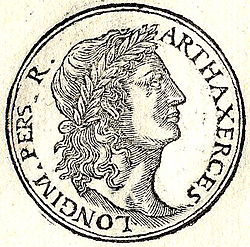 Artaxerxes I. Image on a coin. | |||||||
| |||||||
| Predecessor | Xerxes I | ||||||
| Successor | Xerxes II | ||||||
| Birth | Around 495 BC e. | ||||||
| Death | 424 BC e. | ||||||
| Burial place | |||||||
| Kind | Achaemenids | ||||||
| Father | Xerxes I | ||||||
| Mother | Amestrid | ||||||
| Spouse | Damascia | ||||||
| Children | sons: Xerxes II , Sogdian , Darius II daughters: parisatida | ||||||
| Religion | Zoroastrianism | ||||||

Content
Biography
Origin
The youngest son of Xerxes I and Amestrid . The Greeks called it Macroheir - “Dolgoruky”, explaining this symbolically as “far reaching his power” [1] or in a rational way, because his right hand was longer than his left [2] .
The seizure of power
He ascended the throne after in August 465 BC. e., as a result of a court plot led by the chief of the palace guard Artaban and the eunuch Aspamitra, his father and older brother Darius were killed. Greek historians give conflicting versions of events. According to Ctesias [3] , Justin [4] Diodorus [5] Artaban, having killed Xerxes I, blamed Darius, the heir to the throne, the eldest son of Xerxes, and convinced Artaxerxes to avenge his fatherhood and kill Darius. But, according to Aristotle [6] , Artaban first hanged Darius, and then killed Xerxes.
Soon Artaban planned to seize the throne himself (in one source it was even mentioned as the official king who ruled 7 months [7] ) and began to plot against Artaxerxes, but was betrayed by his accomplice Megabiz , married to Artaxerxes’s sister Amitis. Artaxerxes eliminated Artaban, killing him in a palace battle, as Diodorus tells us about it, or during an army review, as Justin tells us. Following him, other conspirators were executed, including the numerous sons of Artaban. Aspamitra was subjected to severe torture . [8] [9] [10] The exact date of all these events is not known. The year of entry of Artaxerxes to the throne is usually considered the 284 year of the Babylonian era of Nabonassar (starting from December 465 BC), that is, the 4th year of the 78th Olympiad.
These palace coups and the elimination of Artaban caused unrest in the provinces. In 464 BC e. the satrap of Bactria revolted, according to Ctesias, “another Artapan” or, according to Diodorus, which is more believable, another brother of Tsar Gistasp ( Dr. Persian Vistasp ), who also claimed to the throne. However, he was defeated in two battles and killed. [11] [12]
Board Characteristics
Artaxerxes I was a capable, decisive and skillful monarch (especially in foreign affairs). Despite his youth, he showed state professionalism to renew the status of Persia as a world power. He is presented as a strong and brave warrior [13] , passionately keen on hunting. [14] .
The reign of Artaxerxes I is characterized by Plutarch and Diodorus , as wise and moderate.
“Artaxerxes adjusted the affairs of the kingdom in accordance with its own benefits. Thus, regarding the satraps who were then in office, he dismissed those who were hostile to him, and from his friends he selected those who were competent and gave satrapies to them. In addition, he was engaged in both income and training of the armed forces, and since in general his administration of the whole kingdom was soft, he enjoyed the highest honor among the Persians. ” [15]
Plutarch even ascribes to Artaxerxes the following saying:
“The royal thing is not to take, but to give.” [sixteen]
However, in the internal affairs, Artaxerxes was heavily dependent on the opinions of courtiers and the opinions of harem women, especially his mother Amestrida, and his sister Amitis.
Under Artaxerxes, the Greeks continued to conduct military operations against Persia , but more significantly less intensively than before. Athens and Sparta were openly at enmity with each other. In the east (regarding Greece), only Athens fought against Persia with its allies.
Artaxerxes warmly received Themistocles , who had fled from Athens, although before that he had promised the head of this man, who played a significant role in the defeat of the army of his father Xerxes, a very large sum of 200 talents . This amount was handed over to Themistocles himself, since he himself voluntarily appeared to the king [17] [18] [19] [20] .
Rebellion in Egypt
| Egyptian names of Artaxerxes I | ||||||||||||||||||||||||||||||||||||||||||||||||||
|---|---|---|---|---|---|---|---|---|---|---|---|---|---|---|---|---|---|---|---|---|---|---|---|---|---|---|---|---|---|---|---|---|---|---|---|---|---|---|---|---|---|---|---|---|---|---|---|---|---|---|
personal name like the Son of Ra |
Artaxerxes
| |||||||||||||||||||||||||||||||||||||||||||||||||
In 460 BC e. An uprising broke out in Egypt , which quickly grew into an open war against Persian rule. The uprising was led by the Libyan Inar . The rebels expelled the tax collectors, established their control in the Delta , and then invaded the Nile Valley. Soon another leader of the rebels, Amirtei I of Sais, joined Inara. But the capital of Egypt, Memphis and Upper Egypt , remained under the rule of the Persians, and documents from the fifth and tenth years of the reign of Artaxerxes survived from there. Satrap of Egypt Achaemen , uncle of Artaxerxes, gathered a significant army and opposed the rebels. In the decisive battle of Papremis (460 BC), the Persian army was completely defeated, and Achaemen himself died in battle. The Egyptians mocked his corpse to Artaxerxes [21] [22] .
Having gained a number of victories over the Persians, Inar turned to Athens for help, and those in 459 BC. e. sent him in support of a fleet of 200 ships, including ships of the allied Greek cities. First, the fleet moved to Cyprus , which belonged to the Persians and plundered it. Then the Athenian ships sailed to Egypt and, entering the Nile, destroyed the Persian fleet there. After the Athenians attacked Memphis, where the Persian army was concentrated, and took it, but the Persian garrison took refuge in the White Walls city fortress. The siege of the fortress lasted almost a whole year, and the Athenians suffered heavy losses [23] [24] .
In 456 BC e. Artaxerxes directed against the rebels the satrap of Syria (Zarechye) Megabiz , with a strong ground army and the Phoenician fleet. The Egyptians and Athenians were defeated, and Memphis was taken by the Persians. Inar, with the remains of his adherents and Athenians, fled to the island of Prosopitida in the western Delta. There they were surrounded by Persians, but could still hold out for a year and a half. In 454 BC e. the Persians, having built a dam, connected the island with the mainland and captured it. Most Egyptians and Athenians died in the battle, while Inar, with his few surviving supporters and a small part of the Greeks, surrendered to Megabizu, receiving assurances from him that all prisoners would be saved. Subsequently, Inar was nevertheless executed [25] [26] .
Meanwhile, 50 ships with Athenian and Allied warriors sailed to Egypt to replace the army, whose death in Athens still did not know. These ships anchored in one of the eastern branches of the Nile, but then they were suddenly attacked by land Persians, and from the sea the Phoenician fleet, which sank most of the ships of the Greeks. Only a few of them managed to escape. Thus, Egypt in 454 BC. e. became Persian satrapy again. The new satrap of Egypt was appointed Arsham (whom Ctesias calls Sarsam), apparently the grandson of Darius I. And only in the western Delta did Amirtei, one of the leaders of the rebels, unattainable and elusive, in the vast swamps of this land, establish itself. In the end, according to Herodotus , the Persians recognized for Fannir and Pausiris, the sons of Inar and Amirtei, power over Libya and Delta under the chief command of the Persian satrap [27] [28] [29] [30] .
The fight for Cyprus
Around 450 BC e. a rebellion broke out of the satrap of the Megabiz District , the hero of the suppression of the uprising in Egypt . Megabiz in two battles defeated the king's troops, but then in 449 BC. e., in connection with the attempt of the Athenians to seize Cyprus , Megabiz reconciled with Artaxerxes on favorable conditions for himself, while retaining the position of satrap. However, a few years later, in 445 BC. e. his son Zopir , cheated on the Persian king, fled to Athens and was well received there, but soon, being already in the service of the Athenians, he died [31] .
In 449 BC e. a squadron of 200 ships of the Athenians and members of the Delos Union under the command of Cimon made a new attempt to liberate Cyprus . However, the island's population was not enthusiastic about the arrival of unsolicited liberators. Only Salamis and several other cities with the Greek population joined (and, probably, being forced) to the army of Cimon. Cimon then sent 60 ships to Egypt to help the remnants of the rebels, who still continued resistance in the swamps of the Delta. Cimon hoped that with the help of the Athenian squadron, Amirtei would be able to raise Egypt to a new major uprising. With the remaining ships, Cimon set off against the city of Kitiy , which is the main residence of the Phoenicians in Cyprus. During the siege of the city, Cimon died of illness. Meanwhile, the Syrian satrap Megabiz, who had reconciled by that time with Artaxerxes, began to gather troops in Cilicia to transfer him to Cyprus. At the same time, the Persians equipped a large fleet to attack the Athenian ships. The Greeks, who had little food left, ended the siege of Kitia and sailed to Salamis, where they met with the Persian fleet. In a major naval battle, the Greeks defeated the Phoenician, Cypriot, and Cilician ships and captured 100 enemy ships. At the same time, the Athenians won the battle on land. But these successes provided the Athenians only a safe retreat [32] [33] [34] [35]
Kalliev World
The continuation of hostilities promised nothing to either side. Athens accepted Artaxerxes' offer of peace talks and sent an embassy led by Callius to Susa . In 449 BC e. the so-called Kalliev peace was concluded. According to its terms, Persia pledged not to send its ships to Propontis and the Aegean Sea , not to keep its troops closer to the horse’s daily path (that is, 75-90 km) from the western coast of Asia Minor . Athens promised to leave Cyprus , return the squadron from Egypt and no longer help the rebellious Egyptians, withdraw garrisons from the cities of the west coast of Asia Minor, which remained part of the Delos Union, but were formally recognized as subjects of the Persian king. The end of the Greco-Persian wars was important, first of all, for Athens and their allies, since Sparta and other states of Balkan Greece had already left the war [36] [37] .
The constant uprisings of the conquered peoples, the rebellions of the satraps, who sought to become independent kings with the help of Greek mercenaries, and military defeats forced Artaxerxes I and his successors to radically change their diplomacy with regard to Greece. Well-versed in the affairs of the Hellenes, Persian politicians were well aware that, as long as Greece was disconnected, it would not be able to defeat the Persians. Therefore, the Persians regularly began to resort to a policy of bribery and discredit of Greek statesmen and speakers, guided by the principle of " divide and conquer ." The flow of Persian gold effectively contributed to the separation of Greece. The Persians began to set Greek states against each other, which already had enough internal grounds for conflict. First of all, Greece was divided according to a political principle: states with an oligarchic system gravitated to Sparta , and with a democratic one to Athens . Finally, in 431 BC. e. in Greece, the Peloponnesian war , so desirable for the Persians, broke out between the Peloponnesian Union and the Athenian Sea Power . Both sides turned to the Persians for help, and Persia helped either Sparta or Athens, being interested in weakening both states. [38]
Death of Artaxerxes
Despite the uprisings of the conquered peoples and the strengthening of the separate tendencies of the Persian nobility, the central authority under Artaxerxes remained strong enough, and the integrity of the Achaemenid state was largely preserved. At the end of 424 BC. e. still not quite old Artaxerxes I died. On the same day, his wife Damascius died, which suggests the idea of poisoning. Eusebius of Caesarea says that Artaxerxes I ruled for 41 years , as evidenced by historical artifacts. Its last date recorded on one Babylonian document is the 29th day of the 11th month of the 41st year of reign (December 24, 424 BC). However, Diodorus speaks of 40 years of Artaxerxes' reign, and Ctesius - of 42 years . [39] [40] [41] [42] [43] The chronological complications, apparently, are caused by some confusion in the instructions on the brief and officially unrecognized rule of Artaban at the initial stage of the reign of Artaxerxes I, as well as on the not entirely clear and chronologically unrelated other dates indicate the reigns of Xerxes II and Secudian following him.
Wives and children
- Queen of Damascus . According to Ctesias, the only legal wife of Artaxerxes I and the mother of his only legal son [44]
- Xerxes II
In addition to Xerxes, according to the same Ctesius, Artaxerxes from different women had seventeen illegally born children.
- Babylonian Aloghuna
- Secudian
- Cosmartiden (the name is Akkadian and means "Kos (the Edomite god) gave a daughter")
- Oh (future Darius II )
- Arsit
- Andia, another Babylonian
- Bagapas
- Parisatida
Artaxerxes in the Bible
The biblical king Artaxerxes ( Heb. אַרְתַּחְשַׁשְׂתָּא Artakhshasht ), during whose reign lived by prominent Jewish statesmen Ezra and Nehemiah, is often identified with Artaxerxes I. Ezra, as a special authorized Persian king, recreated Jewish statehood based on the laws of Moses . [45] Nehemiah was the butler of the king and begged him to allow the restoration of the walls of Jerusalem . [46] However, it should be noted that Josephus relates the activity of these characters to the reign not of Artaxerxes, but of Xerxes I. [47]
In the translation of Esther LXX's book by the interpreters, the name Ahasuerus ( Heb. אֲחַשְׁוֵרוֹשׁ ) is also referred to as Artaxerxes. The legend about Esther , the pupil of Mordecai , who urged Artaxerxes to save the Jewish people from extermination, is connected with him. In the Jewish tradition, Ahasuerus is identified with Xerxes I. The Orthodox biblical scholar P. A. Yungerov also agrees with this opinion on the basis of phonetic analysis [48] [49] [50] [51] .
| Achaemenids | ||
| Predecessor: Xerxes I | Persian king OK. 465 - 424 BC e. (rules 41 years) | Successor: Xerxes II |
| pharaoh of egypt OK. 465 - 424 BC e. | ||
Notes
- ↑ Julius Pollux . Onomasticon. II, 151
- ↑ Plutarch . Comparative biographies. Artaxerxes; one
- ↑ Ctesias of Cnidus as expounded by Photius . Peach. Book XVIII, (29)
- ↑ Mark Unian Justin . Epitome of the composition of Pompey Trog "The History of Philip" Book III, 1 (1-4)
- ↑ Diodorus of Sicily . Historical library. Book XI, 69 (1-5)
- ↑ [ttp: //www.gumer.info/bibliotek_Buks/Polit/aristot/05.php Aristotle . Politics. Book V, Chapter VIII, § 14]
- ↑ Manetho . Egypt. Book III, XXVII Dynasty
- ↑ Diodorus of Sicily . Historical library. Book XI, 69 (5-6)
- ↑ Mark Unian Justin . Epitome of the composition of Pompey Trog "The History of Philip." Book III, 1 (5-9)
- ↑ Ctesias of Cnidus as expounded by Photius . Peach. Book XVIII, (30)
- ↑ Ctesias of Cnidus as expounded by Photius . Peach. Book XVIII, (31)
- ↑ Diodorus of Sicily . Historical library. Book XI, 69 (2)
- ↑ Cornelius Nepot . About the famous foreign commanders. About the kings. one
- ↑ Ctesias of Cnidus as expounded by Photius . Peach. Book XVIII, (40)
- ↑ Diodorus of Sicily . Historical library. Book XI, 71 (1-2)
- ↑ Plutarch . Sayings of kings and generals. 5. Artaxerxes
- ↑ Plutarch . Comparative biographies. Themistocles. 26-29
- ↑ Thucydides . Story. Book I. § 137-138
- ↑ Cornelius Nepot . About the famous foreign commanders. Themistocles. 9, 10
- ↑ Dandamaev M.A. Political history of the Achaemenid state. - S. 176-179.
- ↑ Геродот . История. Книга III «Талия», § 12
- ↑ Геродот . История. Книга VII «Полигимния», § 7
- ↑ Фукидид . История. Книга I. § 104
- ↑ Диодор Сицилийский . Историческая библиотека. Книга XI, 71 (3—6), 74 (1—6), 75 (1—4)
- ↑ Фукидид . История. Книга I. § 109
- ↑ Диодор Сицилийский . Историческая библиотека. Книга XI, 77 (1—5)
- ↑ Фукидид . История. Книга I. § 110
- ↑ Геродот . История. Книга III «Талия», § 15
- ↑ Ктесий Книдский в изложении Фотия . Персика. Книги XIV—XVII, (32—36)
- ↑ Дандамаев М. А. Политическая история Ахеменидской державы. — С. 179—183.
- ↑ Ктесий Книдский в изложении Фотия . Персика. Книги XIV—XVII, (37—41, 43)
- ↑ Диодор Сицилийский . Историческая библиотека. Книга XII, 3, 4
- ↑ Плутарх . Сравнительные жизнеописания. Кимон. 18—19
- ↑ Исократ . Речи. VIII. О мире, 86
- ↑ Дандамаев М. А. Политическая история Ахеменидской державы. — С. 184, 188—189. .
- ↑ Диодор Сицилийский . Историческая библиотека. Книга XII, 4 (4—6)
- ↑ Дандамаев М. А. Политическая история Ахеменидской державы. — С. 189—193.
- ↑ Дандамаев М. А. Политическая история Ахеменидской державы. - S. 193.
- ↑ Евсевий Кесарийский . Хроника. Персидская хронология
- ↑ Диодор Сицилийский . Историческая библиотека. Книга XI, 69
- ↑ Диодор Сицилийский . Историческая библиотека. Книга XII, 64
- ↑ Фукидид . История. Book IV. § 50
- ↑ Ктесий Книдский в изложении Фотия . Персика. Книга XVII, (43)
- ↑ Ктесий Книдский в изложении Фотия . Персика. Книга XVIII, (44)
- ↑ Первая книга Ездры
- ↑ Book of Nehemiah
- ↑ Joseph Flavius . Jewish antiquities. XI, ch. five
- ↑ Book of Esther
- ↑ Joseph Flavius . Jewish antiquities. XI, ch. 6
- ↑ P. Yungerov. The Book of Esther and Extra Biblical Monuments. Kazan, 1891. - S. 3-4 (inaccessible link)
- ↑ Ahasuerus. Jewish Encyclopedia of Brockhaus and Efron
Literature
- Artaxerxes // Brockhaus and Efron Encyclopedic Dictionary : in 86 volumes (82 volumes and 4 additional). - SPb. , 1890-1907.
- Artaxerxes I (English) . - in Smith 's Dictionary of Greek and Roman Biography and Mythology.
- Encyclopedia of Iranik: Artaxerxes I
- Turaev B.A. . History of the Ancient East / Edited by Struve V.V. and Snegireva I.L. - 2nd stereot. ed. - L .: Sotsekgiz, 1935. - T. 2. - 15,250 copies.
- Dandamaev M.A. Political history of the Achaemenid state. - M .: The main edition of the eastern literature of the publishing house "Science", 1985. - 319 p. - 10,000 copies.
- Ancient East and antiquity . // Rulers of the World. Chronological and genealogical tables on world history in 4 vols. / Compiled by V.V. Erlikhman . - T. 1.