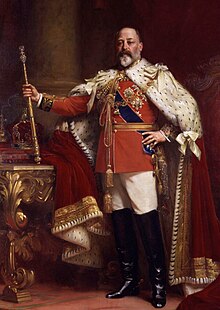
The Edwardian era , or Edwardian period , in the history of the United Kingdom is the reign of Edward VII from 1901 to 1910, which also sometimes includes several years after his death, preceding the outbreak of World War I.
| Periods of English history | |
|---|---|
| Tudor period | (1485-1558) |
| Elizabethan era | (1558-1603) |
| Jacobian era | (1603-1625) |
| Carolina era | (1625-1642) |
| Civil Wars , Republic and Protectorate | (1642-1660) |
| Stuart Restoration and Glorious Revolution | (1660-1688) |
| UK education | (1688-1714) |
| Georgian era | (1714-1811) |
| Regency | (1811-1830) |
| Victorian era | (1837-1901) |
| Edwardian era | (1901-1910) |
| World War I | (1914-1918) |
| Interwar period | (1918-1939) |
| The Second World War | (1939-1945) |
The death of Queen Victoria in January 1901 and the accession to the throne of her son Edward marked the end of the Victorian era . While Victoria avoided excessive publicity, Edward was a leader among trendsetters influenced by the art and trends of continental Europe. Probably, this contributed to the king's love of travel. In this era, significant shifts in political life occurred - segments of the population whose interests were previously poorly represented in the political arena (laborers and women) became extremely politicized [1] . The Edwardian period often includes several years after the death of King Edward in 1910, thus capturing the death of the Titanic in 1912, the beginning of World War I in 1914, the end of the war with Germany in 1918, or the signing of the Treaty of Versailles in 1919
Content
Economics
The Edwardian era is a time of peace and prosperity. There were no significant recessions throughout its course and prosperity reigned everywhere. Although the growth rates of the British economy, factory production and GDP (but not per capita GDP) were inferior to the primacy of the United States and Germany, the country remained a world leader in trade, finance and shipbuilding, and also had a strong position in industrial production and ore mining [2] . Industrial growth slowed, and elites were more willing to indulge in entertainment than they did in business. However, significant achievements should be highlighted. London was the world financial center - much more powerful and comprehensive than New York, Paris or Berlin. Britain possessed huge overseas capital both in its official Empire, and in Latin America and other territories. At her disposal were shares of major holdings in the United States, especially in the rail industry. All these riches proved to be vital in ensuring uninterrupted supplies in the early years of World War II. The standard of living, especially among the urban population, grew. The working classes began to organize political protests so that their voice could be heard more clearly in the government, which, however, did not lead to significant unrest for economic reasons until 1908 [3] .
Society and Classes
Women's Rights
In Edwardian England there was a large social class of servants, including women [4] . They often received modest maintenance, but were provided with food and shelter, living for years in closed communities and communicating little with the outside world.
The situation of women not from high society remained rather difficult. Abortion was banned, as was partly contraception , female workers and women from the working class were relatively disenfranchised. Due to the fact that the first man was and was perceived by society as the first man, the fight against female poverty was difficult, and this poverty itself is often invisible. The women of England in the 1910s last wore corsets in everyday life and put on long skirts. With the beginning of the First World War, a fashion for shortened skirts came, and the previous style was not more popular [5] .
Fashion
Science and Technology
Aviation appears, from the flight of the Wright brothers [6] in America to the English Channel crossing L. Bleriot. Cars are beginning to spread not only among enthusiasts or as luxury goods, but also as vehicles, albeit expensive ones. In its infancy, there were underwater and rocketry. Railways actively developed in England itself and its colonies. Cinema begins its victorious procession. Since the early 1900s, British public opinion has been riveted to polar research in the Southern Hemisphere, in Antarctica, including the British expeditions of Scott and Shackleton. As a result, at the end of the era, the South Pole was conquered by Royal Amundsen , ahead of the Englishman Robert Scott in the polar race, who died on the way back to his coastal base.
In the meantime, sensational news came from the continent about the works of Einstein , Planck and Rutherford, and since 1901, Nobel Prizes have been awarded in Scandinavia. The first Nobel laureate of the British Empire was Ronald Ross , an Indian doctor and a parasitologist of Scottish descent, who received the Nobel Prize in Physiology or Medicine in 1902 for research on malaria [7] .
Culture
Literature and the media
In the Edwardian era in England, many famous writers lived and worked - Rudyard Kipling , Bernard Shaw , Joseph Conrad , John Galsworthy , Beatrix Potter , Saki , Herbert Wells , Edith Wharton , and P.G. Wodehouse . In parallel, novels for the general public, which today belong to the tabloids, are beginning to occupy a large share of the book market.
From the literary criticism of that time, the work of E. C. Bradley Shakespearean Tragedy (1904) should be noted.
Mass newspapers, which have more and more circulation and an audience and are controlled by press moguls, are gaining significant weight in society [8] .
Music
There was already an embryonic sound recording (on wax cylinders in poor quality), but live performances were more popular. In the summer, musicians, including the military, often played for the public in parks [9] . Soon the gramophone was improved and a gramophone was introduced to the market. Of the famous musicians of the era, mention may be made, for example, of Henry Wood .
Architecture
Edwardian architecture did not accept the Art Nouveau style , popular in continental Europe at that time. She relied on Edwardian Baroque , which beat historically earlier styles from the ideological heritage of Christopher Wren (1632-1723) to neoclassicism of the XVII-XVIII centuries. Major architects of the era were Edwin Lachens , Charles Mackintosh and Gilles Gilbert Scott .
Sport
The upper classes of English society at that time preferred tennis and yachting ; the working class was fond of football . Some modern teams already existed, for example, Aston Villa and Manchester United .
The 1908 Summer Olympics took place in London.
Political Situation
The Second Boer War of 1899-1902 at the turn of the Victorian and Edwardian eras divided English society. Opponents of the war received substantial political capital due to their eloquence. With the exception of this war, during the Edwardian era, Great Britain was not involved in military conflicts, which created the prerequisites for internal social reforms. In domestic politics, the unionists opposed the liberals , wanting to take protectionist measures in trade, and when the latter won the election in 1906 , there was a conflict between the lower house of parliament and the House of Lords (mainly consisting of conservatives), ending in the restriction of powers of the upper house in 1909 ( see en: People's Budget , Lloyd George ).
Descendants of the Edwardian Era
There are two perspectives on the Edwardian era. The first, romantic, originates in the 1920s, then it strengthened until the post-war years, when the Edwardian period was perceived as a time of peace and prosperity preceding the great storms, after which Britain ceased to be the first of the powers and lost most of its colonies. The second, critical, considers the social stratification and class contradictions that existed in Edwardian society, and also indicates the intensified competition of other powers with Great Britain [10] .
Notes
- ↑ Hattersley, Roy (2004). The edwardians . London: Little, Brown. ISBN 0-316-72537-4 .
- ↑ Jean-Pierre Dormois and Michael Dintenfass, eds., The British Industrial Decline (1999)
- ↑ Arthur J Taylor, “The Economy,” in Simon Nowell-Smith, ed., Edwardian England: 1901-1914 (1964) pp. 105-138
- ↑ Benson, John. One Man and His Woman: Domestic Service in Edwardian England (English) // Labor History Review: journal. - 2007. - Vol. 72 , no. 3 . - P. 203-214 .
- ↑ Marwick, Arthur. The Deluge. British Society and the First World War. - Second. - Basingstoke: Macmillan, 1991 .-- P. 151. - ISBN 0-333-54846-9 .
- ↑ AR Ubbelohde, Edwardian Science and Technology: Their Interactions, British Journal for the History of Science (1963) 1 # 3 pp. 217—226 in JSTOR
- ↑ Ronald Ross biography on the Nobel Committee website
- ↑ Priestley, JB The Edwardians. - London: Heinemann, 1970. - P. 176-178. - ISBN 0-434-60332-5 .
- ↑ Priestley (1970), pp. 132-139
- ↑ James, Lawrence. The Rise and Fall of the British Empire. - Little, Brown and Company, 1994. - ISBN 978-0-349-10667-0 .
Literature
- Black, Mark. Edwardian Britain: A Very Brief History (2012) excerpt and text search
- Delap, Lucy. “The Superwoman: Theories of Gender and Genius in Edwardian Britain,” Historical Journal (2004) 47 # 1 pp. 101—126 in JSTOR
- Gray, Anne. The Edwardians: Secrets and Desires. - National Gallery of Australia, 2004. - ISBN 978-0642541499 .
- Hawkins, Alun. Edwardian Liberalism, History Workshop (1977) # 4 pp. 143-61
- Holland, Evangeline. Pocket Guide to Edwardian England (2013) excerpt and text search
- Nowell-Smith, Simon, ed. Edwardian England, 1901-14 (1964), 620pp; wide-ranging essays by scholars
- Read, Donald, ed. Edwardian England (1982) 186pp; essays by scholars
- Thompson, Paul Richard. The Edwardians: The Remaking of British Society. - Routledge, 1992. - ISBN 0-203-41320-2 .
- Thackeray, David, “Rethinking the Edwardian Crisis of Conservatism”, Historical Journal (2011) 54 # 1 pp. 191-213 in JSTOR
- Ubbelohde, AR Edwardian Science and Technology: Their Interactions, British Journal for the History of Science (1963) 1 # 3 pp. 217—226 in JSTOR