Gasparinisaura (lat.) Is a genus of herbivorous dinosaurs from the ornithopod infraorder living in the Upper Cretaceous Eroch (83.5–70.6 million years ago) in the territory of modern Argentina [1] .
| † Gasparinisaura |
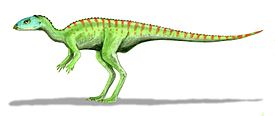
Gasparinisaur Reconstruction |
| Scientific classification |
|---|
| No rank : | Bilateral symmetrical |
| Infraclass : | Archosauromorphs |
| No rank : | Archosauriformes |
| Infrastructure : | † Ornithopods |
|
| International scientific name |
|---|
Gasparinisaura Coria & Salgado, 1996 |
| Single view |
|---|
† Gasparinisaura cincosaltensis
Coria & Salgado, 1996 |
Geochronology83.5–70.6 Ma | million years | Period | Era | Aeon |
|---|
| 2,588 | Even | | | Ka | F
but
n
e
R
about
s
about
th | | 23.03 | Neogene | | 66.0 | Paleogen | | 145.5 | a piece of chalk | M
e
s
about
s
about
th | | 199.6 | Yura | | 251 | Triassic | | 299 | Permian | P
but
l
e
about
s
about
th | | 359.2 | Carbon | | 416 | Devonian | | 443.7 | Silur | | 488.3 | Ordovician | | 542 | Cambrian | | 4570 | Precambrian |
◄ Nowadays◄ Cretaceous-Paleogene extinction◄ Triassic extinction◄ Mass Permian Extinction◄ Devonian extinction◄ Ordovician-Silurian extinction◄ Cambrian explosion |
|---|
|
The first fossils of Gasparinisaura were found in 1922 in Argentina, near the city of Cinco Saltos, Rio Negro province. The typical and only species, Gasparinisaura cincosaltensis, was named and described by Rodolfo Coria and Leonardo Salgado in 1996. The generic name is given in honor of the Argentinean paleontologist Zulma Gasparini (literally "Gasparini lizard"), and the species denotes the name of the city from which fossils were found [2] .
Content
The holotype MUCPv-208 was discovered in the Anacleto formation layer, dated to the early Campanian , about 83 million years ago. It consists of a partial skeleton with a skull; most of the spinal column is missing. The paratype MUCPv-212 includes the lower elements of the hind limbs [2] . In 1997, three additional samples were described: MUCPv 213 — a partial skeleton with a skull, MCSPv 111 — a postcranial skeleton, and MCSPv 112 — a skull, hind limbs, and pelvis. The last three samples belong to young individuals [3] . In 2008, gastrolites found in the abdominal cavities of these three individuals were described [4] .
Gasparinisaura was a small bipedal herbivorous dinosaur. In 2010, Gregory Paul estimated its length at 1.7 meters and weight at 13 kilograms [5] .
Gasparinisaura had a rounded, rather elongated head. The eye sockets are very large and set high. The rather long nape was overhanging. A thin anterior process of the zygomatic bone is sandwiched between the maxillary and lacrimal bones; the back of the zygomatic bone is high and wide. The ascending process of the square-zygomatic bone touches the scaly bone, which is a basal sign. The jaw joints are down. The upper jaw carried 12 large teeth, and the lower - 13. The front limbs are easily arranged. The ilium is short and lowered; The pubic bone is thin. The hind limbs are relatively long and powerful with a short femur and a long rest. The foot is long; the first metatarsal bone is reduced to the periosteum - an advanced symptom. The tail is distinguished by plate-shaped triangular chevrons , expanding towards the back [2] .
Tours of MCSPv 111 (above) and MCSPv 112 (bottom)
Tourists
The guest tour was represented by formed clusters of up to 180 rounded and polished stones with an average stone diameter of about 8 mm. Having a weight of about 0.3% of the total body weight, they were massive enough to function as gastric millstones (grinding of stiff and fibrous plant foods). It must be said that sauropod dinosaurs were denied such a function of gastrolites due to the insufficient relative mass of the latter (0.03% of the total body weight) [4] .
Bone Histology
Postcranial bones of 11 specimens were selected to study the bone microstructure of Gasparinisaura . In the cortical layer of all the axial and peripheral bones studied, fibrolamellar tissue predominated, which is evidence of rapid osteogenesis and, accordingly, rapid growth. The presence of growth retardation lines and / or rings, however, indicates that rapid growth was periodic. At an early stage of development (less than 60% of the size of the largest specimen - MUC-Pv 213), Gasparinisaura had a fast and steady growth rate. Then, the overall growth rate decreased, as evidenced by a change in the internal orientation of the fibers in the matrix , from a disordered, coarse-fibrous tissue to a parallel, lamellar tissue. Gasparinisaura reached puberty before skeletal maturity, as is the case with other dinosaurs. In general, the growth strategy of Gasparinisaura is similar to other basal ornithopods (for example, Orodromeus ) [6] .
Initially, the taxon was considered by researchers as the basal iguanodont, the most basal member of the Euiguanodontia clade [2] . Recent studies have shown that Gasparinisaura is a basal euornithopod [7] . 2013 studies moved the genus even higher in the phylogenetic tree to the basal ornithopods [8] . In 2015, to determine the phylogenetic position of Morrosaurus, an analysis was performed based on a data matrix consisting of 230 characters for 52 taxa. As a result of the analysis, Gasparinisaura fell into the treasure of Elasmaria with other South American and Antarctic basal ornithopods.
Below is a cladogram based on an analysis of Rozadilla and colleagues (2015) [9] :
|
| Hypsilophodon |
|
|
| Thescelosaurus |
| | Iguanodontia | | Elasmaria |
| Gasparinisaura |
|
|
| Morrosaurus |
|
| Trinisaura |
|
| Macrogryphosaurus |
|
| Notohypsilophodon |
|
| Talenkauen |
|
| Anabisetia |
|
|
|
|
|
| |
|
|
|
|
|
|
|
Gasparinisaura featured in the 2011 Air Force documentary “ Dinosaur Planet ” in the “New Giants” series.
- ↑ Gasparinisaura (English) . Paleobiology Database Classic . Date of treatment April 6, 2016.
- ↑ 1 2 3 4 Coria, RA, and L. Salgado. (1996). A basal iguanodontian (Ornithischia: Ornithopoda) from the Late Cretaceous of South America. Journal of Vertebrate Paleontology 16 : 445–457.
- ↑ Salgado, L., Coria, RA, and Heredia, S. (1997). New materials of Gasparinisaura cincosaltensis (Ornithischia: Ornithopoda) from the Upper Cretaceous of Argentina. Journal of Paleontology 71 : 933-940.
- ↑ 1 2 Ignacio A. Cerda. (2008). Gastroliths in an ornithopod dinosaur. Acta Palaeontologica Polonica 53 (2) : 351-355.
- ↑ Paul, GS (2010). The Princeton Field Guide to Dinosaurs. Princeton University Press p. 278
- ↑ Cerda, IA & Chinsamy, A., 2012. Biological implications of the bone microstructure of the Late Cretaceous Ornithopod Dinosaur Gasparinisaura cincosaltensis. Journal of Vertebrate Paleontology 32 (2): 355-368.
- ↑ Norman, DB, Sues, HD., Witmer, LM, & Coria, RA (2004). Basal Ornithopoda. In: Weishampel, DA, Dodson, P., & Osmolska, H. (Eds.). The Dinosauria (2nd Edition). Berkeley: University of California Press pp. 393-412.
- ↑ RA Coria, JJ Moly, M. Reguero, S. Santillana, and S. Marenssi. (2013). A new ornithopod (Dinosauria; Ornithischia) from Antarctica. Cretaceous Research 41 : 186-193. DOI : 10.1016 / j.cretres.2012.12.00.004
- ↑ Sebastian Rozadilla, Federico L. Agnolin, Fernando E. Novas, Alexis M. Aranciaga Rolando, Matias J. Motta, Juan M. Lirio & Marcelo P. Isasi, 2016, “A new ornithopod (Dinosauria, Ornithischia) from the Upper Cretaceous of Antarctica and its palaeobiogeographical implications ”, Cretaceous Research 57: 311–324
