Barasing [1] ( lat. Rucervus duvaucelii ) is a mammal from the deer family . The species name was given in honor of the French naturalist fr: Alfred Duvaucel (1793-1824) [2] . The word barasing means "deer with twelve horns", which in this case are understood as processes. In fact, horns of barassing can have from 10 to 14, and sometimes up to 20 shoots.
| Barasing |
 |
| Scientific classification |
|---|
| No rank : | Bilateral symmetrical |
|
| International scientific name |
|---|
Cervus duvaucelii G. Cuvier , 1823 |
| Area |
|---|
|
| Security status |
|---|
Vulnerable speciesIUCN 3.1 Vulnerable : 4257 |
|

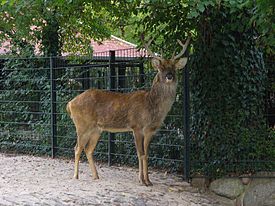
Barasingi, Kanha National Park,
Madhya Pradesh India
Skull drawing of a male barasing
Barasing is slightly smaller than the Indian Zambar . Growth of an adult male reaches 135 cm at the withers, weight - up to 170-180 kg. The horns are 75 cm long, but the longest horns of the barasings reached 104 cm in length. This deer has a thin, light brown coat. Male barasings are usually somewhat darker than females. In summer, these deer are usually lighter than in winter. Some individuals have barely visible spots on their skin.
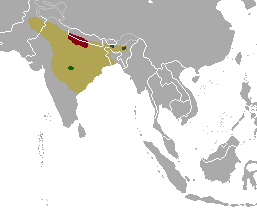
Barasings live in northern, central and eastern regions of India , throughout Pakistan and Bangladesh, as well as in southern Nepal and eastern Iran.
Barasinga always lives in swampy areas and in meadows. His hooves with widely spread fingers help him move around the bog. Barasinga grazes in the mornings and evenings, rests day and night, intently watching the surroundings. Hearing at the carcasses is not very good, but an excellent scent. Feeling the danger, the deer emit a sharp cry, attracting the attention of the rest of the herd and rush to flight.
Nutrition
Barasings feed on grass.
Reproduction
Barasings breed rapidly. The race in males begins at the end of December, when the horns are fully grown. At dawn and at dusk, the males bleed and roar, attracting females and scaring away other males. Often males pierce the horns into the grass and its long bunches hang from the horns as an additional decoration. The more grass hanging from the horns of the male, the more attractive it is for females. Shortly before birth, the female deer leaves the herd and leaves to give birth to tall grass until the deer is strong. Growing up deer of the same age gather in groups called “schools”. In each such group there are from 40 to 50 deer. Year-old deer and adult deer graze together - males and females.
The main natural enemy of leaching is the tiger .
Previously, harassing in India were found in huge numbers. So, until 1955, near the Corbett National Park near the Tumeria Dam, there were about 5,000 barasing. However, the subsequent plowing of swamps almost completely exterminated these deer in those places. In addition, the barassing turned out to be tasty meat, flour is made from the horns, which, according to the recipes of traditional Indian medicine, is used for chest diseases. The last refuge of the marshland was the Gola wetland of approximately 12 km². Until 1965, here you could find 700-800 marauding. However, the plowing of land began here. the surviving deer took refuge in the flattering mass of Dudhava, which was then declared a protected area, which saved the barassing from complete extinction. In 1969 there was a herd of up to 500 individuals. By 1981, the livestock breeding increased to 2000.


