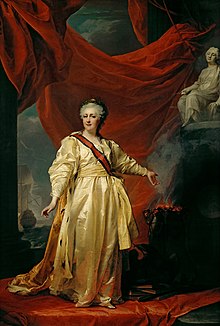
Russian classicism is a style in art that arose in Russia during the process of Europeanization under Catherine II [1] , and was widespread in the second half of the 18th and first half of the 19th centuries .
The approval of this style in the Russian art school became a symptom of its maturation as one of the European schools [2] .
Content
- 1 term
- 2 Periodization
- 3 Characteristic
- 3.1 Aesthetic Creed
- 3.2 Attitude to Antiquity
- 4 Architecture
- 4.1 Examples of buildings
- 5 sculpture
- 5.1 Empire
- 6 Painting
- 7 Literature
- 8 Music
- 9 Theater
- 10 Bibliography
- 11 Notes
Term
Russian classicism, from the point of view of the world history of art, is part of European neoclassicism.
The confusion in terms should be noted: in European art history, the style of the 17th century is the true, first, classicism, followed by the second wave - neoclassicism of the late XVIII - mid XIX century (corresponding to Russian classicism). Then, at the turn of the 19th century, a third surge of interest in the classical style took place, in Russia called neoclassicism , and abroad without a separate name.
| Period | Europe | Russia |
|---|---|---|
| XVII century | classicism | - |
| end of XVIII - mid 19th century | neoclassicism | Russian classicism |
| end of XIX - beginning of XX century | neoclassicism ( retrospective ) |
Periodization
The time frame for the domination of style in Russia was the 1760-1830s, from the time of the early Catherine’s rule to the first decade of the reign of Nicholas I. Within the framework of classicism, there were several phases: [2] .
- Early classicism (1760s - 1st half of the 1780s), when the signs of baroque and rococo were still not completely eradicated
- Mature classicism, strict classicism (1780s - 1790s) - an almost declarative rejection of any non-classical tendencies, a fundamental tendency towards antikization
- High classicism, late classicism, Russian empire (1st third of the 19th century) - you can feel the influence of romanticism, which has gained strength in painting and graphics.
Feature
Classicism arises and develops under the influence of enlightening progressive tendencies in social thought. The ideas of patriotism and civicism, the creation of a “new homeland”, the extra-veritable value of the human person become dominant. In antiquity, the features of the classical era of Ancient Greece find an example of an ideal state structure and harmonious relations of man with nature. Antiquity (known from the monuments of literature, sculpture and architecture) is perceived as a fertile era of the free development of personality, spiritual and physical perfection of man, an ideal human history sometimes without social contradictions and social conflicts [3] .
The emergence of a new style was preceded by more than half a century the development of Russian art of the New Age, characterized by the predominance of Baroque .
The change in the style situation happened very quickly, which is evident primarily in architecture. The accession of Catherine the Great put an end to the "Elizabethan Baroque" and the short period of Peter III with his interest in Rococo . Classicism turned out to be appropriate in the context of strengthening the cult of statehood in the Russian Empire under Catherine II. “The priority of public debt over personal feeling, proclaimed by the theory, encouraged sensations of a sublime unified atmosphere of state myth” [4] .
In parallel with classicism in Russia, there were other, not so influential movements - in particular, the Russian Rococo with its exotic sub-styles ( chinoiserie ), pseudo-Gothic , sentimentalism [2] .
Aesthetic Creed
The ideas of the Enlightenment are reflected in the theory of classicism. At one time, it was even customary to call classicism of the 18th century “enlightening classicism”, in contrast to “class classicism” of the 17th century. The concept of "enlightened mind", capable of rebuilding the world for the benefit of man, has become one of the common places [4] .
Classicism, like no other style, suggested a theoretical justification, especially since it usually reigned where a rationalistic atmosphere arose. In Russia, this coincided with the founding of the Academy of Arts (1757), whose members translated and composed their “manuals”, “works” and speeches [4] .
A. P. Sumarokov in his “The Word on the Opening of the Imperial St. Petersburg Academy of Arts” (1764) draws attention to such important functions of works of art as ministry:
| Pietic expressions and their images, although they are fictitious, serve the knowledge of nature, imitation of great deeds, aversion to vices, and all that mankind requires to be corrected: and they often have more success than the preached Morality. |
Thus, art is called upon to exterminate vices, to instruct in virtues, to cultivate a desire to be useful, above all, in the service of the fatherland. “This inextricable connection of sensual pleasure and moral imperative embedded in elegant forms led to the formulaic declarations of the era, expressed, in particular, in the title of Heraskov’s magazine“ Useful Amusement ”or in the subject of painting designated by Anton Rafael Mengs -“ amusing to teach ”“ [4] .
“Like the ideology of the Enlightenment, classicism is the style of a developed civilization, in which there is no place for prejudices and vices generated by savagery and“ dark ”uncontrollable passions. And the more art “dwells” among the people, the more “ its natural severity softens, the laziness and idleness are extinguished, and harmful tendencies are removed ” ” [4] . Classicism adhered to the principle of creating "a kind of new world in which objects are presented to us as they, according to the assurance of nature," (Catrmer de Crenci). Classicism is characterized by a desire for clarity, certainty, unambiguity, logical accuracy.
Another fundamental task was to imitate a modern and harmonious nature, and the Greeks were valued precisely for this skill. Didro emphasized that to study Antiquity is to learn to truly see nature. Beauty is understood as something extracted from nature, but also superior to it [4] .
Art should contribute to the taming of gross passions and promote the ascent from ignorance to “higher intelligences”, from barbarism to civilization, from a gross individual to an enlightened person. Beauty must portray truth and virtue, engage in moral education. All bad things must be portrayed in an ugly form [5] .
Fine arts were seen as necessary and useful. When they reach perfection and “become universal among a nation”, it is expected that “ignorance and insensibility of a rude and unenlightened person disappears little by little, his mind is filled with amenities.” Thus, art is considered one of the most important ways of educating a person. The educational function is also in the selection of plots from the exploits and noble deeds of the past. Patronage of artists is therefore the most important virtue of those in power [4] .
The beneficial effect of arts on a person is the stronger, the more diverse and at the same time, the stronger they interact with each other - painting, architecture, sculpture, etc. [4]
Antiquity
Antique art was perceived as an authoritative classic, an invaluable pan-European historical legacy. The Greeks were considered a model of moderation and simplicity, unlike the Egyptians, who were based on some "fictional rules", or the Romans, who lost all the rules. In this respect, Russian theorists relied on a tradition already established in Western thought - primarily the works of Johann Winkelmann and Gotthold Efraim Lessing [4] .
The theme of the empress's patronage of the arts occupies an increasingly firm position in the political rhetoric of power. "The steady comparison of the queen with Minerva, the mythological patroness of sciences and arts, once again emphasizes that the" most notable "arts in Russia flourish, as well as everything else," under the shadow of the mercy of the Great Catherine "." [four]
References to Antiquity called for the revival of conditions for the prosperity of the arts, the creation of a "golden age" of art.
Architecture
A feature of Russian classicism in architecture was an eclectic combination in one work of different styles, a departure from the strictly regulated methods and forms of classicism .
In early Russian classicism (1760-1770), the plastic and dynamics of the forms inherent in Baroque and Rococo still persisted, in the era of mature classicism (1770-1790), classical types of palace-estates and large residential buildings appeared, which became examples of the construction of suburban noblemen estates and front buildings of Russian cities. The early Russian classicism includes architects J. B. Wallen-Delamot , A. F. Kokorinov , J. M. Felten , K. I. Blanca , A. Rinaldi . The architects of the mature period of classicism - J. Quarenghi , C. Cameron , I.E. Starov in St. Petersburg, V.I. Bazhenov and M.F. Kazakov - Moscow.
As a result of large-scale urban development at the turn of the eighteenth and nineteenth centuries, urban ensembles of the center of St. Petersburg ( A. N. Voronikhin , A. D. Zakharov , K. I. Rossi ) and Moscow ( D. I. Zhilyardi , O. I. Bove , A G. Grigoriev ), built up after the fire of 1812 . The ensembles of urban centers of Kostroma , Tver , Yaroslavl belong to the same style.
Building Examples
- Anichkov Palace
- Pashkov house
- Museum-Reserve Tsarskoye Selo
- Saint Sophia Cathedral (Pushkin)
- Admiralty
- Tauride Palace
- Kazan Cathedral (St. Petersburg)
- General Staff Building (St. Petersburg)
- The building of the Senate and the Synod
Pashkov house
Kazan Cathedral, 1896
Tauride Palace
General Staff Building
Sculpture
In the era of classicism, sculpture was respected as meeting the main requirement of the style - imitation of nature, as well as the safest part of the ancient heritage [6] .
Antique sculpture was known for its originals and prints, and therefore became an excellent model for new masters. Many Russian artists have made it their main task to comprehend the ancient ideal, a measure of classical perfection. But at the same time, the desire to express current issues of the present remained. Works of Russian sculpture of the era of classicism - an extremely high artistic level and great figurative expressiveness. The masters of this style, primarily - Fedor Gordeev , Ivan Martos , Theodosius Shchedrin , Mikhail Kozlovsky , Ivan Prokofiev . These sculptors in some works are not yet completely free from the influence of the Baroque, but in mature works they expressed the aesthetic ideal of classicism quite completely [3] .
Fedor Gordeev was the oldest of this generation of sculptors. He became famous for the composition "Prometheus" and a number of tombstones. It was to him that Russian sculpture owed a series of copies from antique originals, interpreted quite freely [3] .
F. Gordeev. "Prometheus", 1769, gypsum, timing
F. Gordeev. “Tombstone of A.M. Golitsyna ”, 1788, Annunciation tomb of the Alexander Nevsky Lavra
I. Prokofiev. "Actaeon chased by dogs", 1785, Tretyakov Gallery
Mikhail Kozlovsky was the most significant figure in the field of classic plastic at the end of the 18th century. He was better than others at work that was full of great civilian sound, saturated with the ideals of patriotism (Hercules on a Horse, Jacob Dolgoruky, Vigil of Alexander the Great), which became an example of the content of Russian plastic art. Especially significant are his recent works - the Samson fountain and the monument to Suvorov in St. Petersburg , in which Russian classicism of the 18th century found its most perfect expression.
M. Kozlovsky. “The Vigil of Alexander the Great”, 1780s, State Russian Museum
M. Kozlovsky. "Polycrate", 1790, State Russian Museum
M. Kozlovsky. "Yakov Dolgoruky, tearing the tsar's decree", 1797, State Tretyakov Gallery (copy)
I. Martos. The Running Acteon, 1800, Peterhof, The Big Fountain
I. Martos, “Running Acteon”, 1800, State Tretyakov Gallery (copy)
Samson Fountain is the plastic and semantic center of the Grand Cascade of Peterhof Park . This park is one of the most significant in its artistic value. A number of foreign and Russian architects worked on its Grand Cascade - Mikhail Zemtsov , Jean-Baptiste Leblon , Bartolomeo Francesco Rastrelli , Giacomo Quarenghi , Andrei Voronikhin , Ivan Starov , throughout the 18th century. Here the problem of the synthesis of arts was solved. The reconstruction of the fountains of the Grand Cascade, which had fallen into disrepair by the beginning of the 19th century, and the replacement of statues with new ones, was the largest event of Russian plastic art of this period. Everything that was created earlier required restoration work, and the best artistic forces were involved for this. In addition to castings from ancient statues, new series were created: Perseus, Sirens and Neva by Shchedrin, Volkhov Prokofiev, Pandora Shubin, Actos Martos [3] .
Monument to Suvorov on Suvorov Square is the pinnacle of the work of Kozlovsky-monumentalist. The commander is shown with a sword and a shield in his hands, in a jerky movement, like an ancient hero. It synthesizes the idea of citizenship and triumph. The monument has become one of the most popular, and it can be taken as the result of the development of Russian plastic over the past century [3] .
M. Kozlovsky. “Monument to Suvorov”, 1801, St. Petersburg
M. Kozlovsky. “Monument to Suvorov” (model), State Tretyakov Gallery
Empire
The sculpture of the beginning of the 19th century reflects the growth of national and public self-awareness of Russian society. A very strong influence on these mindsets was the struggle with Napoleon . The Patriotic War of 1812 gave rise to high patriotism, reflected in art in the interest in singing the greatness of the victorious people [3] .
For the development of sculpture of this period, the fact that Russian architecture then rose to an unprecedented high level was important. In St. Petersburg, Moscow and other cities, magnificent structures and entire ensembles were erected, which significantly changed the appearance of the cities. Architects Andreyan Zakharov , Andrei Voronikhin , Tom de Tomon , Karl Rossi gave Russian architecture the solemn grandeur inherent in Alexander Empire. Architects actively collaborated with sculptors, masters of decorative plastic, because the sculpture enriched the architectural structures, introducing them the power of a concrete-sensual image, deepening the content of buildings and making them closer and more understandable. “Plastic developed in close unity with the search in the field of architecture. This, by the way, explains the achievements in the field of synthesis of arts, which still retain the value of a high standard. Decorative sculpture was introduced into architecture not as a simple decoration, but as a necessary part of the structure, connected with it with a thousand threads, enriching its content and introducing plastic beauty into the architect’s plan ” [3] .
Such, for example, is the building of the Admiralty (1823), which cannot be imagined without decorative decoration. According to its author, architect Zakharov, without a sculpture, it loses proportions and beauty. The Admiralty plastic has become a classic example of the synthesis of arts. The best masters worked on it - Theodosius Shchedrin , Vasily Demut-Malinovsky , Stepan Pimenov , Ivan Terebenev . When creating the building, the architect developed the decoration system in detail, determining for each sculptor the work area, the overall silhouette and the scale of the decorative elements. Эта общая схема послужила руководством для скульпторов самого разного дарования и мастерства, которым удалось выразить общий замысел Захарова, сохранив своеобразие в частном. Важную роль в общем композиционном замысле играют «Морские нимфы» работы Щедрина — это наиболее яркое и зрелое произведение скульптора. По четырём углам аттика стоят фигуры Ахилла, Пирра, Аякса и Александра Македонского, скульптуры по наверху башни а также по углам четырёх фронтонов — аллегории 12 месяцев (скульпторы Щедрин, Демут-Малиновский и Пименов). Над «Нимфами» установлен знаменитый горельеф Теребенева «Возрождение флота в России». Им же выполнены рельефы для фронтонов портиков с изображением летящих Слав. «Успех этой грандиозной коллективной работы во многом объясняется тем, что вся скульптура была создана по единому плану зодчего и пронизана единым содержанием. В аллегорических композициях художники передали идею мощи России как великой морской державы, владычицы морей. Была найдена самобытная монументальная форма, которая придала сооружению неповторимую декоративную красоту» [3] .
Здание Адмиралтейства
Ф. Щедрин. «Морские нимфы» на южном фасаде Адмиралтейства, 1812
Южный фасад Адмиралтейства
И. Теребенев. Панно «Возрождение флота в России», под ним «Летящие Славы» на южном фасаде Адмиралтейства, 1812
Северный фасад Адмиралтейства
И. Теребенев. «Гений Славы, трубящий победу» на северном фасаде Адмиралтейства
«К лучшим образцам декоративной пластики того времени относятся также украшения здания Биржи в Петербурге, построенной Томоном, и особенно фигуры, сидящие у Ростральных колонн » [3] . Раньше, в XVIII веке, скульптурные украшения во многих случаях являлись абстрактными аллегориями, то теперь их смысл стремились активно связывать с реальностью, предназначением сооружения. Характерные примеры — убранство арки здания Главного штаба , созданное Василием Демут-Малиновским и Степаном Пименовым , московские Триумфальные ворота работы Ивана Витали и Ивана Тимофеева , Нарвские Триумфальные ворота работы Демута-Малиновского и Пименова вместе с Петром Клодтом . «В этих образцах звучали патриотические идеи, утверждался героизм русского народа, одержавшего блистательную победу в войне с французами» [3] . Типичные черты: фигура Славы на колеснице, фигуры воинов, торжественный ритм коней, которые влекут победную колесницу, летящие славы, военная арматура , аллегорическое изображение освобождения Москвы и т. п. «Трудно представить себе архитектуру классицизма без этой пластики. Она стала неотъемлемой частью стройных и строгих портиков, арочных пролётов. Она органически слилась с городским ансамблем, придала ему особую, строгую красоту, углубила содержание архитектуры, обогатила её живописностью объёмов, игрой светотени». Скульпторам того времени удавалось передать значительное содержание в форме строгой величавости [3] .
Ростральная колонна в Петербурге. Аллегорическая женская фигура («Аллегория реки Невы»). 1810. По моделям французских скульпторов И. Камберлена и Ж. Тибо
Ростральная колонна в Петербурге. Аллегорическая мужская фигура. 1810
Московские ворота . 1838
IN AND. Демут-Малиновский и С.С. Пименов. Арка здания Главного штаба . 1828
Арка здания Главного штаба. 1828
Арка здания Главного штаба.
С.С.Пименов. «Геркулес и Антей». 1811. Горный институт , главный фасад
IN AND. Демут-Малиновский. «Похищение Прозерпины». 1811. Горный институт
П.П. Соколов. « Молочница с разбитым кувшином », 1816
В начале XIX века ведущее положение в русской скульптуре занимал Иван Мартос , который работал очень плодотворно и в самых разных жанрах — портреты, декоративные статуи и рельефы, надгробия. Среди его декоративных работ особенно выделяются работы для Петергофа и Казанского собора . Именно благодаря Мартосу жанр надгробий (см. Русское художественное надгробие ) достиг в России больших успехов. К числу его шедевров относятся надгробия Собакиной, Куракиной, Гагариной и многих других [3] .
Однако подлинную славу он обрёл благодаря своему памятнику Минину и Пожарскому (1818). «Именно в этом монументе проявился тот пафос воодушевления, который был столь характерным для освободительной борьбы против наполеоновского нашествия» [3] . Героика событий XVI века живо соотносилась с событиями Отечественной войны. Замысел создания памятника возник ещё в начале века, средства намеревались собирать по подписке. «История русской монументальной пластики ещё не знала замысла такой прогрессивной силы. (…) Сама по себе проблема связи и постановки в памятнике двух фигур представляет немалую сложность для скульптора. Поиски смыслового единства, выразительности силуэта, динамической связи, сочетания объёмов в пространстве и многое другое создают особый круг проблем, над разрешением которых приходится серьёзно думать любому скульптору, каким бы творческим опытом он не обладал. Поэтому достойно восхищения то мастерство, с которым Мартос блестяще связал своих двух героев» [3] . Этот памятник оказался первым скульптурным памятником в Москве, и вдобавок первым, установленным в разорённой французами столице, в обновлённой Москве. «Мотивы триумфального в новой классицистической архитектуре как нельзя более гармонировали с характером произведения Мартоса» [3] .
I.P. Мартос. «Надгробие Е.С. Куракиной ». 1792. Благовещенская усыпальница Александро-Невской лавры
I.P. Мартос. «Надгробие Е.И. Гагариной ». 1803. Благовещенская усыпальница Александро-Невской лавры
S.S. Пименов. «Проект надгробия М.И. Козловскому ». 1802. ГРМ
I.P. Мартос. «Минин и Пожарский». 1818. Красная площадь
«Минин и Пожарский»
Продолжением этой патриотической тематики, однако уже целиком связанной собственно с историей Отечественной войны, стали памятники работы Бориса Орловского в честь Кутузова и Барклая-де-Толли перед Казанским собором. «Орловскому удалось убедительно передать роль каждого полководца в минувшей войне, лапидарно обрисовать их характер и превосходно связать памятники с ансамблем собора» [3] . Развивалось искусство Демута-Малиновского, также испытавшего влияние освободительных идей. Он создал статую «Русского Сцеволы». Фёдор Толстой создал превосходную серию медальонов , посвященных Войне 1812 года. «Толстой был большим знатоком античного искусства — его рельефы, круглая скульптура и графика стали характерным проявлением русского классицизма» [3] .
Б.И. Орловский. «Памятник М.И. Кутузову». 1836
Б.И. Орловский. «Памятник Барклаю-де-Толли». 1836
Б.И. Орловский. «Сатир и вакханка». 1837. ГРМ
Александровская колонна. 1832
Б.И. Орловский. Ангел на Александровской колонне
IN AND. Демут-Малиновский. «Русский Сцевола». 1813. Оригинал - бронза, ГРМ
«Русский Сцевола». Копия в музее «Бородинская панорама»
Ф. Толстой. Медаль «Народное ополчение», серия медальонов . 1816
В первой половине XIX века больших успехов достигает и жанр портретной скульптуры. Особенно показательно творчество Ивана Витали и Самуила Гальберга [3] .
S.I. Гальберг. «Портрет А.Я. Италинского ». 1823. ГРМ
S.I. Гальберг. «Портрет В.А. Перовского », 1829, ГРМ
I.P. Витали. «Портрет А.С. Пушкина». 1842. ГРМ
I.P. Витали. Фонтан на Театральной площади в Москве . 1835
I.P. Витали. Скульптура западного фронтона Исакиевского собора . 1841-1844
I.P. Витали. «Венера». 1852. ГРМ
Painting
Живопись эпохи классицизма, в отличие от архитектуры и скульптуры, не была настолько строго подвержена влиянию главного стиля эпохи. Параллельные классицизму стилевые тенденции порой, наоборот, выходили на первый план. Так, отчетливо чувствуется линия «рококо — сентиментализм — романтизм», давшая в этот период таких художников, как Фёдор Рокотов , Владимир Боровиковский , Орест Кипренский . Тем не менее, даже на самом радикальном проявлении «неклассического» лежит отпечаток классицизма. А сильнее всего из всех жанров живописи он отразился в исторической [2] .
В иерархии жанров живопись занимала низшее положение по сравнению со скульптурой — как из-за того, что античных образцов живописи практически не сохранилось, так и из-за более высокой мемориальной способности скульптуры, что было важным для назидательности классицизма [6] .
Крайне высокая роль отводится изучению рисунка. Под его «превосходство» подводится теоретический базис — он возник раньше, чем живопись, служит ей фундаментом, способен изобразить вещь без красок, и т. п. Образцы «рисовальной науки» тщательно сберегали.
Во 2-й пол. 18 века искусство становилось все более публичным. В Академии художеств укоренилась традиция выставок, которые становились «судьбоносными» для лучших художников; возник обычай отправлять медалистов в зарубежные поездки. [7]
Literature
Music
Музыка периода русского классицизма ничем не отличалась от музыки, созданной европейскими композиторами.
Theater
Театральное действие рассматривалось как «картина», цель актеров считалась одинаковой с художниками — то есть занять зрение, тронуть сердце и ум, напомнить о славном историческом прошлом и обличить пороки, вдохнув любовь к добродетели. «Театральность», преувеличенность экспрессии оправдывалось из-за дальнего расстояния сцены и условности [6] .
Bibliography
- Власов В. Г. . Русский классицизм // Власов В. Г. Новый энциклопедический словарь изобразительного искусства: В 10 т. — СПб.: Азбука-Классика. — Т.8., 2008. — С.346-353.
- Власов В. Г. . Элективный метод архитектуры раннего русского классицизма второй половины XVIII века // Власов В. Г. Искусство России в пространстве Евразии. - T.2. Классическая архитектура и русский классицизм. — СПб.: Дмитрий Буланин, 2012. — С.107-322.
- Власов В. Г. . Итальянизмы в архитектуре Санкт-Петербурга: Историческая трансляция образов античности и ренессанса // Электронный научный журнал « Архитектон: известия вузов ». — УралГАХУ , 2018. — № 2 (62).
- Власов В. Г. . Полистилизм, элективный метод и классификация композиций архитектуры русского классицизма // Электронный научный журнал « Архитектон: известия вузов ». — УралГАХУ , 2018. — № 3 (63).
- Карев А. Классицизм в русской живописи. М., 2003. ISBN 5-7793-0688-5
- Михайлова М. Б. Государственная власть и архитектурно-градостроительное творчество на юге России периода классицизма // Архитектура в истории русской культуры. — Вып.4: Власть и творчество / Отв. ed. И. А. Бондаренко . — М., 1999. — ISBN 5-86700-001-X — С.107—112.
- Михайлова М. Б. Градостроительство классицизма в России: желаемое и действительное // Архитектура в истории русской культуры. — Вып.3: Желаемое и действительное / Под ред. И. А. Бондаренко . — М.: Едиториал УРСС , 2001. — ISBN 5-8360-0043-3 — С.124—127.
- Михайлова М. Б. Типы сооружений античности в архитектуре русского классицизма // Архитектурное наследство . — Вып.26: Традиции и новаторство в зодчестве народов СССР / Под ред. О. Х. Халпахчьяна . — М.: Стройиздат , 1978. — С.3—12.
- Михайлова М. Б. Соборные площади новых городов юга России периода классицизма // Архитектурное наследство . — Вып.36: Русская архитектура / Под ред. Н. Ф. Гуляницкого . — М.: Стройиздат , 1986. — С.187—202.
- Путятин И. Е. Русская церковная архитектура эпохи классицизма. Идеи и образы. — Автореф. dis. доктора искуств-я. — М., 2011 — 60 с.
Notes
- ↑ Фролов Э. Д. Традиции классицизма и петербургское антиковедение
- ↑ 1 2 3 4 А.Карев. Классицизм в русской живописи. М., 2003. С. 3-4
- ↑ 1 2 3 4 5 6 7 8 9 10 11 12 13 14 15 16 17 18 Русская скульптура. Избранные произведения. Comp. А. Л. Каганович . Изд. «Советский художник». Л.-М., 1966. С. 1-17
- ↑ 1 2 3 4 5 6 7 8 9 10 Карев. Там же… С. 7-15.
- ↑ Карев. Там же. С. 16-17
- ↑ 1 2 3 Карев. Там же. С. 20-23.
- ↑ Карев. Там же. С. 25-29.