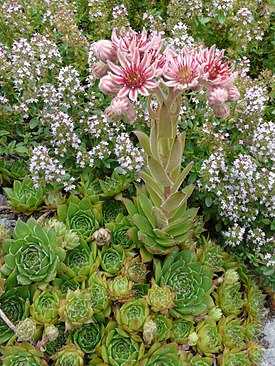
Sempervivum marmoreum ssp. erythreum
Sempervivum marmoreum 'ornatum'

Youngsters in the
Cambridge Botanical Garden,
EnglandA perennial stolon- forming plant. Flat monocarpic rosettes with a diameter of 2.5 to 10 cm extend from strong two-centimeter stolons. Leaves at a young age are pubescent, naked or almost naked, reach a length of 2.5-3 cm. The leaves are fleshy, whole, obovate, spiky, shiny, pale - green or red with green tips and tops. Flowering shoots 10-30 cm tall, branched, pubescent, abundantly covered with sequential leaves. The inflorescence is cimic, voluminous, consists of 25-35 flowers up to 2.5 cm in diameter. Petals 11-12, burgundy at the base, pink to white in the direction of the ends. Fruit - polyspermous seed, small, 0.8 mm long. It blooms in July, bears fruit in August. Propagated mainly vegetatively.
The range covers Southern, Central and Eastern Europe from the Balkan Peninsula to the Carpathian Mountains. It is found in the Czech Republic, Slovakia, Hungary, Romania, Bulgaria, Albania, Greece, Ukraine.
It is found in Ukraine in the Transcarpathian region. It grows in two places in the Ukrainian Carpathians on Mount Kobyl in the southern part of Svidovets and in the Marmarosh mountains in the Beloy valley in the vicinity of the village of Delovoye in the Rakhiv region .
It grows in the mountains of Central and Southern Europe. In the Svidovets massif, the juvenile population lives on a treeless peak of rock conglomerates on the southeastern slope of Mount Kobyla at an altitude of 1045 m above sea level. Xerophytic conditions are provided by intensive insolation of this stony outcrop. The group belongs to the Union Androsacion vandellii . In the Bely Valley, the species grows under similar conditions on rocky peaks above the valley. Xerophyte, petrophyte.
Populations in Ukraine are very small and are at critical risk. The number is only a few dozen generative individuals.
A relict strategy is characteristic of populations; therefore, they cannot withstand competition in the process of gradual forest overgrowth and increased shading.
The species is listed in the Red Book of Ukraine, where it has the conservation status of “endangered”, but no special protection measures have been introduced. The collection of plants is prohibited. It is advisable to thin out the wood and shrubbery around the places of growth.
The view has a decorative, soil-forming, anti-erosion value. Grown in culture since the 18th century.
A very variable species of youngsters, is closely related to roofing youngsters ( Sempervivum tectorum ). It has an extraordinary, varied color. You can find samples as pale green, and samples of chocolate brown or red with green tips. This large variability relates more to color than to plant morphology. There are also some obvious differences in the size of the rosettes, the degree of pubescence, and the width of the leaves.
Some taxonomists divide the view into subspecies and varieties:
- Sempervivum marmoreum var. rubrifolium - diameter of rosettes up to 12 cm. Leaves are wide, reddish-green, the tip is pink. The flowers are pink with a red middle. It grows in Albania and Greece.
- Sempervivum marmoreum var. brunneifolium is a very compact form with brown leaves that turn red in the winter.