The southern arrow [4] , or the mercury arrow [5] , or the arrow of Mercury [6] ( lat. Coenagrion mercuriale ) is a rare species of dragonflies of the Strelka family ( Coenagrionidae ), which is found in Europe and North Africa. Adults fly from May to August. Larvae develop under water for 2 years. It is included in the IUCN International Red Book [7] , and is also protected in the regions ( Great Britain ) [8] .
| South arrow |

South arrow, male |
| Scientific classification |
|---|
| No rank : | Bilateral symmetrical |
| Subtype : | Tracheo-breathing |
| Infraclass : | Ancient winged insects |
|
| International scientific name |
|---|
Coenagrion mercuriale
( Charpentier , 1840) |
| Synonyms |
|---|
- Agrion mercuriale Charpentier, 1840 [1]
- Agrion fonscolombii Rambur, 1842 [2] [3]
|
| Security status |
|---|
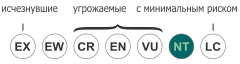
Close to vulnerableIUCN 3.1 Near Threatened : 5081 |
|
Content
A relict Mediterranean look. It is widespread in Europe ( Austria , Belgium , Great Britain , Germany , Spain , Italy , Netherlands , Portugal , Slovakia , Slovenia , France , Switzerland ) and North Africa ( Algeria , Morocco , Tunisia ) [7] .
Separate finds are known in the territory of the former USSR: Azerbaijan , Armenia , Ukraine . In Ukraine, there are reports of the presence of larvae of this species in the estuary of the Southern Bug River on the border with Romania [9] , but it needs confirmation [10] . The species was also cited in the Red Book of Ukraine (1994) for the Danube Biosphere Reserve in the Odessa region [11] .
Climatological and geographical features make it possible to describe its zoogeographic status by various authors as Mediterranean, Ibero-Maghreb, or Atlanto-Mediterranean. In the UK, it is noted only along the south coast. In most European countries it occurs locally (Austria, Belgium, the Netherlands, Slovenia, Switzerland), and only in Germany, Spain, Italy and France it is more widespread [12] .
A population of a species in Italy is sometimes regarded as a separate subspecies of Coenagrion mercuriale castellanii [7] .
Imago
A relatively small blue dragonfly. A characteristic feature is the presence of a special black pattern on the chest and abdomen, reminiscent of the designation of the planet Mercury in astronomy - за, for which the species received a specific Latin name. The total body length is 22–31 mm [5] . The length of the abdomen is 19-27 mm [5] . The length of the front wing is 12–21 mm [5] . The front and rear pairs of wings are almost identical in size and venation. The wings themselves are transparent, they have small black marks on the ends. The color of the males has a sky blue hue. Young females can be blue or green (usually they are lighter than males), but gradually become brown.
Larvae
Nymph larvae are up to 16 mm long. Body color from tan to gray-yellow and greenish. The head is rounded, 2 times wider than its length, lighter on the occipital part. The modified lower lip of the prey mask has a flat shape. Length of wing covers up to 4 mm. The length of the front pair of legs is 5 mm, the average is 5.5 mm, and the back is 7 mm. The abdomen has a cylindrical shape and gradually tapers towards its posterior end. Three caudal branchial plates have a length of up to 3 mm (approximately equal to the last three abdominal segments) [13] .
Unlike most other species of the genus Coenagrion , it is typical for flowing and not for standing types of water bodies [5] . The habitat of the species are rivers with a slow course, open streams and streams with abundant aquatic vegetation and thickets of grass along the banks, swampy streams, ponds. The view has two-year generation [5] . In June-July, the female lays eggs on aquatic plants or in silt off the coast of a reservoir. Embryonic development of eggs lasts 3-4 weeks. Larvae appear in late summer. Larvae are predators. The slow development of larvae is due to the low water temperature in the habitats of the species. Larvae pass 8–9 molts before wintering. The following summer, the development of larvae continues, and they hibernate a second time. In the summer, they molt once and turn into adults. Adults fly from mid-May to August [14] [5] . In the Drome river basin in the Réserve naturelle nationale des Ramières du Val de Drôme nature reserve ( Drome department , France ), the Coenagrion mercuriale population density reaches 72 dragonflies per 100 m [15] .
The reasons for the decrease in the number of species are land reclamation works, intensive farming methods, pollution of water bodies, and a decrease in the number of low-flow water bodies with a temperature regime suitable for the development of larvae. In the second edition of the Red Book of Ukraine (1994), the species had conservation status - category 1 [11] . The species was protected on the territory of the Danube Biosphere Reserve (“Danube Plavni”) . In 2009, the species was excluded from the third edition of the Red Book of Ukraine [16] .
The International Union for Conservation of Nature has included this species in the Red List with the status of NT ( Near Threatened ) - “close to endangered state”. With the same conservation category NT, the species is included in the European Red List of Dragonflies [17] . According to IUCN estimates, the species is endangered in the UK, Switzerland, Italy, Algeria, Tunisia, Slovakia; on the verge of extinction - in Austria, Belgium, Germany, Liechtenstein. The species is extinct in Luxembourg, the Netherlands and Slovenia. Information about the state of the species in the Czech Republic and Bulgaria is checked. Data from Albania, Hungary, Moldova and Romania on the presence of the species and its condition are now considered in the IUCN as erroneous [7] .
In 2013, the image of a dragonfly was included in the Red Book series of commemorative coins of Moldova , which were made of 999 silver (diameter 30 mm) [18] .
South arrow on the commemorative coin of Moldova
Male ( Oxfordshire , England )
- ↑ Coenagrion mercuriale (Charpentier, 1840). (eng.) . A Pan-European Species directories Infrastructure (PESI) . eu-nomen.eu. Date of treatment July 3, 2017.
- ↑ Coenagrion mercuriale Charpentier, 1840. (English) . Catalog of Life . catalogueoflife.org. Date of treatment July 3, 2017.
- ↑ Coenagrion mercuriale (Charpentier, 1840). (Fr.) . Inventaire National du Patrimoine Naturel, Muséum national d'Histoire naturelle . inpn.mnhn.fr. Date of treatment July 3, 2017.
- ↑ Striganova B.R. , Zakharov A.A. The Bilingual Dictionary of Animal Names: Insects (Latin-Russian-English-German-French) / . - M .: RUSSO, 2000. - S. 6. - 1060 copies. - ISBN 5-88721-162-8 .
- ↑ 1 2 3 4 5 6 7 Skvortsov V. E. Dragonflies of Eastern Europe and the Caucasus: Atlas-determinant. - M .: Partnership of scientific publications of KMK, 2010. - P. 173. - 624 p. - 1000 copies. - ISBN 978-5-87317-657-1 .
- ↑ USSR Red Book : Rare and Endangered Species of Animals and Plants. Volume 1 / Home Ed. Collegium: A. M. Borodin, A. G. Bannikov , V. E. Sokolov , etc. - 2nd ed. - M .: Forest industry, 1984. - S. 240. - 392 p.
- ↑ 1 2 3 4 Boudot, J.-P. (2006). Coenagrion mercuriale . (eng.) . The IUCN Red List of Threatened Species 2006 . iucnredlist.org. Date of treatment July 3, 2017.
- ↑ Wildlife and Countryside Act 1981 (Neopr.) . Government of the United Kingdom . Date of appeal October 15, 2010.
- ↑ Volkova L.A., Grigoryev B.F., Guryevskaya L.I. Dragonfly larvae of the Dnieper-Bug estuary region // Issues of fishery development and the sanitary-biological regime of water bodies of Ukraine: Journal. - 1970.- T. 1 . - S. 65-67 . )
- ↑ Gorb S.N., Pavlyuk R.S., Spuris Z. D. Dragonflies (Odonata) of Ukraine: faunistic review = Grandmothers (Odonata) of Ukraine: faunistic look // Herald of zoology. - K. , 2000. - T. Separate issue 15 . - S. 1-155 . (Ukrainian)
- ↑ 1 2 Chervona book of Ukraine: Creatures. - K .: “Ukrainian Encyclopedia” named after M.P. Bazhan, 1994. - 456 p.
- ↑ Coenagrion mercuriale (Charpentier, 1840). // Background Information on Invertebrates on the Habitats Directive and the Bern Convention: Part II. Mantodea, Odonata, Orthoptera and Arachnida / PJ van Helsdingen, L. Willemse, Martin CD Speight .. - Council of Europe Publishing, 1996. - P. 245-253. - 529 p. - (Nature and environment (No.80)). - ISBN 92-871-3062-0 .
- ↑ Popova A.N. Larvae of dragonflies of the fauna of the USSR (Odonata). - Keys to the fauna of the USSR, published by the Zoological Institute of the USSR Academy of Sciences. Issue 50. - M.-L.: Publishing House of the Academy of Sciences of the USSR, 1953. - S. 110-112. - 236 p. - 1,500 copies
- ↑ Error in footnotes ? : Invalid
<ref> ; no text is specified for кку2 footnotes - ↑ Faton JM & Deliry C. Surveillance de la population de Coenagrion mercuriale (Charpentier, 1840) dans la Réserve naturelle nationale de Ramières du Val de Drôme (Odonata, Zygoptera, Coenagrionidae) (Fr.) // Martinia: Journal. - Societe Francaise d'Odonatologie, 2004 .-- Vol. 20, n o 4 . - P. 163-179.
- ↑ Chervona book of Ukraine. Tvarinny svit / І.A. Akіmov. - K .: Globalconsulting, 2009 .-- 624 p. - ISBN 978-966-97059-0-7 . (Ukrainian)
- ↑ European Red List of Dragonflies (2010 ) . http://ec.europa.eu/.+ Date of treatment July 3, 2017.
- ↑ Cuhaj GS, Michael T. Standard Catalog of World Coins 2001 — Date. - 8th ed. - Iola: Krause Publications, 2013 .-- 1056 p. - ISBN 978-1-4402-3568-9 .
- Brooks, Steve. Field Guide to the Dragonflies and Damselflies of Great Britain and Ireland. - British Wildlife Publishing, 1997. - ISBN 0-9531399-0-5 .
- Buchwald R. Zur Ökologie von Coenagrion mercuriale (Charp.) Und Orthetrum coerulescens (Fabr.) In Südwestdeutschland (Odonata: Coenagrionidae, Libellulidae) (German) // Opusc. Zool. Flumin. : Magazine. - 1989. - Vol. 34. - P. 3-6.
- Faton JM & Deliry C. Surveillance de la population de Coenagrion mercuriale (Charpentier, 1840) dans la Réserve naturelle nationale de Ramières du Val de Drôme (Odonata, Zygoptera, Coenagrionidae) (Fr.) // Martinia: Journal. - 2004. - Vol. 20, n o 4 . - P. 163-179.
- Martens A. Group oviposition in Coenagrion mercuriale (Charpentier) (Zygoptera: Coenagrionidae) (English) // Odonatologica: Journal. - 2000. - Vol. 29, no. 4 . - P. 329-332.