
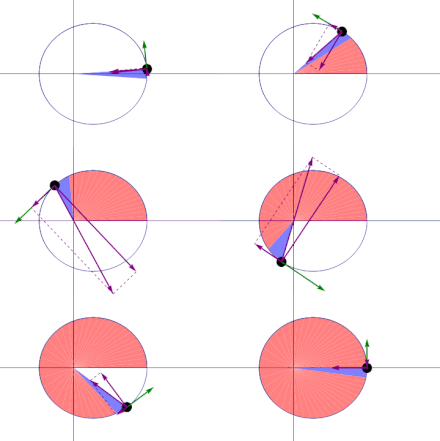
Sector velocity is a physical quantity that determines the rate of change in the area swept by the radius vector of a point as it moves along a curve. Sector speed is a vector quantity and is equal to half the vector product of the radius vector by the point velocity vector:
![{\ displaystyle {\ begin {aligned} {\ vec {\ sigma}} = {\ frac {1} {2}} [{\ vec {r}} \ times {\ frac {d {\ vec {r}} } {dt}}] \ end {aligned}}}](https://wikimedia.org/api/rest_v1/media/math/render/svg/ab4e8cbe24b5ba7821a333c4726b684346cb3271)
Relation to angular momentum
The concept of sector speed is historically closely related to the concept of angular momentum. Kepler’s second law states that the sectorial velocity of the planet remains if the origin is in the focus of the ellipse where the Sun is located. Generally speaking, the concept of sectorial velocity plays an important role in the study of motion under the action of central forces, since in this motion the sectorial velocity remains constant. Isaac Newton was the first scientist to recognize the dynamic significance of Kepler’s second law. In 1684, that any planet that is attracted by a fixed center sweeps equal areas for equal time intervals (area theorem).
The time derivative of the sector velocity is called the sector acceleration of the point.
- where: - acceleration point.
There is a relationship between the angular momentum and the sector speed:
Sector velocity in a cylindrical coordinate system
If a point moves along a plane curve and its position is determined by the polar coordinates ρ and φ, then
Literature
- Olkhovsky, I.I. The course of theoretical mechanics for physicists. - 4th ed. - Doe, 2009. - ISBN 978-5-8114-0857-3 .
See also
- Kepler's laws
- Cylindrical coordinate system
- Momentum