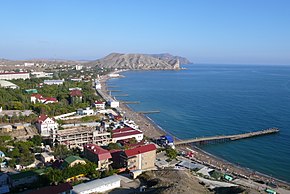
Sudak ( Ukrainian Sudak , Crimean Tat. Sudaq, Sudak , other Russian. Sourozh , Italian. Soldaia, Sugdeya [8] ) is a city of republican subordination [9] in southeastern Crimea , on the Black Sea coast , a traditional center wine production and resort . The administrative center of the urban district of Sudak ( Sudak City Council ).
| City | |||||
| Zander | |||||
|---|---|---|---|---|---|
| Ukrainian Zander Crimean Tat. Sudaq, Sudak | |||||
 | |||||
| A country | Russia / Ukraine [1] | ||||
| Region | Republic of Crimea [2] / Autonomous Republic of Crimea [3] | ||||
| Area | Sudak City District [2] / Sudak City Council [3] | ||||
| Head of the city administration | Nekrasov Andrey Vasilievich | ||||
| History and Geography | |||||
| Based | 212 AD | ||||
| Former names | Soldier, Sugdeya, Sidagios, Surozh | ||||
| Square | 23,477 [4] km² | ||||
| NUM height | 33 m | ||||
| Timezone | UTC + 3 | ||||
| Population | |||||
| Population | ↘ 16,766 [5] people ( 2019 ) | ||||
| Density | 713.72 people / km² | ||||
| Nationalities | Russians, Crimean Tatars, Ukrainians | ||||
| Official language | Crimean Tatar , Ukrainian , Russian | ||||
| Digital identifiers | |||||
| Telephone code | +7 36566 [6] [7] | ||||
| Postal codes | 298000 - 298023 | ||||
| OKTMO Code | 35723000001 | ||||
| COATUU code | 0111700000 | ||||
| sudak.rk.gov.ru | |||||
Sugdeya was founded around 212 BC. The Iranian ethnonym “Sughdak” ( Soldaia - for example, from the anonymous sea atlas beginning of the XIV century, Greek Σουγδαία ) is usually compared with the name of the Sogd country in Central Asia; it is believed that the city was founded by the Alans [10] [11] .
Title
The name Sudak ( Greek Σουγδαία ) is explained from the Iranian * suγda , * suxta-ka - “pure”, “holy”, “sacred”, compare the Osset. sugydæg, played with the same meaning [12] [13] .
In ancient times, the city was called by different names: Byzantines - Sidagios and Sugdeya, Italians - Soldaya, in ancient Russian sources - Surozh [8] .
In Ottoman times, the city received the name Sudak, which bears to this day; Turkic (Crimean Tatar) folk etymology reflects the nature of the area: Suv - water, dag - mountain .
Other names of the city: ancient Port Athenion [14] ; ŝoltāta ( Map of al-Idrisi 1154); Sodania (written peripl “Compasso da navigare” Italian. Compasso da navigare 1250–1265) [15] ; Soudac / Sỹdāk (written interlude of Abu-l-feed by Fr. Géographie d'Aboulféda [16] , 1st third of the 14th century); Soldadia (nautical chart of Francesco Picigano of 1367) [17] ; Sodaya ( Catalan Atlas of Abraham Cresca 1375); Soldaja (Sea Atlas Nicolo Pasqualini ital. Nicolò Pasqualini 1408) [18] ; Soldais (the large copper globe of Blau ( GIM ), the 50s of the 17th century) [19] .
Geography
Sudak is located in the middle part of the south-eastern coast of the Crimean peninsula , 47 km north-east of Alushta and 42 km south-west of Feodosia . The city is located in the valley of the Sudak River , on the banks of the Sudak Bay , limited from the west by Mount Krepostnaya , and from the east by Cape Alchak . The city is closed from the north by a ridge of mountains covered with beech and oak forests, as well as numerous pine forest belts of artificial origin. From the east is the arid Kapselskaya Valley . From the west - a typical Mediterranean area .
The city is constantly expanding its territory, so in 1996 it grew from 480.29 ha to 1429.46 ha [20] , and in 2003 increased to 2347.7 ha [4] .
Climate
The climate of Sudak is close to the climate of the Southern coast of Crimea - mild, without sharp temperature fluctuations, arid. There is little precipitation - an average of 318 mm per year (in Yalta - 609 mm). The average wind speed is 4 m / s and the average humidity is 73%. The sun shines in Sudak 2350 hours a year (in Yalta - 2250 hours). In Sudak there are very few cloudy days a year - 51 and quite a lot of clear days - 152. The average annual temperature is +11.9 ° С. In summer it is warm and sunny, there are a lot of hot and dry, and sometimes very hot days. It is especially hot in July and August - up to +38 ° С. Winter in Sudak is harsher than on the southern coast of Crimea , which determines that the climate is not truly subtropical (palm trees grow, but require care / shelter, because temperatures below -18 ° C are very dangerous for them). According to the USDA frost resistance zone, Pike perch is kept in zone 8a, and sometimes frosts up to -23 ° С are possible. Snow cover is unstable: snow falls rarely and melts quickly. Autumn is warm (warmer than spring) and cloudy. The sea in the Gulf of Sudak warms up early and stores heat for a long time. Cold currents are rare, and the average water temperature in June is +18.7 ° C, July +22.7 ° C, August +22.2 ° C, September +20.2 ° C, October +17.4 ° C . It should be noted that from year to year fluctuations in water temperature are possible: in June 2012 it was +22 degrees, in July-August from +25 to +29 degrees Celsius .
The swimming season is one of the longest in the Crimea - 138 days (from early June to mid-October). The maximum recorded temperature of sea water - +33 ° C .
History
According to the conclusions made by a prominent Soviet ethnographer - a Caucasian historian , professor , doctor of historical sciences A.V. Gadlo , who led the Caucasian archaeological and ethnographic expedition of Leningrad State University - the city was founded by the Alans (tribes of the Iranian-speaking group), presumably in 212 .
In the Middle Ages, the city was called Sugdeya ( Greek Σουγδαία ) and Soldaya ( Italian: Soldaia ), and its population grew due to the arrival of merchants, merchants and artisans from different countries, including Greeks and Italians .
In the VI century , by order of the Bulgarian Khan , a fortress was built in Sudak.
The Byzantine literature monument, “The Life of St. Stephen of Sourozh, ” describes the capture of Sourozh by the Rus at the end of the 8th or beginning of the 9th century:
The great Russian army under the command of Prince Bravlin suddenly collapsed on the Crimean coast. The Rus captured the Byzantine possessions from Chersonesos to Kerch and "with a lot of power" approached Surozh. After ten days of fierce battles, Bravlin with the army, "breaking the iron gate by force," burst into the city.
When Bravlin approached the tomb of Stefan of Sourozh , who was in the Sofia church of Sourozh , "turned his face back." Bravlin ordered the soldiers to return the seized goods to the Surozhans and release the prisoners, but the healing did not come. The pagan Bravlin had to be baptized, only after that his face returned to its former position. Baptized by Bravlin, the Sourozh Archbishop Filaret. Since that time, Christianity began to spread among the ruling elite of Kievan Rus .
The city became an important trading center and a significant transit point on the Great Silk Road , reaching its greatest prosperity in the XII - XIII centuries . In 1206 , after the conquest of Constantinople and the partition of Byzantium, the city passed under the control of the Venetian Trade Republic [21] , however, in fact, it was ruled by the Kipchaks . Around 1222, on the orders of Ala-al-Din Kay-Kubad , the Asia Minor Seljuks raided the city and defeated the Kipchak army, on the side of which Russian troops also appeared. The reason for the raid was the complaints of merchants about the frequent ruin of their ships, and the consequence was the destruction of crosses and bells and the establishment of mihrabs and minbar churches , as well as the introduction of Sharia [22] . It is also known that in Sughde there was a house at Uncle Marco Polo .
In the XIII - XIV centuries, the city was devastated and destroyed by the Mongols , but quickly restored. In 1365, Soldaya was conquered by the Genoese and included in the composition of the Genoese possessions in the Crimea. During this period, the city was governed by an Italian consul, whose elections were held every year. From this era preserved towers and city walls, called the "Genoese fortress." “Surzhane guests” - Russian merchants traded in Italian trading posts in the Northern Black Sea region in the 14th – 15th centuries. from the cities of Surozh and Tana with Moscow, and in search of highly valued hunting birds in the West and East, they reached Pechora [8]
In 1475, along with all the Genoese territories and the Orthodox Principality of Theodoro in Crimea, Sudak was conquered by the Ottoman Empire . During the Ottoman rule, the city, which lost its military significance, fell into decay, although it was the center of the Kadylyk , the smallest administrative unit of the Ottoman state.
In 1783, Sudak, along with the whole Crimea, was transferred to the Russian Empire . At the end of the 18th - beginning of the 19th centuries the city was almost completely depopulated and turned into a small village; according to the census of 1805, only 33 people lived in the abandoned city. In 1804, the first winemaking school in Russia was opened here. Sudak regained the status of the city only in 1982 .
In 1920, the winery GP Sudak was established [24] .
During the Great Patriotic War from November 1941 to April 1944 it was occupied by German-Romanian troops. In January 1942, a Sudak landing was planted in the city, which liberated the city and kept it from the superior enemy forces for almost two weeks. Most of the paratroopers died.
Population
| Population | ||||||
|---|---|---|---|---|---|---|
| 1939 [25] | 1959 [26] | 1970 [27] | 1979 [28] | 1989 [29] | 2001 [30] | 2009 [31] |
| 3246 | ↗ 3612 | ↗ 9802 | ↗ 11 281 | ↗ 15 399 | ↘ 14 495 | ↗ 15 112 |
| 2010 [31] | 2011 [31] | 2012 [32] | 2013 [32] | 2014 [33] | 2015 [34] | 2016 [35] |
| ↗ 15 171 | ↗ 15 300 | ↗ 15 368 | ↗ 15 457 | ↗ 16 492 | ↗ 16 615 | ↘ 16 597 |
| 2017 [36] | 2018 [37] | 2019 [5] | ||||
| ↗ 16 756 | ↗ 16 784 | ↘ 16 766 | ||||
- 1805 - 320 people
- 1926 - 1,877 people
- 1966 - 8,100 people
- 1989 - 15,316 people.
- 2001 - 15,050 people.
- 2004 - 15 071 people.
- 2015 - 16 615 people.
According to the census in the Crimean Federal District as of October 14, 2014, the population of the city was 16,492 people. [38] [39] The population of the city is 51.1% of the population of the Sudak urban district . [39]
National composition
According to the 2014 census, the national composition of the city’s population is as follows: [39] [40]
| nationality | Total, people | % of everything- go | % of indicating shih |
|---|---|---|---|
| indicated | 16107 | 97.67% | 100.00% |
| Russians | 10525 | 63.82% | 65.34% |
| Crimean Tatars | 2780 | 16.86% | 17.26% |
| Ukrainians | 2023 | 12.27% | 12.56% |
| Tatars | 257 | 1.56% | 1.60% |
| Belarusians | 118 | 0.72% | 0.73% |
| Armenians | 118 | 0.72% | 0.73% |
| Azerbaijanis | 27 | 0.16% | 0.17% |
| Poles | 24 | 0.15% | 0.15% |
| Uzbeks | 22 | 0.13% | 0.14% |
| other | 213 | 1.29% | 1.32% |
| did not indicate | 385 | 2.33% | |
| Total | 16492 | 100.00% |
Economics
The main specialization is the production of vintage and champagne wines, the spa industry, the production of rose oil .
Sudak is a climatic seaside resort. Indications are respiratory diseases of a non-tuberculous nature, functional diseases of the nervous system , cardiovascular diseases , etc. Sudak is the only city in Crimea that has beaches of quartz sand and mineral sulfate-bicarbonate water from a local source.
Each year, more than 180 thousand people (mainly unorganized vacationers) come to rest in Sudak and the Sudak region. In 2003, 49 thousand people rested in 18 boarding houses and health centers, a third of which were foreigners.
Distance to Crimean cities
| City | Distance (km) |
|---|---|
| New World | 7 |
| Alushta | 93 |
| Old Crimea | 36 |
| Theodosius | 55 |
| Kerch | 153 |
| Simferopol | 107 |
| Evpatoria | 172 |
| Yalta | 131 |
| Jankoy | 148 |
| Sevastopol | 181 |
Social Sphere
There are 3 secondary schools in the city (school-gymnasium No. 1 named after Hero of the Soviet Union A.E. Chaika , secondary school No. 2, school No. 3 (with the Crimean Tatar language of instruction), the central city library named after the local poet Vasily Rykov, sports school, youth center, Sudak branch of the Romanovsky College of Hospitality Industry, clinic, hospital, House of Culture .
Transport
Sudak bus There are 6 official bus routes, however 4 or 5 of them are seasonal. The route No. 6 with the message "Summer - Cozy" operates all year round. You can also get to nearby villages: Novyi Svit, Almond, Bogatovka, Solnechnaya Dolina, Raven, Mezhdurechye, Morskoye, Grushevka, Kholodovka. The route is served by the local carrier Auto Line LLC. There is a bus station in the city; Sudak is connected by bus to Simferopol , Feodosiya , Alushta and the surrounding villages.
Historical and Cultural Heritage
Of the monuments of history and culture of Sudak, the main object is the Genoese fortress of the XI - XIV centuries, as well as three temples of the 9th-13th centuries, monuments of Byzantine art.
- Church of the Holy Prophet Elijah , in the village of Sunny Valley . Built in the IX-XII centuries. The oldest of the existing temples of Crimea. In place of the temple, earlier than the X century, there was a more ancient church. In the temple there is a marble font from the 4th – 5th centuries brought from Constantinople, made from the capitals of a column of an ancient temple. [41]
- Church of the Holy Great Martyr Paraskeva . The Byzantine church, built in 12 - 13 century. [42] In the courtyard of the temple are preserved tombstones from the family crypt of Christian Steven - an outstanding botanist, the founder of the Nikitsky Botanical Garden .
- Church of the Twelve Apostles . The Byzantine church, built in 12 - 13 century. The altar fresco depicting the Last Supper was lost in the 1960-1970s. In 2009, the temple was restored / [42]
- The ruins of a large Byzantine temple , built in the 12th-13th centuries and supposedly dedicated to John Zalatooust, are located near Sudak, at the foot of Mount Kilisa-Kaya.
Monuments of the 19-20 century include other churches of the city:
- Orthodox church of the Protection of the Holy Virgin . Built in the years 1819-1829 in the style of classicism, church utensils moved to the new church from the church of St. Matthew , who was in the Sudak fortress. The bell tower was built in the 1840s. On September 29, 1869, the church was hit by an earthquake. In 1868, the church was visited by Empress Maria Alexandrovna with her son, future Emperor Alexander III , and his wife Maria Fedorovna. In 1912, the church was visited by Emperor Nicholas II. The Church of the Intercession of the Blessed Virgin Mary was closed in 1936, the abbot Father John (Blumovich) was shot on April 13, 1938; in 2000, as a holy martyr, he was canonized. Since 1942, according to the decree of the German occupation authorities, services continued in the church, which lasted until 1962, when the church building was transferred to Sudak High School to organize the Palace of Pioneers in it. In 1990, the church was returned to the Orthodox Church. Currently - the courtyard of the Kiziltash monastery .
- Church of St. Luke in the village. New World. Services resumed since 1998, the new temple building was built in 2012.
- Lutheran Church . The church was built in 1887, on the territory of a German colony founded in 1804. The colony was settled by the descendants of the Germans from Württemberg who came to Crimea during the reign of Catherine II. The German colony existed until the end of the 1930s.
The image of “Soldayi”, Sudak is captured by many painters and poets.
- Landscapes , views of Sudak, Cape Alchak are depicted in the paintings of Ivan Aivazovsky (Hovhannes Ayvazyan) , who lived for a long time at his cottage in Sudak; Konstantin Bogaevsky , Ilya Mashkov , and many others, including Russian, Italian and German artists. In 1884, the famous artist L. F. Lagorio set up his workshop in Sudak, where he created a number of landscape works, views of Kuchuk-Lambat , Yalta , Feodosiya , Alushta . Since 1936, the artist Lev Bruni lived and worked at his dacha, his wife, Nina Konstantinovna Balmont, children, the grandson - the artist Lavrenty Bruni .
- The "Silver Age" of Russian culture is associated with Sudak. In the city (39 Gagarina St.), the house of Adelaide Gertsyk , the Silver Age poetess, her sister, poetess Evgenia Gertsyk , a scientist, publisher Dmitry Zhukovsky, was built. The Gertsyk family lived in Sudak in their own house, bought by Kazimir Antonovich Lubny-Gertsyk, a descendant of an impoverished Polish noble family. [43] and his wife Sophia Iaksimilianovna Tidebel, the granddaughter of General S. A. Tidebel , in 1880. The guests of the Gertsyk family house at different times were the poets V. I. Ivanov and M. A. Voloshin , Tsvetaeva Marina Ivanovna , Anastasia Tsvetaeva , artist M. V. Sabashnikova , artists K. F. Bogaevsky, L. L. Kvyatkovsky , philosopher N A. Berdyaev . [44] .
- From 1917 to 1923, the poetess S. Ya. Parnok lived in Sudak. The poems written by her during these years were subsequently included in her collections “Roses of Pieria” (1922), “Vine” (1923). In Sudak, in 1917-1918. S. Ya. Parnock wrote the libretto of the opera “Almast”, for collaboration with composer A. A. Spendiarov . The opera Almast was staged at the Moscow Bolshoi Theater . June 24, 1930 with triumphal success was its premiere.
- In August 1917, the poet Osip Mandelstam, while in the Crimea, wrote two poems dedicated to the surroundings of Sudak - “Meganom” and “Golden Honey Jet ..” (“Grapes”), with allusions to the antique plot from “Odyssey” ; the heroine of the last poem was then the artist Vera Sudeikina-Stravinsky, who was then in Crimea.
- In the years 1915-1917. the artist A.N. Benois lived in Kapsel, staying at the cottage of General B.M. Kolyubyakin, capturing the landscapes of these places and writing about them: “I would make Russian Jellowstone Park from Kapsel, Meganom and surrounding areas, give it to this nature type значение неприкосновенного музейного сокровища и непременно оставил бы пустыню такой, как она дошла до нашего времени..» (А. Н. Бенуа «После Крыма»). [45]
Symbolism
- Emblem
Первый герб города Судака был утверждён исполнительным комитетом Судакского горсовета 8 декабря 1987 года в рамках Крымская области УССР в составе СССР . Он представлял собой «щит с золотой каймой, которая в верхней и нижней частях имеет расширения. Верхняя часть щита увенчана стилизованным фризом - элементом крепости. В нижней части - стилизованное изображение белой чайки. Основное поле щита рассечено и пересечено снизу. Первая и четвертая части красного цвета, вторая и третья - голубого. В центре щита золотое восходящее над горами солнце с расходящимися лучами, делящееся линией рассечения щита на две половины"» [46] . Власти Украины не утверждали символику города. После присоединения Крыма к Российской Федерации был утверждён герб города (городского округа) в соответствии с решением Судакского горсовета от 26 ноября 2015 года N 345 [47] :
В червлёном поле с узкой, волнисто выщербленной и дважды нитевидно окаймленной серебром, лазоревой оконечностью золотое солнце (без изображения лица), окруженное сложенными в кольцо чередующимися золотыми гроздьями винограда и серебряными виноградными листьями (по два листа между каждой парой гроздей, причём грозди положены от солнца и сообразно его лучам, а листья направлены к солнцу, в парах сложены веерообразно и попарно переплетены черенками), обремененное червлёной крепостной стеной с низким бастионом справа и высоким слева [48] .
- Flag
Тем же решением Судакского горсовета от 26 ноября 2015 года N 345 [47] был установлен и флаг города (городского округа), соответствующий гербу:
Прямоугольное полотнище красного цвета с отношением ширины флага к его длине 2:3; в нижней части полотнища – волнисто выщербленная горизонтальная полоса синего цвета, к которой сверху примыкают тонкие волнисто-выщербленные полосы белого, синего, белого цветов (максимальная высота синей полосы с тонкими полосами 1/7 ширины полотнища; ширина каждой из тонких полос – 1/49 ширины полотнища); в центре полотнища – солнце (без изображения лица) жёлтого цвета с чередующимися прямыми и пламенеющими лучами, окружённое кольцом из виноградных гроздей жёлтого цвета и виноградных листьев белого цвета: гроздья направлены от солнца к краям полотнища, листья, расположенные попарно между каждой парой гроздей, направлены к солнцу, сложены попарно веерообразно и в каждой паре переплетены стеблями (диаметр солнца по крайним точкам лучей – 3/8 ширины полотнища; внешний диаметр кольца по крайним точкам – 9/10 ширины полотнища; длина крепостной стены 7/20 ширины полотнища). [49] .
Attractions
- Во входящем в городской округ Судак посёлке Новый Свет (до 1912 г. называвшемся Парадиз , основан в конце XIX века Львом Сергеевичем Голицыным ) находятся два дворца Льва Голицына .
- Судакский городской исторический музей [50]
- винодельческое предприятие ГП «Судак» (входит в ГК НПАО «Массандра» ), выпускающее марочные вина
- курортная архитектура XIX века
- открывшийся в 2003 аквапарк
- бюст дважды Героя Социалистического Труда Князевой М. Д.
- монумент «Холм Славы», являющийся братской могилой подпольщиков, десантников (январь 1942 года) и воинов Великой Отечественной войны , погибших при освобождении Судака 14 апреля 1944 года
- высаженная в начале прошлого века Кипарисовая аллея, соединяющая центр города и набережную
Прочие сведения
- В 1260 году Николо, отец Марко Поло , вместе с братом Маффео отправились в Судак, где у их третьего брата, которого также звали Марко, был торговый дом. Далее они двинулись по тому же маршруту, по которому в 1253 году прошёл Гийом де Рубрук .
- Имя «Судак» носит вспомогательное судно Военно-морских сил Украины — морской водоналивной транспорт 1957 года постройки (U756) [51] .
Media
В городе издаются печатные издания — газета «Судакские вести», учреждённая горсоветом, и газета «Крымская пятница», учреждённая частным лицом .
Радиостанции
- 89,1 FM Радио 7 на семи холмах
- 90,3 FM Радио Русь
- 90,7 FM Ватан седасы
- 95,6 FM Маруся FM
- 102,3 FM Дорожное радио
- 103,2 FM Relax FM
- 103,6 FM Маруся FM
- 104,3 FM Радио Крым
- 105,3 FM Россия Cегодня / Радио Спутник
- 105,6 FM Радио Вера (Новый свет)
- 106,6 FM Радио Море
- 107,0 FM Ретро FM
- 107,6 FM Европа Плюс
Topographic maps
- Лист карты L-36-118 Судак . Масштаб: 1 : 100 000. Состояние местности на 1974 год. Издание 1976 г.
See also
- Сокол (скальный массив)
- Капсель (урочище)
- Список памятников культурного наследия города Судак в Викигиде
Notes
- ↑ Данный населённый пункт расположен на территории Крымского полуострова , бо́льшая часть которого является объектом территориальных разногласий между Россией , контролирующей спорную территорию, и Украиной , в пределах признанных международным сообществом границ которой спорная территория находится. According to the federal structure of Russia , the subjects of the Russian Federation are located in the disputed territory of Crimea - the Republic of Crimea and the city of federal significance Sevastopol . According to the administrative division of Ukraine , the regions of Ukraine are located in the disputed territory of Crimea - the Autonomous Republic of Crimea and the city with special status Sevastopol .
- ↑ 1 2 Согласно позиции России
- ↑ 1 2 Согласно позиции Украины
- ↑ 1 2 Об установлении границ города Судака Автономной Республики Крым
- ↑ 1 2 Оценка численности постоянного населения по городским округам и муниципальным районам Республики Крым по состоянию на 01.01.2019 года . Date of treatment March 22, 2019.
- ↑ Приказ Минкомсвязи России «О внесении изменений в Российскую систему и план нумерации, утвержденные приказом Министерства информационных технологий и связи Российской Федерации от 17.11.2006 № 142» . Минкомсвязь России. Дата обращения 24 июля 2016.
- ↑ New telephone codes of Crimean cities . Крымтелеком. Дата обращения 24 июля 2016. Архивировано 6 мая 2016 года.
- ↑ 1 2 3 Среднее Поволжье, 2012 , с. ten.
- ↑ Постановление ВС Крымской АССР от 24 октября 1991 года № 166-I «Об отнесении Судака к категории городов республиканского подчинения»
- ↑ Фоменко И. К., 2011 , с. 130.
- ↑ Бартольд В. В. Сочинения. Т. 3. Историческая география. М. 1965. С. 489–490.
- ↑ Миллер В. Ф. Осетинские этюды. Часть 3. — М. , 1887. — С. 77.
- ↑ Абаев В. И. Историко-этимологический словарь осетинского языка. — Л. : Наука, 1979. — Т. 3. — С. 188-189.
- ↑ Латышев В. В. Известия древних писателей, греческих и латинских, о Скифии и Кавказе. СПб. 1893. T. 1. Bып. 1 (Скилак Кариандский С. 84—86; Перипл Арриана С. 122—138; Анонимный перипл С. 271—288; Географическое руководство Клавдия Птолемея С. 228—248)
- ↑ Фоменко И. К., 2011 , с. 283.
- ↑ Géographie d'Aboulféda : Texte arabe publié d' après les manuscrits de Paris et de Leyde aux frais da la Société Asiatique par M. Reinaud et Mac Guckin de Slane. Paris. 1840. P. 31–34, 203, 215, 222–223.
- ↑ Фоменко И. К., 2011 , с. 288.
- ↑ Фоменко И. К., 2011 , с. 293.
- ↑ Фоменко И. К., 2011 , с. 314.
- ↑ Об изменении границ города Судака. Верховная Рада АРК; Постановление от 22.05.1996 № 797-1
- ↑ Partitio Romaniae, пакт по которому Венеции отошли все Причерноморские владения Византии
- ↑ Рассказ Ибн-ал-Биби о походе малоазийских турок на Судак, половцев и русских в начале XIII в
- ↑ Храмы Крыма: Путеводитель
- ↑ История ГП «Судак»
- ↑ Всесоюзная перепись населения 1939 г. Численность городского населения СССР по городским поселениям и внутригородским районам .
- ↑ Всесоюзная перепись населения 1959 г. Численность городского населения союзных республик (кроме РСФСР), их территориальных единиц, городских поселений и городских районов по полу .
- ↑ Всесоюзная перепись населения 1970 г. Численность городского населения союзных республик (кроме РСФСР), их территориальных единиц, городских поселений и городских районов по полу .
- ↑ Всесоюзная перепись населения 1979 г. Численность городского населения союзных республик (кроме РСФСР), их территориальных единиц, городских поселений и городских районов по полу .
- ↑ Всесоюзная перепись населения 1989 г. Численность городского населения союзных республик, их территориальных единиц, городских поселений и городских районов по полу .
- ↑ Кількість та територіальне розміщення населення України. The data of the All-Ukrainian Population Census 2001 Roku about administrative and territorial supply of Ukraine, the number, distribution and warehouse of the population of Ukraine for the article, the group of population of the cities, administrative districts of the city of 5, 2001. . Date of treatment November 17, 2014. Archived November 17, 2014.
- ↑ 1 2 3 Statistical zbіrnik "The number of the explicit population of Ukraine on 1 September 2011 rock". - Kiev, BCS, 2011 .-- 112s. . Date of treatment September 1, 2014. Archived September 1, 2014.
- ↑ 1 2 Statistical zbіrnik "The number of the explicit population of Ukraine on 1 September 2014" . Date of treatment September 1, 2014. Archived September 1, 2014.
- ↑ 2014 Census. Численность населения Крымского федерального округа, городских округов, муниципальных районов, городских и сельских поселений . Дата обращения 6 сентября 2015. Архивировано 6 сентября 2015 года.
- ↑ The population of the Russian Federation by municipalities as of January 1, 2015 . Date of treatment August 6, 2015. Archived on August 6, 2015.
- ↑ Population of the Russian Federation by municipalities as of January 1, 2016
- ↑ The population of the Russian Federation by municipalities as of January 1, 2017 (July 31, 2017). Date of treatment July 31, 2017. Archived July 31, 2017.
- ↑ Оценка численности постоянного населения по городским округам и муниципальным районам Республики Крым по состоянию на 01.01.2018 года . Дата обращения 24 марта 2018.
- ↑ Таблицы с итогами Федерального статистического наблюдения «Перепись населения в Крымском федеральном округе» 2014 года
- ↑ 1 2 3 городское население городского округа Судак
- ↑ 4.1. Национальный состав населения // Итоги переписи населения в Крымском федеральном округе 2014 года на сайте Крымстата
- ↑ https://www.e-reading.club/bookreader.php/1021315/Timirgazin_-_Sudak._Puteshestviya_po_istoricheskim_mestam.html
- ↑ 1 2 Службы возобновлены с 2010 г.
- ↑ http://www.bogorodsk-noginsk.ru/lubny-gerzyk/index.html Лубны-Герцыки. Семейство инженеров и литераторов
- ↑ http://lytera.ru/golosa-serebryanogo-veka-adelaida-gertsyik.html Голоса Серебряного века
- ↑ 16 сентября 1916 года в газете «Речь» опубликована статья А. Н. Бенуа «После Крыма», написанная вскоре после возвращения в Петербург и полностью навеянная судакскими впечатлениями. См. Алексей Тимиргазин. «Судак. Хроника российского периода (1783—1917)», Симферополь,: СГТ, 2015.
- ↑ Архив украинского сайта Судакского городского совета . Дата обращения 19 февраля 2014. Архивировано 19 февраля 2014 года.
- ↑ 1 2 Решение Судакского горсовета от 26 ноября 2015 года № 345 «Об установлении официальных символов муниципального образования городской округ Судак Республики Крым…»
- ↑ Герб города Судака
- ↑ Флаг города Судака
- ↑ Судакский городской исторический музей
- ↑ Морской водоналивной транспорт Военно-Морских Сил Украины
Literature
- Фоменко И. К. Образ мира на старинных портоланах. Причерноморье. Конец XIII — XVII в. / Рец.А. Л. Пономарев , Р. М. Шукуров . — 2-е, научное издание, исправленное и дополненное. — М. : Издательство «Индрик», 2011. — С. 394—395. — 424 с. — ISBN 978-5-91674-145-2 , УДК 94.04/14, ББК 63.3(0)4.
- Фоменко И. К. Первое упоминание «Самары» в западноевропейских средневековых источниках (рус.) // Среднее Поволжье в контексте средневековой российской истории: на перекрестке культур (конец XIII-XVI в.) : Материалы научно-практической конференции / Редкол.: Д. А. Сташенков (отв. ред.), А. Ф. Кочкина, Л. В. Кузнецова. — Самара : «Офорт». Министерство культуры Самарской области, Самарский областной историко-краеведческий музей имени П. В. Алабина , 2012. — С. 9—23 . — ISBN 978-5-473-00859-3 , ББК Т3(2Р354.2)43я431(2Р), Т3(2Р354.2)44я431(2Р), Т4(2)431.99Поволжье.я431(2Р). - OTRS.