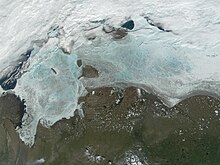
The Great Siberian Wormwood is a strip of open water and young ice regularly formed beyond the outer edge of landfast ice in a section from the Bolshoi Begichev Island in the Laptev Sea to the Bear Islands in the East Siberian Sea . It is the territory of the state nature reserve [1] . In some years, the wormwood decreases significantly and at the same time two relatively independent sections of open water and young ice are formed - Lenskaya and Novosibirsk wormwoods. [2]
Content
Discovery History
The first information about the existence of wormwood was obtained in the XVIII century. Back in 1736, Lomonosov, in his “Brief Description of Various Travels in the Northern Seas and the Indication of a Possible Passage by the Siberian Ocean to East India,” wrote, based on historical documents and information received from Pomors , “five and seven hundred miles Siberian distant from the Siberian shores in the summer months, the ocean is free of such ice, which would impede the ship's navigation. ” He gave a classic description of the Great Siberian Wormwood.
In 1811, the centurion of the Tatarins was observed in wormwood 25 versts from the island of New Siberia and Sannikov - 30 versts north of the Cape of Annunciation .
In 1821, in early April, Anjou with his companions came to the edge of landfast ice near the Great Siberian wormwood. Despite numerous attempts to advance on sledges pulled by dog sleds, north of the shores of the Siberian islands, they did not succeed, because everywhere they met open water.
Economic Use
Large areas of water free from pack ice are used for swimming in ice, the intensive development of shipping in the Laptev Sea, the East Siberian Sea and other parts of the Northern Sea Route .
Research
There are various explanations for the existence of the Great Siberian Wormwood. A. Peterman explained the existence of wormwood by the influence of the Gulf Stream , penetrating the Laptev Sea. In 1908, G. Gebel and L. Breitfus held similar views on the existence of wormwood , who hypothesized that high temperatures in the deep part of the Arctic are associated with the formation of wormwood in March-April.
In the future, after the expeditions of Nordenskjöld in 1878–1879 and Delong in 1879–1881, an opinion appeared that the formation of wormwood was associated not with the temperature regime, but with the dynamic. V. Yu. Wiese in 1922 suggested that ice formation from the Arctic basin affects the formation of wormwood. He called the areas north of the mouths of the Ob, Yenisei, and Lena "centers of origin of polar ice." Modern researchers add the formation of tidal wave deformation in the mainland and constant tidal currents as the reason for the formation of near-ice wormwood.
As early as 1906, a Russian Arctic explorer A. V. Kolchak discussed in his monograph the reasons for the formation of the Great Siberian Wormwood and noted that the Siberian Wormwood is located on the border of a developed landfast ice and the region of the Arctic pack located near the Novosibirsk Islands [3] . Kolchak wrote about the Great Siberian Wormwood: “The formation of this phenomenon on the border of a fixed coastal ice sheet and a constantly moving Arctic pack is caused by the known movement of the latter in the direction from the mentioned border and, therefore, is closely connected with currents existing at the site, or, probably, in this case by winds, more precisely the resultant sum of winds blowing over a known period of time in the considered region. The latter circumstance probably determines the WNWth NWth Arctic pack drift in this area. The connection of these local winds with the winter baric elevation of Northeast Asia is very likely, and the mass of fresh water carried by the great Siberian rivers can also cause the existence of a surface current in the N-th half of the compass, in any case, contributing to the formation of wormwood ” [4] . Of the modern works examining the unique phenomenon of the formation of the Great Siberian Wormwood, the monograph by A. Yu. Gukov “The Ecosystem of the Siberian Wormwood”, which develops the ideas of A. V. Kolchak from the standpoint of modern ideas about the movement of ice and water masses in the Arctic basin, is of particular interest [5] .
Modern observations of the ecosystem state of this wormwood were carried out by Russian oceanologists in 1982-1996, as well as in 1996-2001 by joint Russian-German complex helicopter expeditions [6] . As a result of these studies, it was found that at the end of February-March, the rapid development of algae begins, even in places covered with thick ice cover. Sunlight penetrates under thin ice and gives rise to the development of photosynthesis. Zooplankton was discovered in the wormwood waters, which includes both brackish-water and marine crustaceans . Benthic animals are represented by mollusks , snaketail , and worms. Two species of cetaceans live: narwhal and beluga whale . The pinnipeds are represented by the Laptev walrus , sea hare and ringed seal .
Notes
- ↑ Great Siberian Wormwood
- ↑ Gukov A.Yu. The Great Siberian wormwood, century XXI // Science and Technology of Yakutia. - 2009. - No. 1 (16) .
- ↑ Sinyukov, V.V. Alexander Vasilievich Kolchak: Scientist and patriot: at 2 o'clock / V.V. Sinyukov; open ed. A.P. Lisitsyn; Institute of the History of Natural Science and Technology. S. I. Vavilova RAS. - M .: Nauka, 2009 .-- ISBN 978-5-02-035739-6 . Part 1: The beginning of a life journey and Arctic research. - 293 p. - ISBN 978-5-02-035740-2 (in the lane), S. 272
- ↑ Kolchak A.V. Ice of the Kara and Siberian seas. // Notes of the Russian Academy of Sciences Scientific results of the Russian polar expedition 1900-1903 under the leadership of E.V. Toll: VIII series. - SPb, 1909. - T.T.XXVI # 1 . - S. 26-58 .
- ↑ Sinyukov, V.V. Alexander Vasilievich Kolchak: Scientist and patriot: at 2 o'clock / V.V. Sinyukov; open ed. A.P. Lisitsyn; Institute of the History of Natural Science and Technology. S. I. Vavilova RAS. - M .: Nauka, 2009 .-- ISBN 978-5-02-035739-6 . Part 1: The beginning of a life journey and Arctic research. - 293 p. - ISBN 978-5-02-035740-2 (in the lane), S. 273
- ↑ Ice Secrets of the Great Siberian Wormwood
Literature
Gukov A.Yu. The ecosystem of Siberian wormwood. - Moscow: Scientific World, 1999. - 334 p. - ISBN 5-89176-065-7 .