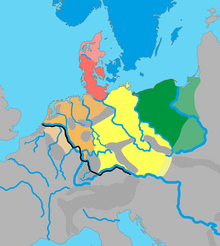
Ingevona (Ingävonen, Ingväonen, drevnegerm. Ingwiaiwen) - according to Pliny and Tacitus one of the largest groups of Germanic tribes .
Already in the IV century BC. er Greek traveler Pytheus spoke of the Inguones as inhabitants of the North Sea coast .
Content
Tribes
This group included friezes , Saxons , Angles, and possibly Utahs , which according to some historians should still be attributed to the East Germans: the Gothic tribes, the Burgundians and the Vandals, and were more closely related to the Germanic tribes inhabiting Scandinavia. If the Frisians still live in Friesland to this day, then the Angles, and partly the Saxons and the Utes, crossed over to the British Isles , where they became the backbone of the current English-speaking part of the British nation.
Origin of title
One of the first names “ingevony” is used by Tacitus in one of his small works (“ On the Origin of the Germans and the Location of Germany ”). According to him, the Germans raised the beginning of a kind to the divine ancestor named Tuiston . Thuiston had a son named Mann (cf. the Indian name Manu , in the legend of the flood; probably the name goes back to the Indo-European root). Mann, in turn, had three sons - Inge, Isk and Hermine , whose descendants call themselves by the name of the progenitors.
In ancient chants, - and the Germans know only one this type of narration about the past and only such annals, - they praise the god Thuiston born out of the earth. His son Mann is the progenitor and forefather of their people; They attribute to Mannu three sons, by whose names those who live near the Ocean are called Inguones , in the middle - Hermions , all others - Istetons . But since the old man always gives room for all kinds of speculation, some argue that God had a greater number of sons, from which there are more names of peoples, what are the mars, Gambriya , svebi, vandilii, and that these names are original and ancient.
There are also fragmentary mentions of ingevonah in Pliny's "Natural History" .
Inge, Divine Ancestor
Our information about Inge is short and sketchy. In "Beowulf" it is mentioned that he lived first with eastern dans , then went east, across the sea, accompanied by his magic chariot. As J. Grimm notes, the chariot is a practically unchanged attribute of the German gods.
As is often the case in myths, we are confronted with several conflicting versions, according to one of which Inge is Freyr's grandfather, then the genealogy is built like this: Twisco , Mann, Inge , Njord , Freyr.
It is contradicted by another myth that directly identifies Inge and Freyr . Grimm assumes that Inge is not a name, but a nickname, and elevates it to the Old German ýnglîngr - "young." This is the name he receives and then bears among the Herdings - whose name Grimm decrypts as “heroes”, or perhaps just “certain people”, “some people”. Probably from the same Hurdings come from Hartung, King of Rus, whose name lived in German legends as far back as the 19th century. Hartung was a friend and adviser to Inge on his travels, the second adviser of the legend is called the Turkish “king” Iginvi .
Ingevona in linguistics
In the linguistic studies, the name of the ingevones is usually defined as the speakers of some West Germanic languages, such as English, Saky, and Frisian, which are characterized by certain features of the language structure and distinguish them from other dialectal Old Germanic groups: Eastern and Central, as well as Northern. This subgroup is characterized by t. ingevonian nasal drop .
Literature
Grimm, Jacob. Deutsche Mythologie. - 1835. Deutsche Mythologie (German)
- Tacitus in the translation of A. Bobovich ("On the origin of the Germans and the location of Germany") [1]
- Introduction to Germanic Philology. A textbook for the philological faculties of universities Arsenyev MG, Balashov S. P., Berkov V. P., etc. Publisher: GiSb 2003, ISBN 5-8330-0102-1